Says pollution caused by flyover works is triggering respiratory illnesses
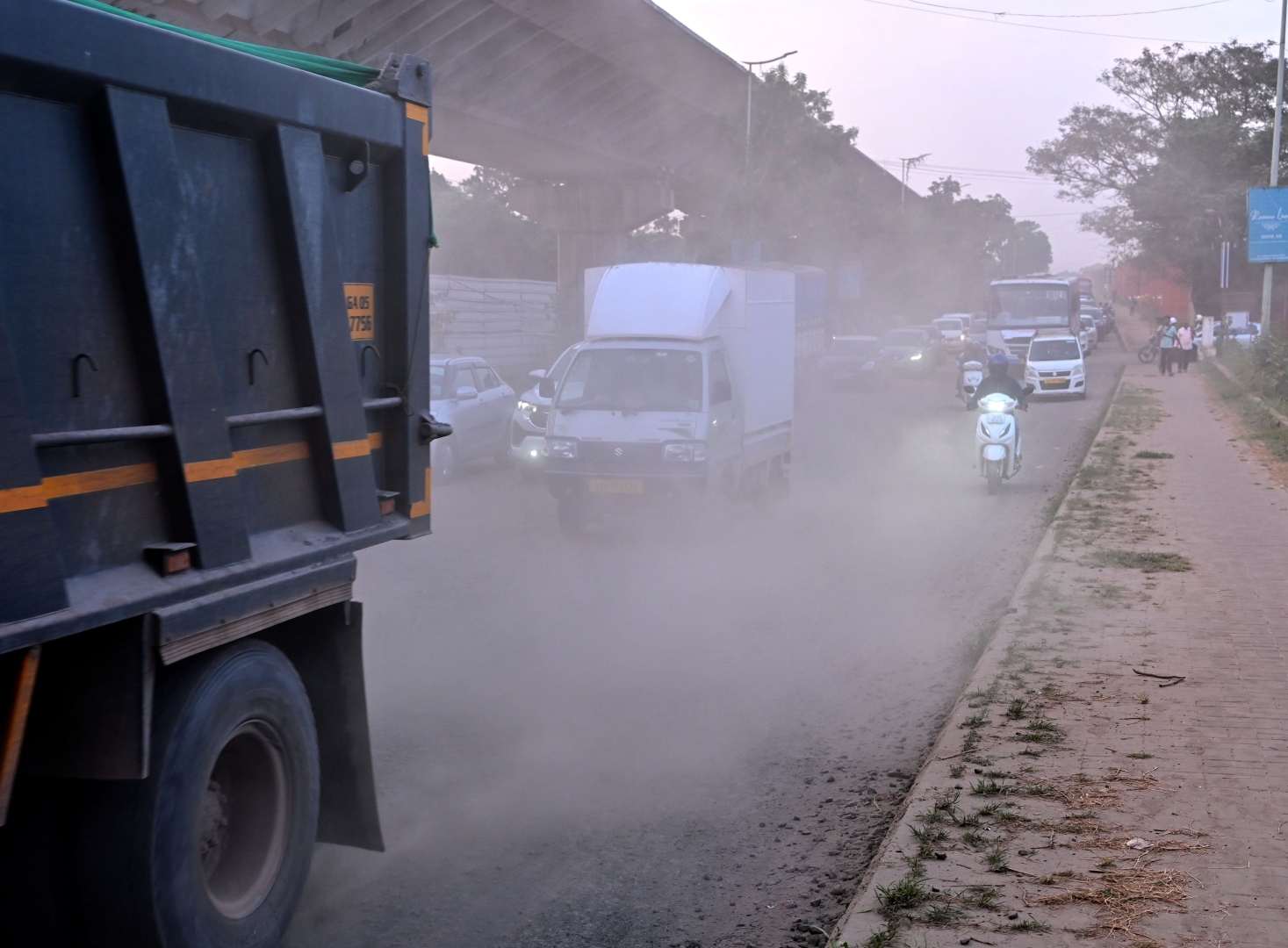
Uncontrolled road dust from the flyover construction continues to choke daily commuters in Porvorim.
MARGAO
Occupational hazard expert Dr Jorson Fernandes has said the pollution situation in Porvorim is equally alarming or even worse due to very poor road dust management because of the construction of the flyover.
In fact, Dr Jorson has said that air pollution and dust pollution in Porvorim should be a major concern for its citizens as they are linked to various health issues, from respiratory problems to cardiovascular diseases, with dust aggravating asthma and bronchitis, particularly among children and the elderly.
He said latest reports have stated that air pollution is doubling Chronic Obstructive Pulmonary Disease (COPD) and that experts opined that the lung crisis is growing faster than heart disease. “Porvorim is under stress due to the ongoing construction of the flyover, more so due to poor management and inadequate enforcement of the existing guidelines related to construction dust management. The right to a clean and healthy environment is a fundamental right which has been affirmed by the Supreme Court. Consequently, the government must adopt and enforce comprehensive measures to curb the problem affecting Porvorim’s citizens,” Jorson stressed.
He said real-time air quality monitoring and public awareness must be enhanced with deployment of sensors integrated with satellite and AI analytics for real-time air quality alerts and forecasting. “Water-spraying on construction sites, good drainage channels across roads, reducing speed from 40 to 20 mph can reduce dust emission by 65 per cent as fast-moving vehicles stir up dust. Studies have shown that PM10 goes up with vehicle speed. Presently, it is seen that our road surfaces have poor to very poor drainage, resulting in puddles being formed,” he said.
He added: “The generation, dispersion and impact of dust particles need to be minimised and this can be done by resorting to dust abatement services so as to curb dust emissions and mitigate their adverse effects on both human health and the environment. Appropriate techniques and approved dust control measures are necessary to create cleaner air and healthier and more sustainable environments for all, especially those close to the construction stretch and the users of the road, especially children as well as close-by residents.”
“Everything can be well managed provided there is effective policy implementation to significantly reduce dust pollution and improve air quality. It is a pity that we still depend on manual sweeping and inadequate mechanised sweepers which only lead to dust build-up and frequent re-suspension. And continuous inhalation of both coarse as well as fine particles increases respiratory illnesses and eye irritation to those exposed. Road dust contributes 20 to 25 per cent of PM10 and 8 to 25 per cent of PM2.5, worsening overall AQI levels,” he further said.
Saying that Goa undoubtedly, in the first place, needs to raise the air quality monitoring network so as to ensure that comprehensive and reliable data is available, he said “Side-by-side, there is a need to develop an outreach mechanism to inform citizens and encourage their participation in air pollution control measures,” adding “the way Goa is moving nowadays, with deterioration at most levels and decline in standards in most fields, what with massive corruption raising its ugly head, without caring to know the carrying capacity, the air pollution problem is somewhat frightening.”