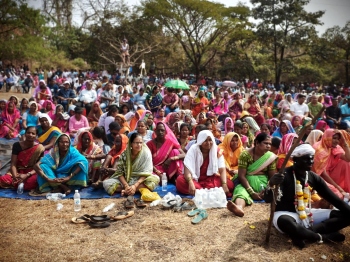
 A file photo of locals agitating against the Unity Mall project in Chimbel. Photo: Narayan Pissurlenkar
 The writer is professor at Columbia University in the USA who hails from Cortalim.
Goa Chief Minister Pramod Sawant’s decision to scrap the Unity Mall project without waiting for the new hydrology report marks a clear victory for people’s power and sustained public vigilance.
The protests in Chimbel were not driven by misinformation or attempts to prevent development, but by the government’s lack of transparency and the circulation of incomplete and shifting explanations.
Citizens asked legitimate questions, sought clarity, and insisted on being hear, and that collective resolve and immense sacrifice especially by women of Chimbel, ultimately prevailed.
It is important to state clearly that the Unity Mall initiative itself was a well-conceived and well-intentioned programme of Prime Minister Narendra Modi, designed to create professionally managed spaces for artisans, ODOP and GI-tagged products.
Like other national initiatives of the prime minister, such as Smart Cities and Swachh Bharat, the intent has been developmental and transformative. However, in Goa, as seen earlier with these programmes, weak groundwork, poor execution and lack of transparency by the ruling establishment have diluted and squandered that intent.
Crucially, the Unity Mall programme is not discretionary in nature. For a proposal to move forward, foundational requirements had to be met upfront: conclusive land readiness on unencumbered government land, location outside environmentally sensitive zones, demonstrated institutional and governance capacity, a credible Detailed Project Report, integration with artisan and ODOP ecosystems, and evidence of meaningful apriori consultation with local communities. In the absence of these prerequisites, proposals were not expected to progress beyond the appraisal stage.
While the scrapping of the project is now being projected as a course correction, it also appears to be an attempt to avoid deeper scrutiny into how the project was originally presented and justified.
These foundational requirements were evidently not in place when the proposal was advanced, raising serious questions about whether facts were misrepresented or selectively presented in the rush to access central funds.
Most importantly, the matter cannot end with the project’s withdrawal. Nearly a quarter of the total project funds are reported to have already been spent, with little tangible to show on the ground.
This calls for clear accountability and full disclosure, not as a political exercise, but as a basic obligation to the public. Transparency does not conclude with scrapping a flawed project; it begins with explaining how public money was spent, by whom, and with what outcomes.