People have disregarded warning signboards by WRD
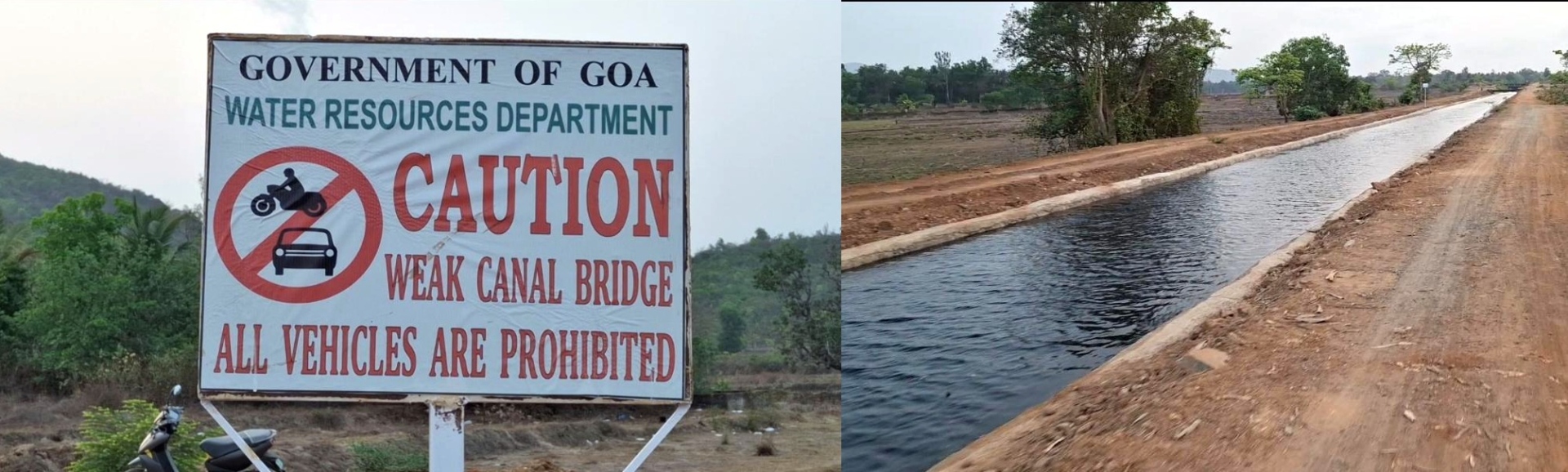
A WRD signboard at the Selaulim Canal. (Right) The canal.
SANGUEM
The Selaulim Canal has increasingly become a site of recurring tragedies, marked by a distressing rise in fatalities and mishaps that have claimed the lives of residents, visitors, and livestock alike.
The most recent tragedy occurred this past Sunday afternoon at Bopremoddi, Quepem, where two youth, identified as Ignatius Fernandes from Fatorda and his friend Harjit from Uttarakhand, lost their lives after venturing into the canal for a bath.
This incident serves as a grim reminder of the deceptive dangers posed by the canal’s currents, which are frequently underestimated by those seeking recreation.
Despite the Water Resources Department and local authorities installing numerous signboards at various intervals, the public—particularly the youth—continues to ignore explicit bans on swimming, bathing, and washing clothes.
In several locations, notifications even prohibit the movement of vehicles across the canal banks. However, these warnings are routinely disregarded, leading to a preventable and mounting death toll.
In April last year, 57-year-old Prakash Gaonkar of Cotarli-Sanguem lost his life after accidentally falling into the canal at Cotarli. Prior to that, a heartbreaking incident at Nagvem saw the drowning of two toddlers, 13-month-old Rehan Shetty and 16-month-old Wahid Hashmi.
In 2023, another youth, Suresh Jadhav, lost his life while bathing alongside his sibling. The danger extends beyond pedestrians and swimmers; in just the last month, two separate incidents occurred where cars plunged into the canal at Quepem and Nagvem, and reports of cattle falling into the water are becoming alarmingly frequent.
Current safety measures, which consist primarily of static signage and sporadic fencing in isolated sections, have proven entirely insufficient to deter entry or prevent accidental falls.
Given the increasing frequency of these disasters, there is an urgent and growing demand for the government to install continuous steel fencing along the entire length of the canal, especially where it intersects with residential areas.
While the Selaulim Canal remains a vital resource for the State, it currently represents a significant public hazard that requires immediate reinforcement to ensure no more lives are lost to its waters.