The traditional Bonderam festival is all set to be celebrated at Malar, Divar on September 2 by the Sa Mathias Sports Club, which is also celebrating its 50th anniversary. The villagers who are in an upbeat mood tell BHARATI PAWASKAR how the festival has changed over the years
 #TGLIFE
The Divar island, with its twin villages, Sa Mathias or Malar and Piedade, is famous for many things, the most popular among it is the Bonderam festival that not only witnesses the participation from the village, but attracts crowd from across Goa. The festival is celebrated separately by the two villages on two consecutive Saturdays, the first being by Sa Mathias, which falls on September 2 this year.
Celebrated by Sa Mathias Sports Club for more than three decades, Bonderam has seen changes over the years though the underlying spirit of this harvest festival has remained unchanged. "It's the 50th anniversary of our club this year and a very special occasion for us, islanders. We have been religiously organising our annual Sa Mathias traditional Bonderam for over 30 years and we shall see to it that all four wards from our village participate in it with their full anniversary spirit ," says Melca Vaz, president of Sa Mathias Sports Club.
Bonderam, was initially started as the ‘first crop festival' (konsanchem fest), much before the Portuguese era, by the local farmers from the four wards each of which had its own flag demarking the farming area in the village, explains Maxy Picardo,a villager. Even today, the whole village gears up for the festival and different themes are chosen by each ward.
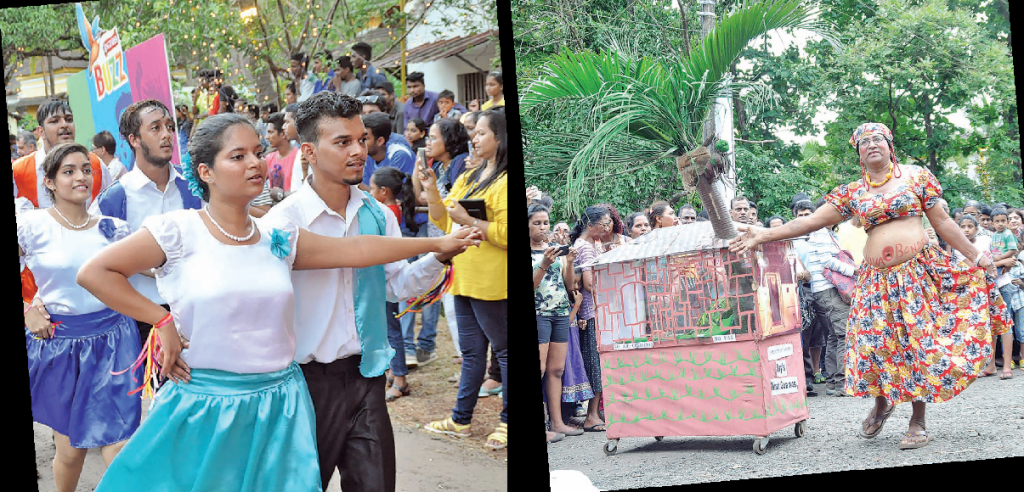
While in the good old days men were the dominant participants, today the scene has changed and men, women and children of all ages have embraced this village festival.
"Today's women driven Bonderam displays art, music, culture and heritage," shares Bernadette Azavedo co-ordinator in the church ward. Azavedo has been participating in Bonderam for the past 25 years. Her husband and her three children are also neck-deep in the celebrations.
"The Bonderam of yesteryears involved ‘fotash' (hitting the people with fake weapons) while marking the boundaries of the fields, today the custom has been replaced by fun-filled friendly mock fights fought among the villagers in total unison. There is spirit of oneness among all four wards. However the competition persists when it comes to the themes of our floats and no ward wants to disclose their theme in advance," adds Bernadette.
Like Bernadette, Francis Vaz from Godar ward has taken the initiative in gathering his ward to create the float. "Our ward is a sleepy one with all elderly and very few youth. It's the first time we have gathered under an umbrella to celebrate Bonderam traditionally," he says.
60 per cent of the population in Godar ward is elderly. But Francis has appealed to the residents to come and join in the celebrations. "I have physical problems too and you can see me limping but I want people to come forward in this good initiative. Overcoming the hurdles that life places before our paths, one must enjoy the journey," says Francis.
Keeping in line with the spirit of enjoying life up to the brim, octogenarian Justine Coutinho is also busy preparing for the competitions. "It's been three years that our church ward is winning the first place," Justine shares with pride. Speaking of this harvest festival, 82-year-old Justine remembers how there used to be disputes over demarcation of land. "Now agriculture has reduced as it is no longer profitable. I have a plot of 400 sq mts but we don't do farming anymore," says Justine.
The paddy fields belonged to Communidades and every five years it used to call for ‘arrematocao' (bidding). The highest bidder used to get the land for cultivation for the next five years. In return the cultivator had to pay rice to the Communidades which they used to sell or distribute as ration. The profit was given to the gaonkars as ‘jonos' (dividend). After Goa's liberation, the ‘jonos' is not given any more and the Communidades also are running into losses. But the people still hold the land that belonged to the Communidades. The gaonkars used to get the revenues from the ‘moradors' (outsider users) who used to cultivate the land on leave and licence basis. Now ‘moradors' have become the owners and the Gaonkari system no more functions. But the flag festival symbolises the traditional system of marking of the agricultural fields.
Ivo Azavedo recalls the Bonderam of his childhood. "We used to enjoy the ‘fotash' pain in our mock fights and it was fun. The Communidades used to fund the festival and when it stopped the club shouldered the responsibility," says Ivo. To take the festival to next level the villagers needed funds and hence commercialisation was the only option. The liquor companies stepped forward and Bonderam managed to attract a big crowd. "The communidades got their incomes from the fields and all farmers used to cultivate the land. The geography of the village was such that there were fields, river and full-fledge farming. Today, farming has ceased but the festival continues in another avatar," shares Ivo.