


PANAJI
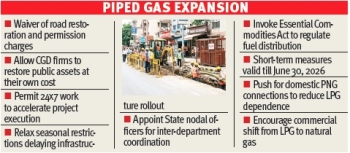
In response to the ongoing LPG supply constraints, the Centre has urged states to fast-track expansion of City Gas Distribution (CGD) networks by introducing immediate measures such as granting deemed approvals for pending pipeline permissions and waiving road restoration charges to speed up infrastructure rollout.
Invoking provisions under the Essential Commodities Act, the Union Ministry for Petroleum has already stepped in to regulate fuel distribution. As part of its broader strategy to ease pressure on LPG supplies, the Centre has asked states to implement a series of short-term measures, valid until June 30, 2026 to ensure rapid CGD expansion.
These include granting deemed permissions for all pending CGD pipeline applications from municipal bodies, PWD and other authorities, and mandating approval of new permissions within 24 hours. States have also been asked to waive road restoration and permission charges, which are seen as a major financial hurdle for CGD entities.
Additionally, the Centre has proposed allowing CGD companies to restore public assets at their own cost, with an undertaking to meet required standards. To accelerate on-ground work, states have been urged to permit 24x7 working hours and relax seasonal restrictions that typically slow infrastructure projects.
“The CGD expansion remains stunted due to the following reasons: absence of dedicated utility corridors, which requires a long-term solution; delays in obtaining statutory permissions from various local authorities, which can be alleviated by the State immediately, and, in the long term, addressed through a single-window portal; and high road restoration and permission charges, which can be eased by the State through a short-term waiver,” the Ministry said.
To streamline execution, the Centre has recommended appointing a State nodal officer to coordinate between departments and facilitate quicker implementation of CGD networks.
The push for CGD expansion comes amid growing concerns over LPG shortages, particularly affecting commercial establishments such as hotels, restaurants and hospitals. The Centre has directed CGD entities to prioritise new domestic PNG connections and convert commercial users to natural gas, which is considered more economical, safer and less vulnerable to global supply disruptions.
Officials also highlighted structural bottlenecks hindering CGD growth, including delays in statutory clearances and the absence of dedicated utility corridors. While long-term reforms are needed, states have been asked to immediately address procedural delays to manage the current crisis.
The proposed measures are also linked to the Centre’s emergency intervention to ensure additional LPG supplies, including temporary allocations to states. The Centre has indicated that these short-term steps could eventually lead to a more uniform policy framework for CGD expansion across the country.


