


PANAJI
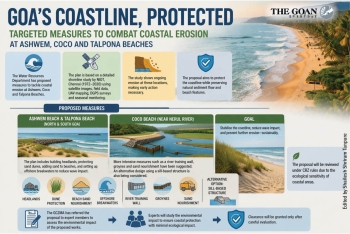
The State Water Resources Department has proposed a series of measures to tackle coastal erosion along vulnerable stretches at Ashwem Beach, Coco Beach and Talpona Beach, and has approached the Goa Coastal Zone Management Authority (GCZMA) for the necessary clearances.
The proposal is based on a detailed shoreline management study prepared by the National Institute of Ocean Technology (NIOT), Chennai, under the National Hydrology Project with support from the World Bank. The study examines changes along Goa’s coastline from 1972 to 2020 using satellite images and extensive field data.
According to the report, scientific assessments such as UAV mapping, DGPS surveys, and seasonal monitoring of waves, currents and sediment movement were carried out to understand long-term coastal patterns.
The findings show ongoing erosion at the identified locations, making early action necessary.
The department has proposed a mix of structural and soft engineering solutions to stabilise these coastlines.
“Site-specific erosion control measures have been identified based on shoreline direction, past shoreline changes, sediment movement, and local wave and coastal conditions,” the WRD said.
At Ashwem in North Goa and Talpona in South Goa, the plan includes building headlands, protecting sand dunes, adding sand to beaches, and setting up offshore breakwaters to reduce wave impact.
At Coco Beach, near the mouth of the Nerul river, more intensive measures such as a river training wall, groynes and sand nourishment have been suggested. An alternative design using a sill-based structure is also being considered.
Officials said the plan aims to protect the coastline from further erosion while preserving natural sediment flow and beach features. However, the proposal will be reviewed under CRZ rules due to the ecological sensitivity of coastal areas.
The GCZMA has referred the proposal to its expert members to study the environmental impact of the proposed works before taking a decision on granting clearance.


