


MARGAO
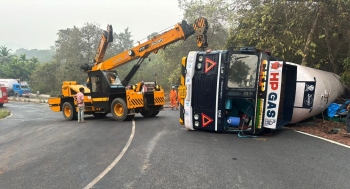
An LPG tanker belonging to Hindustan Petroleum Corporation Limited (HPCL) that overturned on the busy NH66 at Paddi in South Goa was finally towed away on Wednesday morning after an 18-hour-long rescue operation that crippled traffic and exposed gaps in the State’s disaster response infrastructure.
While normal vehicular movement was restored by 7 am on Wednesday between Canacona and Cuncolim, the tanker itself was removed only around 10.30 am, underlining the prolonged nature of the operation. The incident has now sparked serious questions about the preparedness of the State and district disaster management machinery, particularly the absence of a locally stationed Emergency Response Vehicle (ERV).
The tanker turned turtle at around 1.15 pm on Tuesday on NH66 at Paddi. As a precautionary measure, traffic was diverted via Canacona and Balli by 2 pm after one of the tanker’s valves developed a gas leak. From 2 pm Tuesday until 7 am Wednesday, police diverted all incoming and outgoing traffic on NH66 at Canacona and Balli, causing widespread inconvenience to motorists.
The delay in restoring normalcy stemmed largely from the unavailability of an ERV within the State. HPCL officials had to send out an SOS to Mangaluru for an ERV to safely transfer the LPG from the damaged tanker. The vehicle reached Paddi only around 10 pm ” nearly five hours after being requisitioned. Operations to transfer the LPG continued through the night and were completed around 6.30 am on Wednesday. Heavy-duty cranes were also brought in from Karwar, further contributing to the delay.
Officials acknowledged that the absence of a dedicated ERV in Goa significantly slowed the response.
“If an Emergency Response Vehicle had been stationed in Goa, the transfer of LPG from the tanker could have been completed within a couple of hours. In this case, it took over five hours for the ERV from Mangaluru to arrive,” a senior official said.
Authorities pointed out that the incident should serve as a wake-up call for State and district disaster management agencies to strengthen the off-site emergency plan and enhance response capabilities. They have urged oil companies to station a dedicated ERV in Goa, which could also cater to neighbouring Karwar in times of emergency.
“Imagine if such an incident had occurred in a densely populated market area like Balli, Cuncolim, Chinchinim or Navelim. The delay in mobilising an ERV could have resulted in a major disaster,” the official added.
The Paddi tanker mishap has thus exposed critical gaps in emergency preparedness, prompting renewed calls for improved infrastructure and quicker response mechanisms to handle hazardous material incidents along the crucial NH66 corridor.
Senior police officers, who rushed to Paddi after the incident, underscored the need for a dedicated ERV stationed in Goa by the oil companies.
Meanwhile, the Cuncolim police said they are investigating the incident when asked whether an offence is contemplated in the case.


