Petitioner tells court that state measures are incomplete, lack data, and may worsen risks ahead of the monsoon
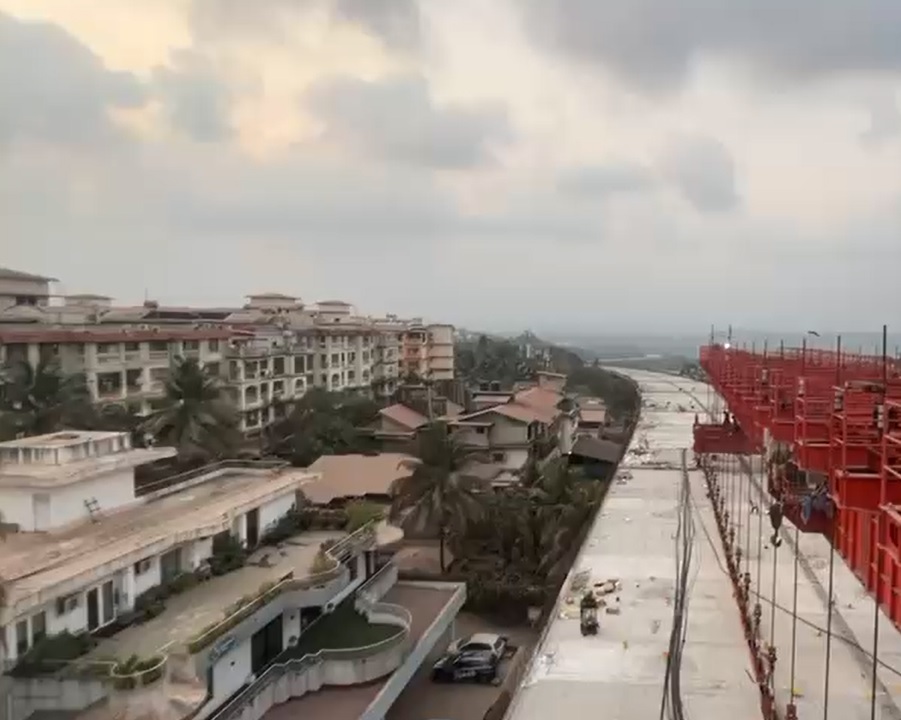
A view of the unfinished flyover in Porvorim.
PANAJI
The High Court of Bombay at Goa was on Monday told that safety and public health concerns along the Porvorim corridor works have not been properly addressed.
The petitioner, Advocate Moses Pinto, appearing in person in the ongoing PIL hearing, alleged that the State has taken only partial measures and offered broad assurances.
In a detailed written note submitted before the Division Bench of Justice Valmiki Menezes and Justice Amit Jamsandekar, the petitioner said the replies filed by the State government and the project contractor are “generic, based on claims and lacking figures”, and do not properly answer the hazards reported along the busy highway stretch.
He pointed out that while authorities claim to have installed barricades, deployed traffic marshals and taken dust-control measures, no chainage-wise data, photographs, visibility audits or independent verification have been submitted on record.
The note highlighted several risks, including unsafe diversion surfaces, lack of safe paths for pedestrians and two-wheeler riders, skidding due to water sprinkling, and movement of heavy materials through live traffic lanes. These issues, the petitioner said, have not been properly addressed.
He also argued that citing contract limits, such as saying air quality checks or weekly dust audits are “not within scope”, cannot override the State’s duty to ensure commuter safety under Article 21.
On dust pollution, the petitioner said authorities mainly rely on water sprinkling, which has made conditions worse by creating slush and increasing the risk of skidding. He also flagged the absence of air quality data, including PM2.5 and PM10 levels, as a major gap.
The note added that although some parts of the road have been hot-mixed, untreated stretches still pose serious risks, especially to two-wheeler riders and pedestrians.
The petitioner warned that the situation may worsen with the onset of the monsoon, expected in Goa in early June, as rain could increase problems like potholes, poor visibility, slippery roads and drainage failures.
Given the approaching monsoon and Goa’s annual road-digging ban from mid-May, the petitioner urged the Court to issue time-bound directions. These include a full monsoon-readiness plan, installation of air quality monitoring systems, and certification that all commuter stretches are safe to use in wet conditions.
Other demands include route-wise compliance affidavits with geo-tagged evidence, strict safety rules for transporting heavy materials, and weekly status reports to ensure proper monitoring.