PWD yet to take final call on comprehensive review of traffic calming measures
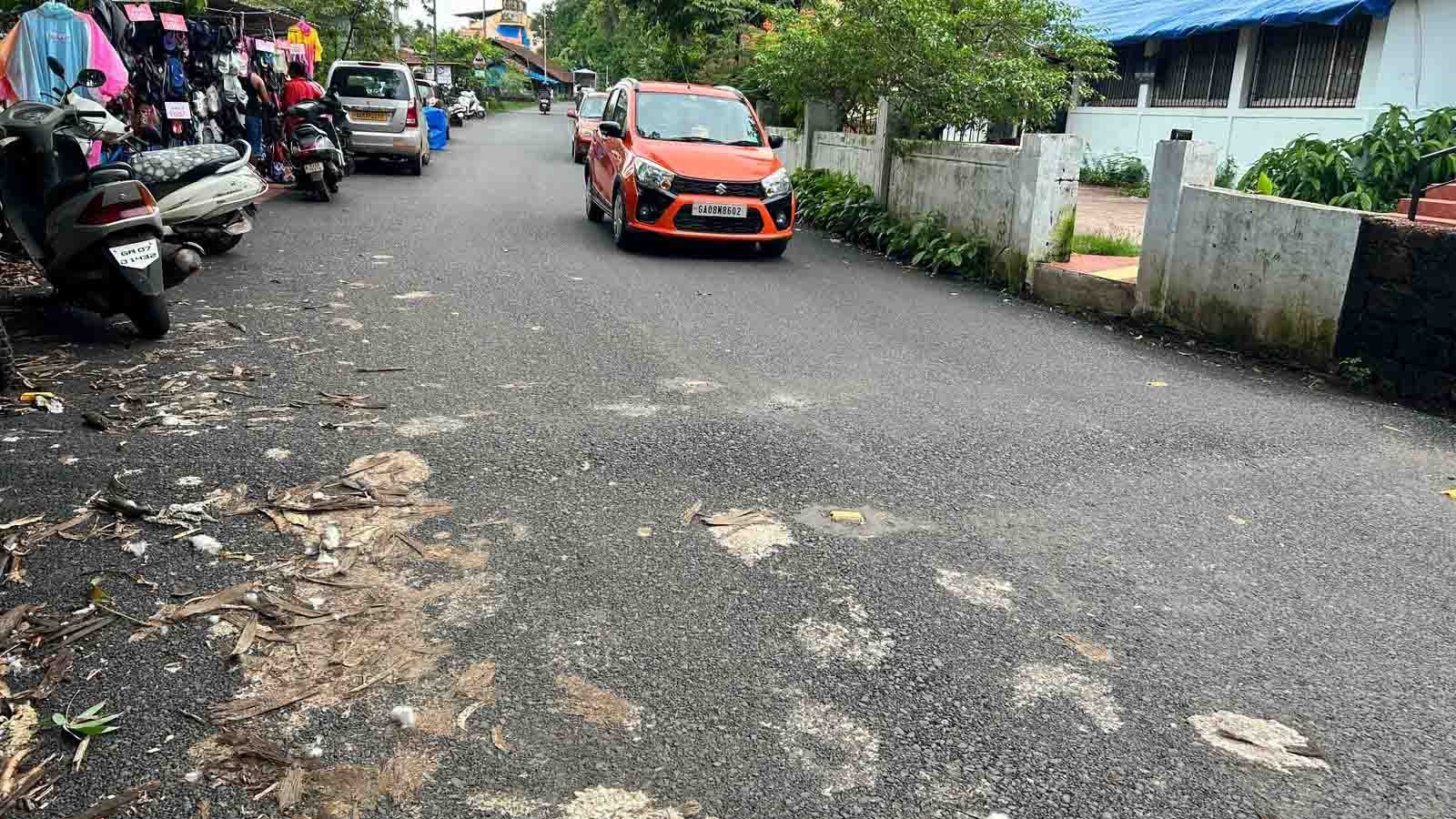
A poorly marked speed breaker at Bhatlem, illustrative of the irregular design and poor maintenance of humps.
MAPUSA
Even as concerns mount over the condition and placement of speed breakers across Goa, the Public Works Department (PWD) is yet to take a final call on a comprehensive review of the traffic calming measures installed on roads across the State.
From unevenly shaped humps to faded paint and missing cautionary signage, motorists have increasingly flagged inconsistencies in the way speed breakers are designed and maintained.
The issue has now drawn the attention of district road safety management committees, which have called for a thorough review to ensure uniformity and compliance with prescribed standards.
Standards and site constraints
A senior engineer from the PWD’s road division maintained that speed breakers are installed strictly in accordance with norms laid down by the Indian Roads Congress (IRC). “There are clear protocols regarding height, width and gradient and these are followed while executing works,” the engineer said.
However, he acknowledged that practical constraints sometimes lead to deviations. “In certain locations, land availability and site conditions become limiting factors. In such cases, adjustments are made within the available space, but the broader framework of IRC guidelines is adhered to,” he added.
The engineer further explained that the nature of traffic calming measures varies depending on the location and requests from local authorities. “Installation depends on the area and on the requisition of the concerned authority. Some panchayats prefer speed humps, while others opt for rumble strips. All of these fall within IRC standards,” he said.
As per norms of the Ministry of Road Transport and Highways (MoRTH), speed breakers are not permitted on national highways. Instead, rumble strips are used to alert motorists and reduce speed at specific points such as junctions and accident-prone zones.
An engineer associated with national highway works said that, typically, a set of six rumble strips is installed as standard practice. “However, in stretches where there is a tendency for overspeeding, additional rumblers may be provided to reinforce caution,” the official noted.
Civil society flags irregularities
Civil society groups, however, argue that the issue goes beyond mere compliance on paper.
Roland Martins, convenor of GOACAN and a member of the district road safety management committees, said there are multiple concerns surrounding the installation and maintenance of speed breakers in the State.
“There are instances of illegal speed breakers being put up by individuals or local bodies without technical approval. In other cases, the dimensions do not match standard specifications. At certain locations, humps should ideally be replaced with rumblers,” Martins said.
He also pointed to the lack of proper painting and signage as a serious safety lapse. Martins stressed that speed breakers are only one of many tools available to improve road safety.
“Speed breakers are one type of solution, not the final solution. Road safety issues must be analysed from a technical and professional perspective, considering engineering, enforcement and awareness,” he said.
According to Martins, a review of speed breakers across districts is expected to commence next month under the supervision of the PWD. He revealed that road safety audits – in which speed breakers form a key component – have already been conducted.
“The audit findings will be presented from April onwards. Based on the discussions at the district road safety committee meetings, further action will be decided,” he said.