With local resistance growing in Curchorem, reliance on a near-saturated waste management facility raises sustainability concerns
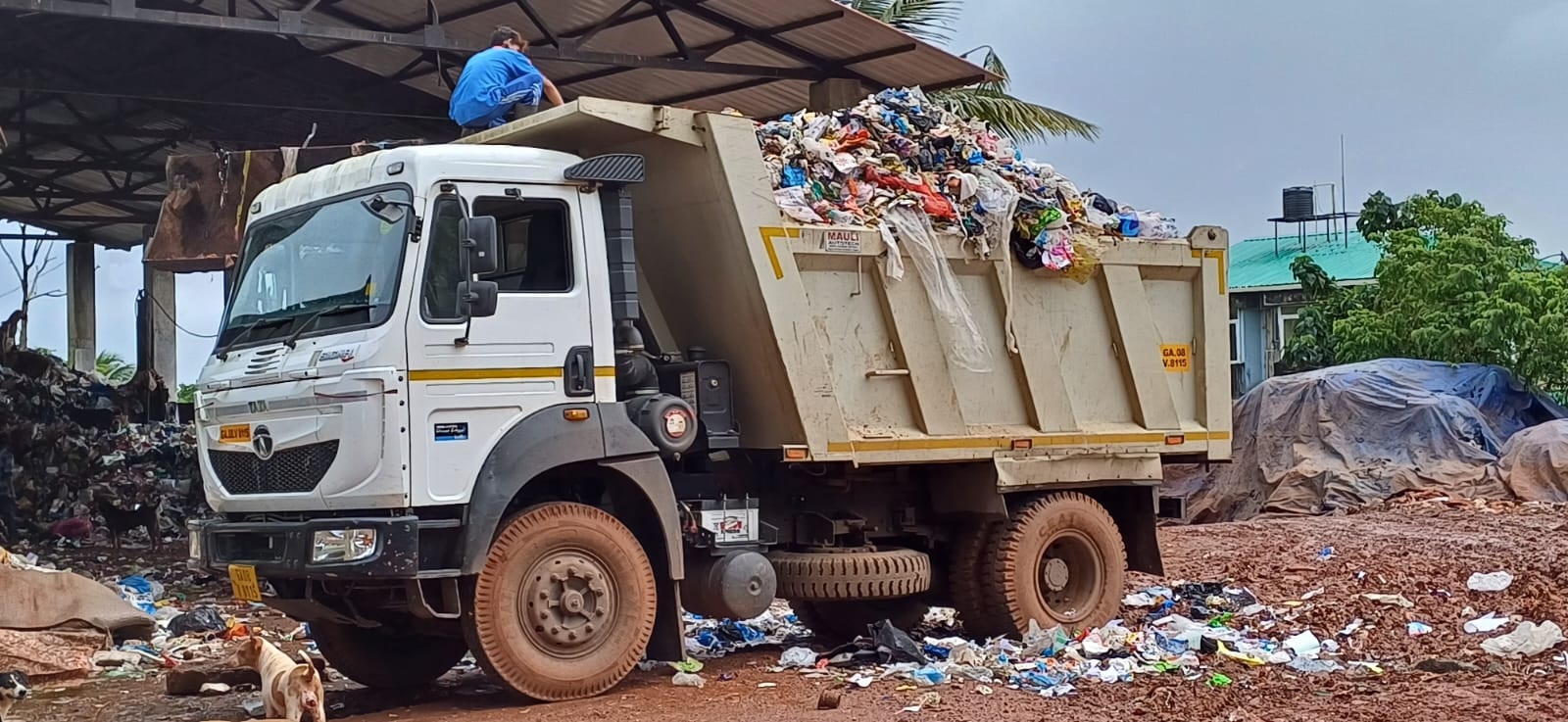
Waste from Sonsodo being transported by a truck to Cacora for processing.
MARGAO
Mounting opposition in Curchorem over the treatment of “outside waste” at the Cacora waste treatment plant is fast emerging as a critical flashpoint—one that could force the Margao Municipal Council (MMC) and the State government to confront long-pending gaps in urban waste management.
At the heart of the issue lies a stark reality: nearly 35 tonnes of wet waste generated daily in Margao continues to be transported to Cacora for processing. While this arrangement has helped improve conditions at Sonsodo—once notorious for stench and sanitation concerns—it is increasingly being viewed as a temporary fix rather than a sustainable solution.
The situation has gained urgency on two fronts. First, residents in Curchorem have begun opposing the inflow of waste from outside their jurisdiction, raising environmental and local governance concerns. Second, officials warn that the 60 tonnes-per-day Cacora facility is nearing saturation, leaving little room to accommodate additional waste in the near future.
The issue recently took centre stage during the commissioning of MMC’s 10 TPD gasification plant at Sonsodo. Speaking at the event, PWD Minister Digambar Kamat said he would pursue with Chief Minister Pramod Sawant the proposal to establish a bio-methanation plant at Sonsodo as per the High Court directions.
The assurance came after Fatorda MLA Vijai Sardesai flagged the government’s failure to fulfil an undertaking given before the High Court in 2024 regarding the project.
Warning signs
Officials from the Goa Waste Management Corporation (GWMC) say the warning signs are already visible. According to sources, the Cacora plant is operating close to capacity, prompting authorities to stop accepting waste from other municipal bodies such as Ponda and Mormugao.
“The situation underscores the urgency for Margao to develop its own waste treatment infrastructure,” a GWMC official said, adding that reliance on a single external facility is fraught with risks. “In the event of a breakdown or complete saturation at Cacora, the MMC will be left scrambling for alternatives.”
Notably, the Mormugao Municipal Council has already initiated steps to set up its own bio-methanation plant, signalling a shift among urban local bodies toward decentralised waste processing systems.
“It is indeed high time that the Margao Municipal Council address the issue of waste management at the earliest. The civic body will find it difficult to treat the waste generated in the commercial capital in the event of the breakdown of the Cacora plant or if the plant reaches a point of saturation,” the GWMC official informed.
Financial burden
Apart from logistical concerns, the financial burden of transporting waste to Cacora is significant. The MMC is estimated to be spending around Rs 12 lakh every month on transportation—amounting to roughly Rs 1.4 to Rs 1.5 crore annually. Over the past 18 months, this expenditure is believed to have exceeded Rs two crore.
While civic officials highlight the improved sanitation at Sonsodo as a success, critics argue that the gains come at a steep and recurring cost. GWMC sources point out that these funds could be better utilised as capital investment toward building a dedicated bio-methanation facility within Margao itself.
Such a plant would not only process the city’s wet waste locally but also offer long-term environmental and economic benefits, including reduced transportation costs and the potential generation of biogas energy.
With public resistance intensifying in Curchorem and capacity constraints tightening at Cacora, the message for policymakers is becoming increasingly difficult to ignore. The call for a dedicated waste treatment plant at Sonsodo is no longer just a proposal—it is rapidly turning into an urgent necessity for the commercial capital of Goa.