


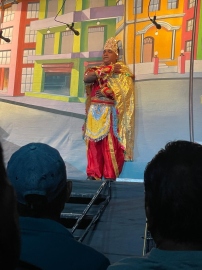
Long before Goa’s coasts were lit up with electricity, and before television became entertainment, there was the ‘Zagor’, a night of faith and festivity. The word itself refers to ‘Zagronnachi Raat’, meaning a night of being awake. The people gathered as a community and spent the night together, immersed in music, performance, prayers, and shared belief till dawn. To date, in the coastal areas of Calangute, Candolim, and Anjuna, this nocturnal festival still thrives alongside bustling tourism.
Living tradition
Salvador Silveira, from Calangute, fondly known as Salu, is a key figure in keeping this tradition alive. He organises, writes, and directs the Zagor every year in Calangute, often showcasing the same in Anjuna. This year, the Zagor will return to Candolim on May 3, 7.30 pm onwards, reclaiming a spot where it was historically held.
Fading practice
“Every vaddo would do a Zagor back then; now, only a few remain as those areas have been mostly converted to hotels or accommodations,” recalls Romeo Fernandes from Calangute.
Cultural roots
The coastal Zagor is distinctly Catholic, differing from the Gauda, Perni, and Kunbi versions, though it shares similarities with the Siolim Zagor. Previously, it was performed twice in coastal villages: once during the ‘Intruz’ period just before Ash Wednesday, and again after Easter. Over time, the tradition evolved and is now staged exclusively after Easter.
Stage setting
The performance is staged on a platform near the cross, which is to date mounted on a cutting of a coconut tree in a few localities. “However, in the much earlier days, the performance would be staged on a structure built with mud and stones around the ‘maand’,” recalls Salu, who inherited the responsibility of organising this Zagor from his father.
Night procession
The Zagor begins at night with a suvari, a foot procession. Starting at a designated spot, the community walks a specific route to the Maandailo Khuris (cross at the maand), accompanied by a traditional percussion band. While traditionally restricted to men, women also join the procession today.
Torch tradition
In the past, coconut shell torches lit the way in the dark. In some vaddos, groups would walk from two different directions, converging at the cross to play their instruments together as a unified band.
Opening rituals
Before the program begins at the maand, traditional folk songs called ‘Ovio’ are sung three times, calling upon God to bless and protect the place and its people. Prayers are also offered for the souls of their ancestors from the area.
Structured performance
The programme then unfolds through a structured sequence of songs and characters, with the band accompanying all the songs later. It begins with an introduction song followed by a ‘Saied’- a song that is written based on biblical teachings. The Saied is told using a character, sometimes a King, an angel, or even a prophet, with appropriate shining/colourful costumes. Next is the Morya (or Borborea), a cultural song often sung by a performer in character.
Recurring themes
After these three foundational segments, the program explores varied themes. Certain essential themes are revisited every year, dedicating one song to each. These include songs about the Kunbbis, the Khapulem, Zonglli, and Kollvonta, alongside commentary on current affairs. In total, 18 to 20 songs are performed as solos, duets, trios, or group numbers. Villagers, including children, actively participate in singing these compositions.
Musical core
The music is the most exhilarating aspect of the coastal Zagor. The three instruments used by the all-male band members include a Ghumot, Madheim (both traditionally made with mud and the openings sealed with the skin of a monitor lizard), and Kassaeim (bronze cymbals “While playing, they sit with six madheim, three ghumot, and two kassaeim,” explains Salu. These instruments vary in size and thickness, producing distinct sounds when heated over embers. The songs are sung across nine different rhythmic patterns, creating an immersive, percussion-only soundscape that carries through the night.
All-night gathering
Earlier, the programme would begin around 10 pm and continue till just before dawn. Families came prepared for the long night after dinner. Unlike today, where chairs are arranged for seating, audiences used to bring their own mats or bedsheets, with some simply sitting on the sand.
Changing roles
Women and girls were originally not allowed to perform on stage; men would dress up to perform female roles. However, a few years ago, Salu opened the stage to girls from the village who sang beautifully, marking a significant and welcome shift in the tradition.
Local beliefs
Alongside the performances, the Zagor is surrounded by long-held beliefs and local folklore. Some locals recall a time when it was believed that disaster would strike if they ever missed organising the annual Zagor. Another persisting belief is that one shouldn't leave in the middle of the program or speak ill of the event, lest it invite negative consequences. Tradition also dictates that the ancestral route used for the procession must never be shut or altered. While often discussed in hushed tones, these beliefs remain a core part of the festival's cultural memory.
Enduring legacy
Today, even as tourism continues to reshape Goa's coastal villages, the annual Zagor persists as a unique celebration. Blending faith, memory, music, and community with entertainment, the shore stays awake for one night, binding the community together through an enduring tradition.


