With the Navratrotsava kick-starting, Goans across the State are already in the celebratory mood of worshipping the goddess and singing her praises. The festival is accompanied by Garba and Dandiya, a mixture of song and dance that sets the mood for men and women clad in colourful traditional wear. While women wear their choicest ethnic wear, especially chaniya choli and men prefer to wear kurta-pajama or dhotis. While the steps of the dance are simple and rhythmic, many attend workshops to learn them perfectly.
Garba and Dandiya Raas, the two most popular dance forms performed during the nine days of Navratri are different. “Both are performed in circles with quick footsteps and music but there is a difference in style, purpose and tradition,” shares Sangeeta Dilip Shah, a homemaker. “While Garba is performed in honour of Goddess Durga and is more spiritual in nature, the Dandiya is a lively group dance using sticks, often seen as a celebration after the Garba performance by women.
Garba is a traditional Gujarati folk dance performed in a circular formation around a clay lamp (garbo) or an idol of Goddess Durga. The word Garba comes from Garbhdeep, which means an earthen pot with a lamp inside, symbolising life and creation. It is performed with clapping, graceful hand movements, and rhythmic footwork. The songs are usually devotional, praising Goddess Amba or Durga. Traditionally, women wear chaniya choli (a colourful skirt and blouse), and men wear kediyu (a short kurta) during Garba.
Dandiya Raas, or Dandiya, is another popular dance performed during Navratri. It is known as the ‘sword dance’ of Gujarat because the sticks used in the dance represent swords. Each dancer carries two decorated sticks (dandiyas) and strikes them in rhythm with a partner. The dance is faster and more energetic compared to Garba. Dandiya is often performed after Garba as a way of celebrating victory and joy, explains Sangeeta.
Garba is performed without props, while Dandiya requires two sticks. Garba has a medium-paced rhythm, whereas Dandiya is fast and energetic. Garba symbolises devotion and the cycle of life, while Dandiya represents the battle between Goddess Durga and Mahishasura (good vs evil). Garba is usually performed before midnight, while Dandiya follows later in the night. In Garba, the music is more devotional, featuring traditional folk instruments like dhol, dholak, and harmonium. In Dandiya, the beats are sharper and faster, often accompanied by modern instruments like drums and keyboards.
“Garba and Dandiya may seem similar, but they have unique cultural and spiritual significance. While Garba is a graceful devotional dance performed around a lamp or idol, Dandiya is a lively stick dance symbolising the victory of good over evil. Together, they make Navratri one of the most colourful and joyful festivals in the world,” shares Sangeeta.
Several workshops training enthusiastic learners in both the forms of dance are being conducted in the State for the past few years, as many are not aware of the steps and their matching with the rhythm. Playing with two sticks (dandiya) is also risky sometimes as it may mistakenly hurt the opposite person or partner dancing with you. That’s why people flock in to learn the steps and perfect themselves before actual participation.
A workshop held at Ravindra Bhavan Margao from September 13-19 saw a participation of over 70 enthusiastic learners. Shammi Rasaikar, the organiser of the workshop trained these men and women to play Garba and Dandiya. Such a workshop will be organised in May next year stated Rajendra Talak, chairman of Ravindra Bhavan.
Dandiya and Garba workshops started early at Devi Santoshi Mata Annapurna Mandap at Curchorem from September 12, to help participants get tuned to the dancing. Ginesh Karelia and Ramesh Naik of ‘Krishna Event India’ have organised Krishna Navratri Mahotsava at the SGPDA ground in Margao which is attracting footfalls from day one. The event will continue till October 1 with music, songs and dance. Lions Club of Madgao Ravanfond has organised Dandiya Dhamaka on September 27 at the Shanmukhanand hall near Ganapati Murugan temple, with an entry fee of Rs 150 per person and 20 special prizes for those who perform well. The programme will start from 7 onwards.
Gujaratis in Chicago celebrate Garba & Raas
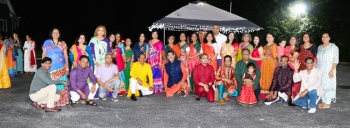
The Dhol-Raas Dhamaka of Chicago group, based in Lisle, Illinois, hosted a lively celebration of Navratri 2025, drawing a spirited gathering of over 100 participants including family, friends and community members. The event marked the traditional Shree Mataji Garba and Raas festivities, a cherished annual celebration for the Gujarati community in Chicago.
Founded by Jayesh and Trupti Brahmbhatt and Sameer and Nirupa Shah, the group began organising Shree Mataji Garba in 2021 on a small scale as the public celebrations were halted. Over the years, the event has grown in scope and popularity becoming a highlight of the Navratri calendar in the Chicago area.
“This year, attendees enjoyed vibrant Garba and Raas performances following Shree Mataji’s Sthapana, with participants from multiple Gujarati families coming together to celebrate their heritage. Some American family members also joined, embracing the rich traditions of Indian culture,” stated Jayanti Oza, senior journalist from Indo-US Tribune in Chicago.