


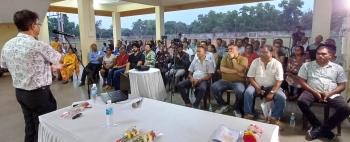
MARGAO
A meeting organised by Goyche Fuddle Pillge Khatir (GFPK) in Cavelossim on Sunday sent a message loud and clear ” Goa’s “survival water level” has reached our noses. If Goans do not act now, they risk becoming “slaves in their own land.”
The Cavelossim gathering was the 11th meeting organised by GFPK as part of its relentless village-to-village awakening campaign under the “Gardener’s Movement.” The initiative has already travelled through Fatorda, Curla, Morod, Comba, Baga, Navelim, Tilamol, Telaulim, Varca and Maina.
The evening began with a historical reflection by researcher Hector Fernandes, who marked 500 years since the recording of the Carta de Foral in 1526. Fernandes framed the Comunidade not as a private club for members but as the “Magna Carta of the Goan people.”
“The Comunidade is the only institution that can safeguard our Goan identity,” Fernandes warned.
He cautioned that the stakes are extraordinarily high. “If this 2,000-year-old union of God, people and land is allowed to dissolve, an estimated 70 per cent of Goa’s protected village land could automatically default to government ownership.”
Fernandes pointed to the Goa Land Revenue (Disposal of Government Lands) (Amendment) Rules, 2025 (Notification No. 16/01/01/2025-Rev-I/PF-I/2835), noting that once title shifts to the State, the traditional protections disappear. “This would leave orchards, grazing grounds and salt pans vulnerable to state-sanctioned corporate capture without local consent,” he said.
Former bureaucrat Elvis Gomes then delivered what many described as a modern-day “crime scene report” on Goa’s land governance. A prominent voice of the “Enough is Enough” movement, Gomes offered a sharp critique of how administrative machinery, he said, has increasingly worked against the land itself.
Highlighting rampant land conversions under controversial provisions such as Sections 17(2) and 39A, Gomes alleged that the Town and Country Planning (TCP) Department often ignores Survey of India contours in favour of architect-prepared plans that facilitate development approvals.
He reminded residents of Cavelossim of their earlier success in pushing casinos out of the River Sal, only to see the industry expand elsewhere.
“You drove the casinos out of the Sal, but the cancer multiplied in the Mandovi,” Gomes said.
He urged panchayats to exercise their powers more firmly. “Where ground realities do not match the documents presented, panchayats have the authority to reject permissions,” he said, calling for a renewed assertion of local governance under the 73rd Constitutional Amendment.
Local villager Polly Lobo gave voice to the anxieties felt by many households in the village.
“This is the final call for Goans to wake up,” Lobo said. “We must reflect deeply on what is happening and stand together with those on the frontlines who are protecting our land and our interests.”
His plea captured the mood of a community determined not to be erased. For many present, the issue was no longer merely about policy ” it was about survival.
Rejecting what he called decades of “hero politics” that have failed Goa, GFPK president Jack Mascarenhas introduced what he described as the “Gardener’s Philosophy.”
“We are not looking for a mob; we are looking for the 3.5 per cent,” Mascarenhas said, referring to the Law of Diffusion of Innovation.
According to the “3.5 per cent rule,” a committed minority of innovators and early adopters can trigger a social wave powerful enough to transform society. Mascarenhas described this group as the “Gardeners” ” citizens motivated by community spirit rather than political identity.
The movement’s secular spine was reinforced with a defiant call for unity: "Hindu, Kristanv, Muslim, tem uprant; ami Goemkar poile" (Hindu, Christian, Muslim - that comes later; we are Goans first)”, he added.


