


PANAJI
Revealing the precision, mobility and cross-border escape tactics of the seasoned Bangladeshi dacoity gang, the Goa police on Friday detailed how these illegal immigrants executed two high-value robberies in North Goa and slipped out of the State within hours, prompting a multi-State manhunt that stretched to the Bangladesh frontier.
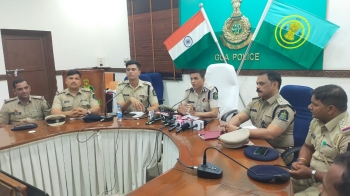
At a press conference held at the headquarters in Panaji, Director General of Police Alok Kumar said the accused were identified early but managed to escape by constantly staying ahead of pursuing teams and eventually fleeing to Bangladesh after committing the crimes.
“Two robberies were reported in the North District -- one in Dona Paula (April 2025) and the other in Mapusa (October 2025). During the investigation, the accused were identified early, but the main accused initially remained at large,” he said.
The DGP added that the Goa police mounted an extensive operation that went far beyond State borders. Teams were not only coordinating with interstate police forces, the Railway Protection Force (RPF) and the Border Security Force (BSF), but were also physically deployed across Andhra Pradesh, Telangana, West Bengal, Odisha, Meghalaya, Delhi and other locations to track the accused persons’ movements.
“The investigation required prolonged and patient effort. It involved sustained coordination, intelligence gathering and surveillance across several states,” he said, as the Goa Crime Branch this week obtained the custody of five of six accused -- Suman Hauldhar alias Pannu (35), Saifful Islam (31), Sohail Sheikh (35), Md Nasir (48), Noor Islam alias Nadim Khan (56) and Zakir (40) from the Delhi Crime Branch.
The Ganeshpuri-Mapusa robbery proved a critical turning point, accelerating the probe as teams tracked the accused across multiple cities and repeatedly came close to intercepting them. “On several occasions, it appeared the accused were within reach, but leads slipped away at the last moment,” Kumar said.
One such instance unfolded in Hyderabad, where teams trailed the suspects but lost them by a matter of hours due to gaps in CCTV coverage and logistical constraints.
Superintendent of Police (Crime) Rahul Gupta said the gang’s escape plan relied on exploiting surveillance blind spots and shifting quickly between transport hubs. “We were minutes away from intercepting them. But beyond a point, there was no CCTV coverage. They boarded a bus from the outskirts of Hyderabad and moved towards Bangladesh,” he said.
Goa police then widened the net, deploying teams in Kolkata, Guwahati and Meghalaya, among other places, based on intelligence inputs on likely escape routes. RPF personnel simultaneously checked trains arriving from Hyderabad and Bengaluru, while BSF units were alerted across border points.
Gupta said identifying the accused itself was one of the most challenging aspects. “They deliberately targeted isolated houses without CCTV coverage and disabled recording systems wherever present. They operated in masks. There were no eyewitnesses,” he said.
The SP further revealed that the gang carried out detailed reconnaissance before striking, studying the daily routines of residents and selecting vulnerable targets. They moved in small groups, used temporary shelters, avoided digital communication, and relied on buses and trains to evade detection.
Armed with locally procured weapons such as knives, sickles and hammers, the accused restrained and assaulted family members before looting valuables.
Police said the gang’s movements were reconstructed through technical surveillance, particularly CCTV footage from transport hubs, which helped establish travel patterns later matched with past criminal records.
Extensive field operations were carried out across Belagavi, Vijayapura, Bengaluru, Hyderabad, Kolkata, Delhi, Guwahati, Tripura and Meghalaya, with inputs shared across a pan-India intelligence network. Despite this, the suspects repeatedly evaded capture by staying ahead of pursuing teams.
Investigations revealed that the accused are Bangladeshi nationals from Bagerhat district, with a criminal history spanning 20 years across different Indian states since 2010. They are believed to have routinely entered India through the Bangladesh border, committed crimes across States, and returned using informal routes.
“The Bangladeshi dacoity gang has been active since 2010 across Andhra Pradesh, Odisha and other states. Nadim Khan is the suspected mastermind, but our investigation is still underway. The accused allegedly entered India via the Meghalaya route and fanned out to different parts of the country to commit crimes,” the DGP added.
Police also uncovered local support networks. In the Dona Paula case, a carpenter allegedly provided shelter and financial assistance. Some accused had prior links to Goa, including earlier incarceration at Colvale jail, where criminal connections were established.
One key accused had earlier attempted an ATM robbery in Ponda and spent over 22 months in jail before being released on bail, after which he returned and played a central role in executing both robberies.
A vehicle used in the crime was recovered within hours, while forensic evidence, including fingerprints, proved crucial in building the case.
Following the incidents, Goa police have intensified night patrolling across the state, deploying teams in shifts from evening to early morning. Officials said no major property crimes have been reported since.
Police have urged citizens to verify tenants and domestic help and report suspicious activity, emphasising that public cooperation and continuous monitoring remain essential.


