From Mariza to Roberto Carlos, Rui Veloso to Amalia, Goa has failed to even scratch the surface of Portuguese music. However, with events like Vem Cantar striving to make a difference, the future promises to be brighter.
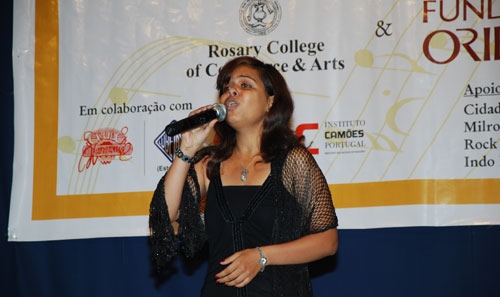
Think Goa andPortuguese music, and one automatically sees a young girl, in a long blackdress, perhaps forlorn, with the idyllic setting of Fontainhas in thebackground, while she sings the Fado, in a mournful voice. However, there isfar more to Portuguese music than that, and enlightening the public of thatfact is precisely what the objective of Vem Cantar, Goa’s ‘one of its kind’Portuguese singing competition hopes to achieve.
Started in 1998, as aninitiative taken by the Heritage Cell of Rosary Collegeof Commerce and Arts, Navelim, Vem Cantar was staged on the college premisesand was restricted to a few solo participants, and an even smaller number ofgroups. It continued in the same fashion for a couple of years before coming onleaps and bounds after the then delegate of Fundação Oriente, Dr Adelino Rodrigues da Costa attended the event and sawgreat potential in supporting it.
With the organisersabout to venture into the competitions 14th edition, theinfrastructure of the competition has taken a complete volte-face, and is stateof the art in terms of facilities provided, all of which are funded by Fundação Oriente.
Official spokesperson and all roundorganiser of events at the Fundação, Yvonne Rebello says“The Fundação sees this as a an opportunity to build a strong level of interest inthe Portuguese language through music. Every year, we see the involvement ofparticipants, that but for the song, may have no knowledge of the language. Butthrough this medium, interest develops.”
However, one obstacleof sorts was the limited knowledge of Portuguese music in Goa. While the Fado,as well as folk songs were, and continue to be popular, the acute lack ofawareness of other genres has proven to be a stumbling block.
One person that has taken a keen interestin the development of the competition on the whole is Delfim Correia da Silva,director of Instituto Camões, based in Panjim. For the last three years he hasbeen actively involved in conducting audio-visual sessions on contemporaryPortuguese music, so as to expose participants to various genres of music inthe Iberian language. "I was beyond impressed with the singers. Not only becauseof their vocal strength, but also because of their level of fluency when itcomes to the Portuguese language. This competition is crucial to the promotionof the language," he states.
When asked for her view on thecompetition’s progress since its inception, Rebello says, “It’s come a long way from being a small competition in acollege.”