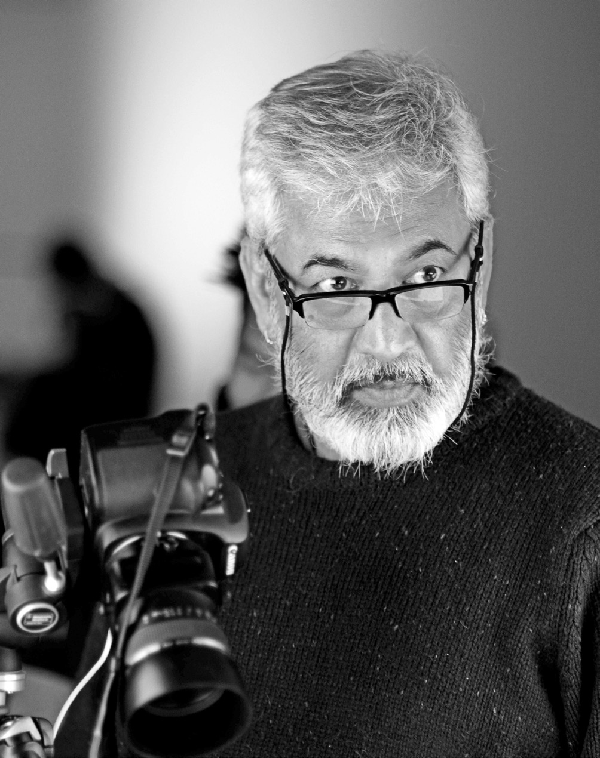
Dinesh Khanna, the curator of five photography exhibitions at Serendipity speaks to #TGLife of his love for photography, his gestures of giving back to photography and his plans of ‘not retiring’ as a photographer
#TGLife: You are very active on social media...
Dinesh Khanna: Yes, social media platforms like Instragram or FaceBook allows me to see what's happening around. With people posting their pictures, commenting on each other's pictures, sharing the pictures and also posting interesting articles from photography magazines or from museum or galleries - that keeps me updated. Such interaction is fairly rich and allows one to keep a track of what's going on. As founders of Nazar foundation and the Delhi Photo Festival, we found it extremely useful, considering our limited resources, to use social media to create and enlarge the photographic community. Whenever the festival happened we wanted to promote through social media so that it reaches larger audience than if we just try to post or mail it to people we know. That's been an extremely valuable lesson in the last few years.
As a curator, what were your concepts?
Everyone talks about how photography today is the more democratic art form - because the camera is very easily available. It is easy to take pictures and every phone has a camera and every person has a phone. Everyone is taking pictures all the time; this doesn't mean that everyone is a photographer but everyone is becoming visually a lot more sophisticated.
On the other hand, most festivals or galleries normally tend to show what is serious photography - which is seen as photography which is a documented in photojournalistic in nature and which is more concerned with social and political issues. So it's fine; it's great. But serious photography cannot be the only kind of photography. I am expanding the meaning of serious photography to include photographers who are serious about what they do. Your subject does not have to be the only serious, your approach as a photographer has to be serious. Which is where then the difference between everyone who takes pictures all the time and the one who takes pictures with a thought and an idea of expressing themselves.
And it doesn't have to be always in a documentary style, or only about things which are bad or to be worried about - there is wildlife, fashion, interior, architecture, food, art where the photographers with a great deal of talent and integrity shoot in these genres but not necessarily because they feel that the world has to change. They are looking at the aesthetics, beauty, probably someone else's talent - but they are serious about how they do it - so I thought it is very important for festivals such as these (Serendipity) to bring in those genres of photography so that people also get to see what (genres) they like.
Could you spill out the secrets of Panjim?
The Serendipity festival based in Goa and we expect a large part of the audience to be from Goa itself. But also considering it's happening in the month of December, there's also lot of tourist to come here. Whereas people from Goa might know some of the places in and around Panaji but the people from abroad may not know the city of Panaji. The idea was to ask two photographers from Goa - Assavari Kulkarni and Manish Jaju to do photo essays on interesting aspects of Panaji - to reveal the lesser known secrets of Panaji.
Specialities of the photographers - Navtej Singh, Anup Shah and Arati Kumar Rao, whose work you have curated
In Oceans of Life: India's Coastal Inhabitants, Navtej Singh's perspective to look at the coastline is different - he is shooting from the air, so none of us have really seen the beaches that way. He shoots from the point of beauty of the coastline, the colour, the texture, the form - through helicopters.
Wild life is a very widely popular genre of photography, but most of the time in India we see wildlife photography where photographers have used long tally lenses (500 and 600 mm), stand half kilometre away and you can see the animal from a distance. In Nature Untamed, Anup Shah uses a wide angle lens placing on the ground and he uses a remote trigger so it's only when once the animal knows that there is no human being around that it's on their own and Anup captures those moments which otherwise you don't get to see. So he has used both his sense of aesthetics, his compassion for wildlife and his technological bent of mind and has combined all to create the work.
Aarti Kumar Rao works on the life of the waters. She does serious photography seriously and she thinks she is an environmentalist, an activist. In ‘A Slow Violence: Stories from the Largest River Basin in the World' she looks at how things like dams are making, changing or disturbing the lifelines of people who bank there.
Comment on ‘Unsung 3' - and why you chose five women photographers?
Co-curated by Mahesh Bhat, this group show Unsung 3: Celebrating the Extraordinary Grandeur of Smallness, has the work of five women photographers. It is about the extraordinary lives of ordinary human beings who are doing work for society not expecting any returns.