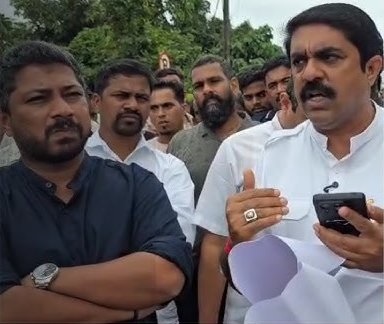
Goa Forward chief Vijai Sardesai and Revolutionary Goans Party president Manoj Parab found common ground at a taxi operators’ protest, raising political eyebrows.
MAPUSA
Last week’s impromptu protest by taxi operators at the Mopa airport may have been about safeguarding the livelihoods of hundreds of Goan drivers, but it also triggered an unexpected political development.
The sight of Goa Forward Party (GFP) President Vijai Sardesai and Revolutionary Goans Party (RGP) President Manoj Parab standing shoulder to shoulder at the agitation set off a flurry of speculation about the possibility of a regional realignment in Goa’s volatile political landscape.
For decades, Goa has witnessed shifting sands in electoral politics, with regional outfits often playing the role of kingmakers in a State where coalition governments are the norm rather than the exception.
Against this backdrop, the camaraderie between Sardesai and Parab has drawn unusual attention. Not only did both leaders share the dais at the protest, but their subsequent statements hinted at an openness to collaboration — something unthinkable even a few months ago.
Meeting by chance, but with consequences
Both Sardesai and Parab have publicly maintained that their encounter at Mopa was unplanned. Yet, the optics of two prominent regional leaders jointly championing the cause of Goan taxi operators struck a chord with the public — and rattled their political rivals.
While the protest itself was short-lived, the political chatter that followed has lingered. Analysts were quick to point out that the chemistry on display between the GFP and RGP could evolve into a more structured understanding in the run-up to the 2027 Assembly elections.
Even the leaders themselves appeared slightly taken aback by the buzz. “We are made-in-Goa parties. There is not much difference between the two,” Sardesai remarked, adding that while ideological divergences remain, the larger objective of safeguarding Goan interests could form common ground.
Parab too did not dismiss the idea, though he was careful to underline that any tie-up must be rooted in concrete policy commitments rather than mere opportunism.
Shared enemy in BJP
What perhaps unites the GFP and RGP more than anything else is their opposition to the Bharatiya Janata Party (BJP), which has dominated Goa’s politics since 2012.
Both leaders have consistently accused the saffron party of eroding Goa’s unique identity through policies that favour centralisation and large-scale migration. The repeated refrain that “Goa should be run from Goa and not by a high command in Delhi” is clearly aimed at national parties, whether BJP, Congress, or AAP.
Parab has also articulated his party’s three non-negotiables: the passage of the ‘POGO Bill’ (Prioritisation of Goans in Opportunities), a robust land protection law, and the safeguarding of the Mhadei river.
Sardesai, for his part, has signalled flexibility, noting that seat-sharing or power equations can be discussed later, provided there is consensus on critical issues. This issue-first approach marks a shift in tone for both leaders.
Until recently, Sardesai and Parab were seen as political adversaries who could not even see eye to eye. Their paths had barely crossed in Goa’s political corridors. But the Mopa taxi protest appears to have changed that equation, at least temporarily.
The regional parties’ dilemma
Despite the early signals, hurdles remain.
Parab himself candidly admitted that the RGP, a relatively young party, lacks the resources and manpower to contest all 40 constituencies. While the party did manage to spring a surprise by winning one seat in 2022, it still has to consolidate its grassroots machinery.
The GFP, on the other hand, has faced setbacks after its 2017 alliance with the BJP, which cost it credibility among sections of the electorate. A potential tie-up, therefore, offers both an opportunity and a risk. For the GFP, aligning with the RGP could help reclaim its image as a “Goa-first” party while expanding its base among younger, more aggressive voters who have flocked to Parab’s rhetoric.
For the RGP, joining hands with the GFP could provide institutional depth and electoral strategy in constituencies where it lacks organisational strength.
However, the challenge lies in reconciling their approaches. The RGP’s uncompromising stand on “Goenkarponn” and its sharp anti-migrant rhetoric have often courted controversy. Sardesai has cautioned against extremism, insisting that “Goem, Goenkar, Goenkarponn” should not mean hostility towards non-Goans but rather prioritisation of locals in opportunities and decision-making.
Balancing this nuanced stance with the RGP’s grassroots-driven populism will not be easy.
Reading the signals
Political observers argue that while it is premature to project a formal GFP-RGP alliance, the bonhomie signals a broader trend: regional parties in Goa are beginning to explore synergies in the face of national parties’ dominance.
With Assembly elections still a year and a half away, the road to any structured coalition remains long and uncertain. Yet the symbolism of Sardesai and Parab sharing space — and a cause — has already added a new layer to Goa’s political churn.
Coincidentally, both leaders drew attention to the election of a Lamani as sarpanch in Sancoale, a development that struck a nerve among many Goans concerned about cultural and demographic shifts. By referencing such flashpoints, Sardesai and Parab have found common ground on issues that resonate deeply with voters.
The road ahead
In the coming months, both parties are expected to hold internal discussions on alliances and strategy.
Parab has confirmed that the RGP top brass will debate the idea of alliances soon, while Sardesai has declared his willingness to “compromise with anyone for Goa’s sake — except the BJP.”
Whether these words translate into a pre-poll pact remains to be seen. Goa’s history is littered with alliances that fizzled out or backfired. Yet, in a State where politics changes with the tides, the Sardesai-Parab camaraderie has already served its purpose: it has set the political class talking, stirred speculation, and hinted at possibilities that could reshape the balance of power in 2027.
For now, what began as an accidental meeting at a taxi protest has evolved into one of Goa’s most intriguing political subplots. In a place where politics is as much a staple diet as fish curry and rice, Goans will be watching closely to see whether this chance camaraderie matures into a durable coalition — or remains just another fleeting episode in the State’s colourful political theatre.