


PANAJI
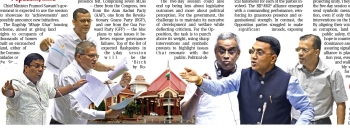
The Goa Legislative Assembly will convene on Monday for a five-day session that promises to be as much about governance as it is about political theatre. Running from January 12 to 16, the session opens with the customary Governor’s Address, setting the stage for what is expected to be a combative week in the House.
This first session of the year comes at a critical juncture: the Assembly has entered the fifth and final year of its tenure. With elections looming at the end of its tenure, the ruling Bharatiya Janata Party (BJP)“Maharashtrawadi Gomantak Party (MGP) alliance and the fragmented Opposition alike will be keen to use the Assembly floor to shape narratives that will resonate with voters.
===
Govt’s agenda: populism, infrastructure
Chief Minister Pramod Sawant’s government is expected to use the session to showcase its 'achievements' and possibly announce new initiatives.
The flagship ‘Mhaje Ghar’ housing scheme, aimed at giving land rights to occupants of thousands of homes built on encroached land, either of the Communidades or the State, is expected to be highlighted, designed to appeal to the electorate.
Alongside, the government is likely to trumpet its big-ticket infrastructure projects ” roads, bridges, and urban development works ” which it claims will transform Goa’s economic landscape. Supplementary demands for grants will also be tabled, seeking authorisation for additional spending beyond the budget passed in the monsoon session.
For Sawant and his ministers, the session is an opportunity to project stability and progress. With a brute majority of 31 MLAs against the Opposition’s seven, the government and the members of the treasury benches will be expected to push through its way while limiting space for dissent and shouting down the other side.
====
Oppn strategy: Cornering ministers
The Opposition, though numerically weak, will be determined to make its presence felt. Comprising seven MLAs ” three from the Congress, two from the Aam Aadmi Party (AAP), one from the Revolutionary Goans Party (RGP), and one from the Goa Forward Party (GFP) ” the bloc plans to raise issues it believes expose governance failures.
Top of the list of expected flashpoints in the 5-day session will be the 'Birch by Romeo Lane' nightclub fire tragedy in Arpora, which claimed 25 lives. The outrage it sparked over umpteen licencing and safety lapses of the administration is likely to see the treasury and Opposition benches engage most fiercely.
The alleged cash-for-jobs scam, which has eroded public trust in government recruitment processes is another issue that could see some amount of clashes between the two sides. Yet another subject which could heat up proceedings is the large-scale land conversions, an issue which is recently being spearheaded by Justice Ferdino Rebello. The contentious issue has for years stirred fears of unchecked urbanisation and the loss of Goan identity at the behest of real estate giants from the North.
Opposition leaders argue that these matters reflect large-scale corruption and systemic failures in the government and deserve urgent debate at the legislature level.
However, the government has already signalled its intent to stymie such discussions, a strategy perceptibly visible throughout the tenure of the current assembly.
One indicator that the government has no intention to yield even an inch of space to the Opposition on these contentious issues during the five-day proceedings was the outcome of the Business Advisory Committee (BAC) meeting held earlier this week.
At the meeting, the Opposition’s demand to dedicate time for a debate on the Arpora fire, land conversions and other contentious issues, was outrightly rejected, underscoring the ruling side’s strategy to frustrate dissent.
====
Battle for perception
The five-day session could also end up being less about legislative outcomes and more about political perception. For the government, the challenge is to maintain its narrative of development and welfare while deflecting criticism. For the Opposition, the task is to punch above its weight, using sharp interventions and symbolic protests to highlight issues that resonate with the public.
Political observers, meanwhile, note that while the BJP enjoys numerical dominance, the optics of silencing the Opposition could backfire in an election year, with a significant section of the electorate often judging governments on how they handle dissent.
====
Election year context
The timing of this session adds to its significance. With the Assembly entering its fifth and final year, Goa is on the cusp of an election cycle that will culminate in the selection of 40 legislators to form the next government.
For the ruling BJP-MGP alliance, the session is a platform to consolidate its achievements and set the tone for its campaign. Announcements and rhetoric aimed at reinforcing the image of a government that delivers on promises.
For the Congress, AAP, RGP, and GFP, the session is a rare opportunity to capture public imagination. Each party will seek to carve out distinct narratives:
Congress will emphasise governance failures and corruption, hoping to revive its traditional base. AAP is likely to focus on transparency and people-centric governance, themes that are its DNA, while RGP will continue to champion Goan identity and resist large-scale land conversions, appealing to local sentiment. GFP will position itself as a regional force, highlighting issues of cultural preservation and grassroots development.
====
Oppn's post-ZP calculus
The Assembly session will also carry undertones of the recent Zilla Panchayat election results, which served as a political barometer for each of the parties involved. The BJP-MGP alliance emerged with a commanding performance, reinforcing its grassroots presence and organisational strength. In contrast, the Opposition parties struggled to make significant inroads, exposing their fragmented strategies and limited reach across rural constituencies.
The elections, nonetheless, underscored the Opposition’s inability to forge a united front. While the Aam Aadmi Party (AAP) chose to chart its own course, the Congress, RGP, and GFP explored possibilities of an electoral alliance but failed to arrive at a concrete, workable formula. Personality clashes, divergent priorities, and mistrust among the leadership of these three parties scuttled any chance of cohesion.
Yet, with the Assembly entering its final year, these parties are seemingly recognising the political prudence of projecting unity. They acknowledge that the five-day session offers a platform to send symbolic messages of collaboration, even if only through coordinated interventions on the floor of the House. By aligning their voices on issues such as corruption, land conversions, and public safety, the Opposition will hope to counter the government’s dominance and perhaps send reassuring signals to voters that an alliance is plausible.
In an election year, every speech, protest, and walkout in the Assembly will be scrutinised for its potential to sway voters.
====
Governor’s address
The session will kick off with the address of the Governor, Ashok Gajapathi Raju, a constitutional formality that doubles as a political statement of the ruling side.
The speech is expected to highlight the government’s achievements over the past year and outline policy priorities for 2026. An emphasis on welfare schemes, infrastructure expansion, and digital governance initiatives has been the norm in the past, but with a new Governor in Gajapathi Raju, it will be keenly followed to see what is new.
Despite its majority, the government faces challenges, though. Public anger over the nightclub fire tragedy and allegations of corruption could dent its credibility. The Opposition, though small, will exploit these issues to question the government’s moral authority. Moreover, the contentious land conversion debate could become a rallying point for civil society groups, adding pressure on the government to respond.
In many ways, this Assembly session will serve as an informal curtain raiser to Goa’s 2027 election campaign: the government will use it to reinforce its narrative of development and welfare, while the Opposition will strive to highlight failures and present itself as a credible alternative.
The stakes are high. For the ruling side, the challenge is to maintain momentum and avoid missteps that could snowball into major controversies and muddy the State's political climate. For the Opposition, the goal is to punch holes in the government’s narrative and build momentum for the months ahead.
In an election year, every gesture counts, every word matters, and every session becomes a stage for political theatre.
====
New Gov, Speaker in spotlight
The five-day session of the Goa Legislative Assembly beginning Monday will be marked by two fresh faces at the helm ” Governor Pushapati Gajapati Raju and Speaker Ganesh Gaonkar.
Governor Raju, who assumed office in July last year, will deliver his maiden address to the House, setting the tone for the session that traditionally begins with a review of government achievements and policy priorities.
His speech will be closely watched for signals on the Sawant government’s agenda in the final year of its tenure, especially as Goa heads into an election cycle early next year.
More significant will be the role of Speaker Ganesh Gaonkar, elected in mid-September 2025 after Sports Minister Ramesh Tawadkar vacated the chair to join the Sawant cabinet.
With the Assembly entering its last lap, Gaonkar faces the delicate task of conducting proceedings in a manner that balances the ruling BJP-MGP alliance’s brute majority with the Opposition’s demand for space to raise issues.
Observers note that his ability to maintain a non-partisan demeanour will be tested as the House debates contentious matters ranging from the Arpora nightclub fire tragedy to land conversion controversies.


