PANAJI
Despite persistent tourism pressures ranging from loud music and artificial lighting to heavy beach activity, Goa’s Olive Ridley conservation efforts have delivered a major success story, with turtle nesting at the tourism hotspot of Morjim-Mandrem more than doubling over the last decade, while South Goa beaches have emerged as key nesting hubs during the ongoing 2025-26 season.
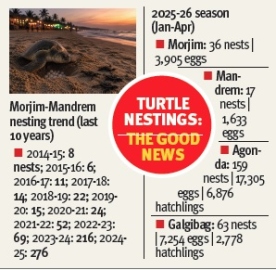
Forest Department data shows nesting at the protected Morjim-Mandrem coast increased from just eight nests in 2014-15 to 276 nests in 2024-25, indicating a sharp recovery in nesting activity at one of Goa’s busiest beach tourism belts.
The growth accelerated after 2020, with nesting numbers rising from 24 nests in 2020-21 to 52 in 2021-22, 69 in 2022-23, 216 in 2023-24 and reaching 276 in 2024-25. Hatchling releases also saw a substantial increase, rising from 331 in 2014-15 to 12,857 in 2024-25.
The upward trend has continued into the ongoing 2025-26 season. Between January and March this year, Morjim recorded 36 nests with 3,905 eggs, while neighbouring Mandrem registered 17 nests and 1,633 eggs.
The recovery is being viewed as significant as it comes despite continued tourism activity at Morjim ” one of Goa’s most visited beaches, where nesting season overlaps with peak tourist arrivals and beach operations.
While Morjim-Mandrem has sustained its recovery, Agonda in South Goa emerged as the State’s largest turtle nesting beach.
Between January and April 2026, Agonda recorded 159 nests and 17,305 eggs, besides releasing 6,876 hatchlings.
Neighbouring Galgibag also reported strong nesting activity with 63 nests, 7,254 eggs and 2,778 hatchlings released during the same period, reinforcing South Goa’s growing role in turtle conservation.
Conservationists, however, cautioned that the revival remains fragile amid mounting tourism pressure, particularly at Morjim and Mandrem.
Previous studies and reports have flagged artificial lighting from shacks and resorts, loud music, beach events, human movement and coastal development as factors capable of disturbing nesting turtles and disorienting hatchlings.
This season too, turtle enthusiasts alleged that noise and lights from beach activities at Morjim forced a turtle back into the sea without nesting, reviving demands for stricter enforcement of protection measures during nesting months.
Concerns have also persisted over illegal shack activity near sensitive nesting habitats, with inspections in recent seasons detecting structures within turtle protection zones.