PWD Minister announces coordination committee, GIS-based planning
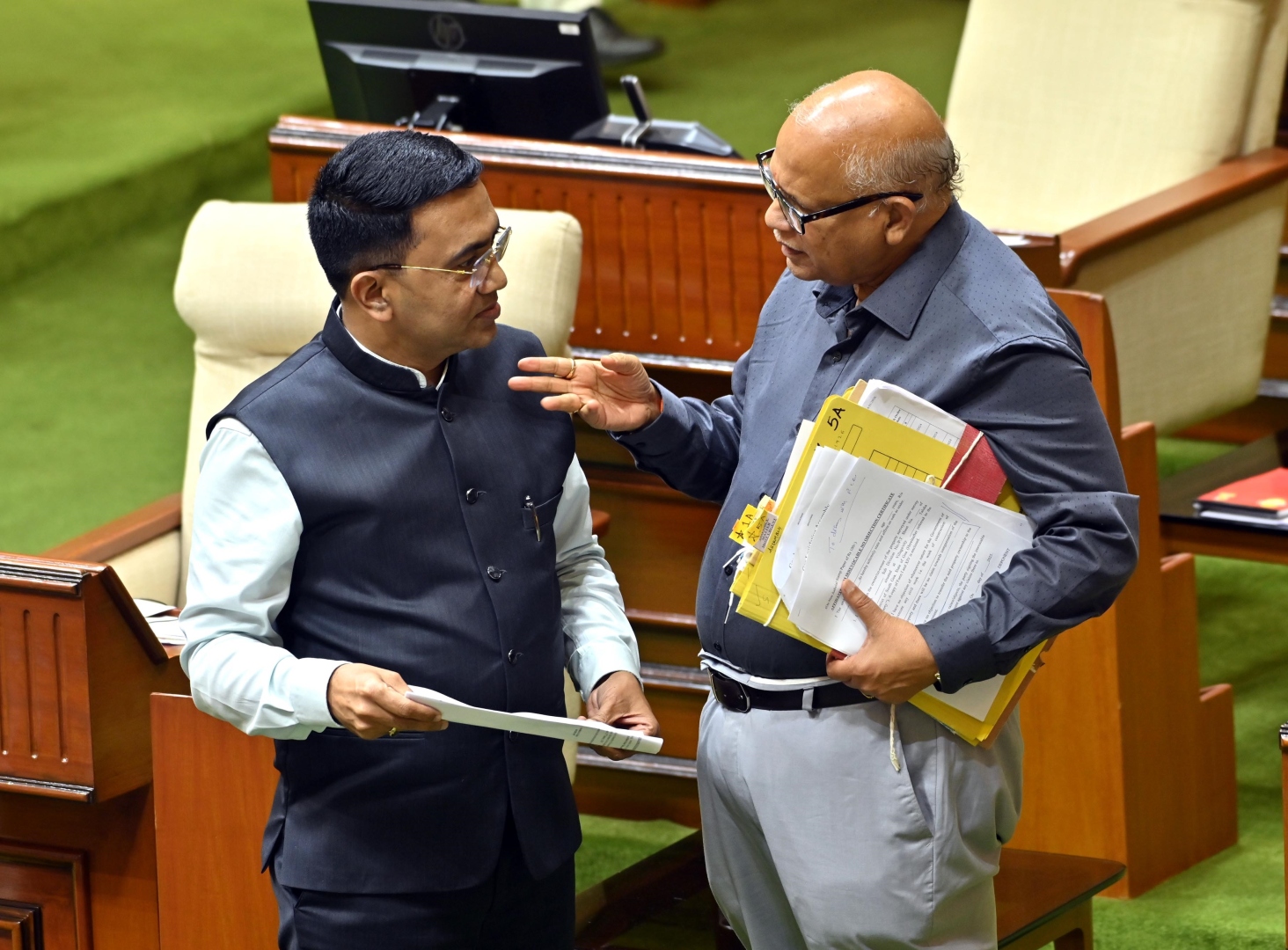
PWD Minister Digambar Kamat speaks with Chief Minister Pramod Sawant on Day 3 of the Assembly Session.
MAPUSA
In a decisive move to curb the frequent and uncoordinated digging of roads across Goa, the State government has put in place a multi-layered mechanism to regulate road cutting, with strict accountability measures for officers who fail to follow protocol, Public Works Department (PWD) Minister Digambar Kamat informed the Goa Legislative Assembly on Wednesday.
Responding to concerns raised during Question Hour, Kamat said the government has constituted a high-level Road Cutting Coordination Committee, headed by the Principal Chief Engineer, with heads of all major utility departments and agencies as members.
The committee will ensure that road works and underground utility projects are properly coordinated before any road is dug up.
To further streamline planning and avoid duplication of works, Kamat said a GIS-based mapping system has already been put in place, with the PWD acting as the nodal agency. The mapping system will help identify existing utilities and align future projects in advance.
The minister also announced plans to introduce utility corridors on a pilot basis along a one-kilometre road stretch, which will later be extended to major roads across the State.
The utility corridor model is aimed at minimising repeated road cutting for water, sewerage, power and telecom works.
Advance notice mandatory
Making it clear that officers would no longer be allowed to work in silos, Kamat said all PWD engineers have been directed to notify all departments and agencies concerned at least one month in advance before hot-mixing of roads.
“If engineers fail to write to departments or agencies in advance, then those engineers will be held accountable,” the minister told the House, underlining the government’s intent to fix responsibility within the system.
While admitting that unregulated road digging has “played havoc” with Goa’s roads, leading to premature damage and potholes, Kamat said there were situations where road cutting becomes unavoidable.
“If a water pipeline develops a defect and 10 to 15 houses are affected, we have no option but to allow road cutting for urgent repairs. Sometimes even local MLAs direct such works,” he said.
However, he clarified that in all such cases, the department or agency responsible for digging the road will have to restore and maintain the road until it is hot-mixed.
Defect liability to be extended
In another major step to improve road quality, Kamat announced plans to increase the Defect Liability Period (DLP) from three years to five years, ensuring longer accountability of contractors and agencies involved in road works.
He also informed the House that a tender has been floated to appoint a new agency to monitor roads during the DLP period. Until the new agency is finalised, RITES will continue to carry out the monitoring work.
MLAs seek stronger deterrents
Vasco MLA Krishna Salkar, who raised the issue, expressed strong displeasure over the constant digging and cutting of roads, saying it had caused severe inconvenience to the public due to poor road conditions.
Fatorda MLA Vijai Sardesai pointed out that cities such as Bengaluru, Hyderabad, Chennai and Delhi follow a single-window GIS-based road-cutting system, and asked whether Goa could adopt a similar deterrent-driven mechanism.
“So far, there is no deterrent for people who cut roads. Why don’t we have a single-window road-cutting system?” Sardesai asked.
Leader of Opposition Yuri Alemao echoed concerns over the lack of coordination between departments and stressed the need for technology-driven transparency. He suggested the use of AI-based systems and a public dashboard displaying details such as the agency undertaking the work, the nature of the project, start date and completion timeline, so citizens are kept informed.
The government’s measures, including coordinated planning, GIS mapping, advanced communication, utility corridors and enhanced defect liability, signal a clear intent to rein in reckless road digging and enforce accountability, even as lawmakers continue to push for stronger deterrents and public transparency.