PANAJI
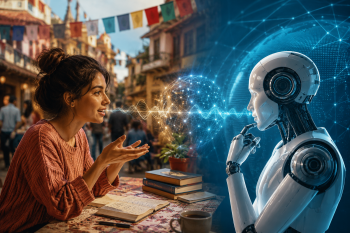
Real-time language translation is now becoming part of daily life. From translated video calls to auto-dubbing on social media platforms, artificial intelligence (AI) is making communication across languages easier than ever.
Major technology companies such as OpenAI, Meta and Google offer tools that can translate many languages almost instantly, and these systems continue to improve.
This has led to an important question: if AI can translate quickly and accurately, is learning another language still necessary?
Tools Can Help, But Not Replace
Humans have always relied on tools to make tasks easier. Writing reduced the need to remember everything, while calculators simplified arithmetic. AI follows the same path and can support learning and improve access to information.
However, there is a difference between using technology to assist learning and using it to completely avoid learning. This becomes especially important with language, which is more than just a practical skill.
Why Effort Matters
Learning a language requires effort, and that effort plays a key role in building knowledge.
Researchers describe this idea as “desirable difficulties” ” challenges that may feel hard but help people remember and understand better in the long run.
Working through grammar, searching for words and switching between languages strengthens memory, attention and mental flexibility. Over time, these activities help build what researchers call cognitive resilience ” the brain’s ability to stay strong as people age.
Using several languages requires the brain to constantly adapt, manage context and handle competing information. Passive use of translation tools does not provide the same mental exercise.
About Multilingualism
The idea of a general “bilingual advantage” is not always supported by research. Some studies show benefits, while others find little difference.
A recent study involving adults aged 18 to 83 found that multilingual and monolingual participants performed similarly in many tasks. However, people with broader multilingual experiences showed stronger visuospatial working memory, especially older adults.
This suggests that speaking multiple languages may not improve every aspect of thinking, but it could help maintain certain mental abilities over time.
Other studies have also linked multilingualism with later onset of conditions such as Alzheimer’s disease and healthier ageing, although researchers continue to study the reasons behind this.
What AI Still Cannot Do
AI translation works well for speed and convenience, but it often misses cultural meaning, humour, emotion and context.
Language learning is not only about understanding words. It also involves understanding people, cultures, values and ways of thinking.
Many multilingual people describe different languages as expressing different parts of themselves. One participant said they think in Telugu but count in English. Another described Afrikaans as the language of emotion and English as the language of everyday life.
These experiences show that language is more than translation ” it is part of identity.
More Than Words
AI will continue to influence language learning by making education more accessible and personalised.
However, it cannot replace the deeper mental and cultural experience that comes with learning another language. Understanding a language also means understanding how others see the world ” and that remains valuable.