


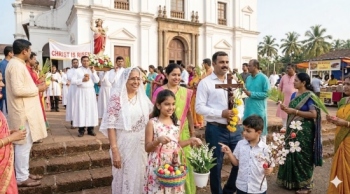
Easter is the most sacred feast of the Christian Church, commemorated on the Sunday following the full moon after the spring equinox. It celebrates the Resurrection of Christ, which occurred three days after His crucifixion, death, and burial under Pontius Pilate. A central doctrine of Christianity is that He rose in glory from the dead, appearing to His disciples and many others, fulfilling the prophecy of triumph over sin and death, and awakening in their hearts the promise of new life and everlasting hope.
In theological terms, Easter marks the glorious dawn of the New Covenant between God and humanity. Through Christ’s resurrection, sin and death are forever conquered, opening the way for deep reconciliation and intimate fellowship with God.
Easter also unites the faithful worldwide in sacred community and joyful fellowship, as they celebrate their shared faith and the blessed hope of eternal life. This holy observance strengthens the bonds of love among Christians across the globe, revealing the inclusive and transcendent power of Christ’s victory.
The Easter Symbols
The Easter Bunny traces its roots to ancient symbols of fertility and new life. German immigrants brought the tradition of the Oschter Haws ” an egg-laying hare ” to America in the 1700s. Today, it gently reminds us of the abundance and joy of new life that flows from Christ’s resurrection.
The Easter egg represents the empty tomb and the miracle of resurrection ” new life breaking forth from what appeared to be death. Its deeper meaning points to the hope and renewal found in the risen Lord. The Dogwood tree is believed to be the tree from which a cross was crafted for Christ’s crucifixion. Its white petals bear four reddish spots, symbolising the five wounds of Jesus.
The Crucifix, once a cruel instrument of Roman execution, has become the ultimate sign of divine love, forgiveness, and victory over sin and death.
The spear that pierced Jesus’ side as He hung on the cross reminds us of the reality of His suffering and the outpouring of blood and water ” symbols of the sacraments and the birth of the Church.
Lily of the Valley holds special significance as it echoes the beauty and purity with which Christ described Himself, symbolising innocence, humility, and the promise of everlasting life that springs forth through His resurrection.
Easter baskets are a joyful symbol of new life and resurrection hope. Often filled with eggs and other signs of abundance, they beautifully represent spiritual fruitfulness.
The celebrations
Easter in Europe beautifully blends deep religious devotion with the joyful spirit of spring. It is marked by colourful egg decorating, fragrant special breads, and a wide variety of local customs. Highlights include Spain’s solemn and moving Semana Santa processions, Germany’s charming Ostereierbaum (egg trees), traditional egg-rolling games, and playful water-throwing or willow-whipping rituals in Eastern Europe, believed to bring health and blessings.
In Finland, children dress as Easter witches, carrying brooms and decorated willow twigs, visiting homes to exchange them for sweets, blending Christian customs with local folklore. In Florence, Italy, the centuries-old Scoppio del Carro features a fireworks-filled cart ignited before the cathedral. In Greece, Easter is observed with solemn midnight masses and the tradition of Tsougrisma, where red-dyed eggs are cracked to symbolise the breaking of the tomb.
In the US, Easter is celebrated as a vibrant blend of religious observance and joyful family traditions. Families attend church services, hunt for colourful Easter eggs, enjoy festive meals, and take part in parades and Easter brunch. The holiday highlights themes of spring, renewal, and togetherness, with the Easter Bunny and decorated egg baskets remaining beloved favourites.
In many Latin American countries, such as Chile, Ecuador, Uruguay, and Venezuela, Easter takes on a deeply religious character centred on Holy Week. Processions wind through streets adorned with vibrant sawdust and flower carpets (alfombras). A unique tradition in Chile, Ecuador, Uruguay, and Venezuela involves burning papier-mâché figures of Judas, symbolising the ultimate triumph of good over evil. Families also share special fish dishes and gather together, beautifully blending solemn faith with rich local cultural celebrations. In Florence, Italy, a cart filled with fireworks is lit in front of the cathedral to ensure a good harvest.
Russian Easter, known as Paskha, is a family celebration. Families bake fragrant kulich, a sweet Easter bread, and prepare paskha, a rich pyramid-shaped cottage cheese dessert. Eggs are traditionally dyed deep red using onion skins to symbolise the blood of Christ, after which people enjoy the lively game of egg tapping to see whose egg is the strongest.
Norwegian Easter combines skiing, cosy cabin living, and cultural traditions, celebrating the return of sunlight with oranges, Kvikk Lunsj chocolate, watching “pÃ¥skekrim” crime stories, and enjoying family outings in the mountains.
Unlike spring-themed Easter elsewhere, in Greenland, people celebrate with outdoor activities and a traditional lamb lunch, emerging from the polar night to enjoy the returning sun, which brings a festive, lively atmosphere to towns like Nuuk and Ilulissat.
Australian Easter blends Christian traditions with local culture, featuring the chocolate Easter Bilby to raise awareness for an endangered marsupial, a four-day holiday weekend, the Sydney Royal Easter Show, and family activities like camping, beach trips, and enjoying hot cross buns.
Easter in Africa is marked by vibrant expressions of faith and culture, with packed churches, midnight vigils, and, in Ethiopia, white-robed worshippers gathering in churches. Traditional meals vary across regions, with doro wat and injera in Ethiopia, fufu in West Africa, and pickled fish, braai, and hot cross buns in South Africa, while festive chapati is common in Kenya.


