


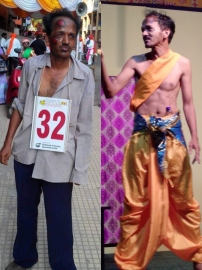
Bunty Udelkar’s acting journey started when he got an opportunity to act in a professional drama in 1989 through the Alankar Club.
Famed and celebrated for his role as ‘Bebdo,’ a drunkard, Bunty Udelkar admits that he has never had a drink in his entire life. This leaves everyone to wonder how he manages to portray such a realistic and relatable bebdo on stage!
“Observation and concentration,” he says. “I observe the bebdos in every village and try to mimic their every action. For instance, they roll their tongues around their mouths. The real bebdos do that to lick the tiny traces of alcohol that may have remained."
"I haven’t mastered it, but I still try. In fact, you can say that I have done my PhD in bebdos by sheer observation,” he adds with a laugh.
If there is some time before the drama starts, Udelkar sits and concentrates on his character for a while before getting into the role. “It won’t be as convincing if I directly start playing the role of the character on stage,” he explains.
His character of Bebdo was first seen on stage in the Konkani translation, ‘May Maai Wanted,’ of the Marathi play ‘Vasu chi Sasu.’ “I was asked if I could play the role of a bebdo, and it was a role I had been looking for,” he says.
With Goa often stereotyped as a destination where one can get all the booze, for Udelkar, this becomes a source of inspiration. Udelkar hasn't studied theatre arts, but the power of observation is what he swears by.
“Every Goan village has its own bebdo. I observe them all! In the past, I have often followed a village bebdo walking home for 1-2 km, simply studying him. I keep that in mind as I don’t drink. This helps me bring my character to life,” he notes.
He further adds, “I have done many shows from Canacona to Pernem, performing even in Karwar, and villagers keep telling me, ‘There is a bebdo like you in our village.’ That is wrong. They should instead say, ‘Your acting is exactly like one of the bebdos in our village.’ When they say that, it is the biggest award any actor can get.”
His acting is so real that he has managed to fool the audience, actual drunkards, and at one point, even the police.
“During a film shoot, I was on set when a real drunkard staggered in; I was already in character. At first, he fired obscenities, but after talking to him, he asked me if I had eaten lunch," he recalls.
"When I said I had not, he held on to my hand and asked me to come home. I also held on to him then, and we both lurched for some distance. The filmmakers from Mumbai filmed it. They were surprised to know that I don’t drink despite living in Goa.”
“Yet another incident happened in Dodamarg," he reminisces. "I was in the audience waiting for my entry, and the committee had been informed. However, on the previous day, a real drunkard was beaten up for causing a scene."
"When I shouted as a part of the act, a well-built man came and raised his hand to slap me, but he hit the chair, and it broke. I wasted no time and quickly staggered on stage."
"It was only when I interacted with the actors on stage that the villagers realized I was an actor too. They also apologized to me during halftime,” he adds with a hearty laugh.
Through his character, he wants to give the message that drinking causes trouble not just for the individual, but also for the family, leading to their downfall.
“I can’t tell people to stop drinking sorro completely; bar owners will bring a morcha in front of my house. So drink, but drink in moderation,” he advises.
In this fast-paced world, actors like Udelkar sit still and watch the world and characters around them, helping them bring the magic of observation into their acting. His upcoming works include Drishyam 3 and a Konkani film, Umesh, which is set to release on April 11.
“God has given art to everybody, but it depends on how you polish and emulate it. It is very important to preserve that art and work on it," he offers as his words of wisdom. "Work is always there, but practicing your art will give a different sense of peace of mind.”


