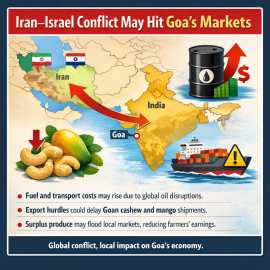
The ongoing conflict between US-Irael and Iran is expected to have ripple effects on markets in Goa, particularly through disruptions in global crude oil and gas supply chains. As fuel costs rise, the prices of essential commodities in the state are also likely to increase.
At the same time, Goa’s key agricultural exports”especially cashews and mangoes”are projected to witness a bumper harvest this year due to favourable climatic conditions. However, if the surplus produce is not exported in time, it could flood the local markets, leading to a drop in prices and affecting returns for farmers.
Farmers in Goa, who until recently were happy about the prospect of a good harvest this year, are already expressing concerns about potential losses to their farm produce.
“Our joy seems to be short-lived, and if the war extends beyond a month, we will suffer huge losses,” said a cashew producer from Valpoi who exports his large-sized nuts and sells the rest in the local market.
“Large nuts are of export quality and do not have much demand locally. We send them to other states such as Delhi, Punjab, Gujarat and Maharashtra, where high-end consumers with purchasing power create demand. We may have to sit on this quality produce until the next festive season and also wait for the war to end to find an outlet for sales,” the farmer added.
A similar situation exists with mangoes. Goa exports its local ‘king of mangoes’, the Mankurad, to the Gulf and other countries. Due to favourable climatic conditions ” extended cold weather followed by heat ” mango flowering has been good this season. Farmers who were expecting strong sales and good prices for Mankurad are now worried that their produce may not be exported.
Flights and shipments have been hampered due to the war situation, and if this continues, locals may get the king of mangoes at much cheaper rates. “It was not too long ago that a single Mankurad sold for Rs 500“600 in Panaji and Margao. The same mango may now be available for Rs 500“600 per dozen,” hoped a homemaker from Panaji.
The suspension of flights to Dubai, Doha and Sharjah will affect air traffic to the Arab world and Europe. It will severely impact airlifted exports, including mangoes from the Konkan region. Devgad and Vengurla varieties are also expected to take a hit, and prices are likely to crash in the markets, said Miguel Braganza, horticulturist and former agriculture officer.
“The increase in fuel and LPG prices will directly impact all sections of society. Rising fuel prices will affect the transportation sector, and the cost of air tickets, bus fares and taxi services will go up,” said a tour and travel agent from Patto.
“I was expecting inquiries from domestic tourists for summer vacation bookings to start from March, but now I am keeping my fingers crossed. The flow of tourists ” both foreign and domestic ” may reduce drastically,” he said.
Meanwhile, the Hindu marriage season is underway, but fluctuating gold and silver prices have confused buyers. Those who made their purchases last year now feel fortunate.
“Whenever there is geopolitical tension or war, gold prices tend to rise because people see gold as a safe investment,” said Vikram Verlekar, managing director of Ulhas Jewellers.
Agreeing that higher prices reduce jewellery demand, Verlekar noted that in places like Goa ” where gold jewellery is deeply linked to weddings and traditions ” people often have no choice but to invest in lighter jewellery or postpone purchases in anticipation of price corrections.
The sale of electric vehicles, including e-bikes and four-wheelers, may also see an increase as consumers shift towards electrically powered vehicles instead of petrol or diesel ones, anticipating possible fuel scarcity in the coming days, said an e-bike dealer.
All eyes are currently on gold prices. While prices initially rose after the war began, they later dipped, returning close to pre-war levels. In curb trading ” transactions carried out after market hours ” silver rose to 105 dollars, but when markets opened on Monday it stood at 97 dollars and dropped further to 79 dollars by closing. Such rapid fluctuations create opportunities for investors who track short-term price movements.
However, market analysts advise caution.
“I would warn common investors to stay cautious and avoid taking risks until prices stabilise. Those getting married should consider wearing old jewellery or artificial jewellery instead of buying new pieces during this period of war-related uncertainty,” advised commodity researcher and market analyst Ibrahim Patel.
According to Patel, if the war continues, GDP growth could slow while inflation rises. The stock market may decline, reducing people’s purchasing power even as essential commodity prices increase. Imports will become costlier, and if fresh stocks fail to enter local markets, supply chains may be disrupted.
A shortage of goods combined with rising demand could create chaos in the market. The lower middle class is expected to suffer the most, as their purchasing power is already limited. Factory workers may face job losses, salary cuts, or delayed payments as reduced production leads to fewer business transactions.