


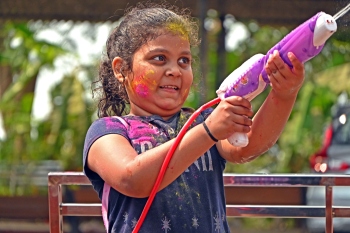
It’s the festival of colours that brings joy, laughter, and mischievous playfulness to those who celebrate it year after year during February“March. As with every festival, Holi has its own set of songs, often sung by village women in temples. In metro cities, however, the festival takes on a different avatar.
One of India’s most vibrant celebrations, Goa too immerses itself in the festivities each year. The festival spans two days”day one is Holika Dahan, and day two is Dhulawadi or Dhuleti, when people sprinkle coloured water and powder on each other in joy and excitement.
Holi is an emotion experienced across India, transcending communities, cultures, and regions, even though modes of celebration and rituals may vary slightly.
The underlying spirit remains the same. Whether traditional, grand, or subtle, the festival brings communities closer. Temples and residential complexes come alive, blending tradition with modernity. Applying colours is not just playful”it symbolises the spread of positivity and happiness, celebrating unity beyond social barriers. It reflects inclusivity, and there is no age limit”young and old alike revel in the festivities.
Gulal, puranpoli, thandai
After the symbolic bonfire ritual on the previous night, the next morning marks Rangwali Holi, the main celebration when people play with gulal (dry colours) or coloured water. This year, it falls on March 3, when the streets of Goa will echo with youth shouting “Holi Hai” and playfully tossing water balloons, even at commuters on public transport. At home, women prepare puranpoli, a sweet made of gram flour, jaggery, and wheat flour or maida. In some temples, thandai”a cooling milk-based drink with dry fruits”is distributed to visitors.
Chief Minister Pramod Sawant and Sulakshana Sawant will participate in Rangotsava, to be held at Ravindra Bhavan on March 3 from 9 am to 12 noon. The programme will include competitions for women, children, and the elderly, along with prize distribution. For children, two artificial ponds will be created, alongside live music performances and other activities. The event is open and free to all, as announced by vice president Dattaram Chimulkar and coordinator Amol Betkikar.
Markets all set for sale
Markets are brimming with Holi essentials”gulal, colourful masks, water sprayers (pichkaris), and puja items. Natural colours made from flowers, fruits, seeds, leaves, and tree bark are chemical-free, non-toxic, and gentle on the skin and senses.
In Panaji, natural colours are priced at around Rs 500 per kilo, while synthetic ones are available from Rs 120 per kilo, with smaller packets priced at Rs 50. Though more expensive, eco-friendly colours are increasingly preferred over chemical variants that can harm the skin, eyes, hair, and lungs.
Water guns are available in various sizes starting at Rs 80, while T-shirts range from Rs 50 to Rs 300 for festive wear. Masks start at Rs 100, and traditional gulal costs around Rs 50 per quarter kilo. Attractive gift hampers, priced between Rs 150 and Rs 300 for 250“300 gram packs, are also in demand.
Prayer to deities
Village communities across Goa celebrate Holi in unique ways. In Canacona, the Velip community worships deities located on hilltops in the Danda area. Historically, they moved there to protect their deities from Portuguese rule, later settling at the foothills while the deities remained above. During Holi, they carry a mango branch, circle the deities, and offer prayers before lighting a ceremonial fire with the branch and surrounding grass. Representatives from each area then break a stone at the base of the Holi. Unburnt mango leaves are worn by women in their hair, while men apply ash to their foreheads. This tradition remains entirely nature-friendly. On Zatra day, devotees offer fruits and seek blessings.
Playing a safe Holi
“Removing colours from the skin can be difficult, especially if they are chemical-based, as they may cause allergies if left unwashed. I follow a method that helps prevent rashes. First, remove dry colour from the hair and skin using a cloth. Then apply coconut oil or a mixture of besan, curd, and lime juice. Avoid using chemicals, petrol, or detergents. If colour enters the eyes, rinse with fresh water; if irritation persists, use rose water or eye drops. After washing the hair, oiling the scalp helps retain smoothness,” advises Ashwini Painginkar, who, despite coming from a large joint family and actively participating in Holi, ensures she follows these precautions.


