


A moving car stops at a remote, lonely corner, pulls down the windowpane, and throws a plastic bagful of garbage before swiftly moving away in the wee hours. People drink beverages and throw the bottles anywhere, without waiting to spot a dust bin. Gardens are full of junk food wrappers. Beaches have used water bottles and beer cans. Hospitals generate bio-degradable waste. Every hotel and home also generates a lot of plastic, metal, glass and wet waste. Educational institutions and offices generate E-waste. Where does all of this go? Is Goa capable of handling its waste?
Responsibility With Citizens
If each one of us is aware enough that we have to be responsible citizens and not litter wherever we go, carry our own water bottles, and bring back the waste that we create to dispose of in a thoughtful manner, the State would remain clean and beautiful as it was a few years ago.
Even a single citizen can sow this thought in the minds of others around him or her, making them aware and vigilant civilians.
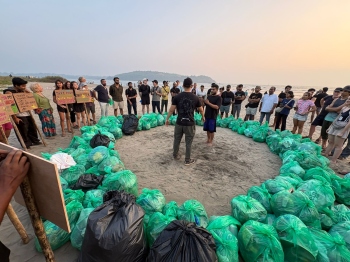
Dr Ashish Narvekar has been an ideal example of initiating a lone clean-up drive single handed, and now joined by hundreds of enthusiastic volunteers. Dr Narvekar, who works at the TB Hospital in Taleigao, recalls joining a clean-up drive in 2023, which inspired him to start organising such drives himself, appealing on social media for people to join him.
“My first beach clean-up was in 2024 where we cleaned Hawaii beach. More people started coming on board and we organised more drives in the following months. I had never envisioned that I would pioneer something like this. It’s a philosophical thing ” to be conscious and aware of our surroundings and take care of it,” says Dr Narvekar, who is saddened to see Goa being littered even in isolated hidden spots.
Volunteers Join In
Goa used to be a much cleaner place but in the past 10 years one can see trash everywhere ” streets, beaches, waterfalls, mentions Dr Narvekar who is also a part of a hiking group, and takes a trash bag with him and wherever he sees garbage, he picks it up.
He is happy that for the past few months more than 100 people join him in his clean-up drives across Goa. “It’s a wonderful thing to know that people do care. They want to make a difference to the environment they live in,” he quips.
Tech-driven Solutions
Various NGOs and start-up companies are supporting the State initiatives of garbage management through waste collection, segregation and disposal. Some of them recycle the waste and make it reusable.
Enabling cleaner communities through decentralized waste management YIMBY (Yes In My Backyard), an initiative of Inovativa Waste Aid & Management Pvt Ltd, is focused on transforming waste management through technology-driven decentralized solutions. The initiative promotes the idea that waste should be responsibly processed where it is generated, reducing the burden on landfills while converting waste into valuable resources.
YIMBY designs, manufactures and deploys innovative systems for organic waste processing, recycling and decentralized treatment, enabling villages, institutions, industries and urban communities to manage waste scientifically and sustainably.
One of their notable achievements is the WOOW (Waste of Our World) plant established at the Chicalim Village Panchayat to process organic waste locally and convert it into useful compost while ensuring efficient waste segregation and management within the village.
“This initiative has significantly strengthened Chicalim’s waste management system and contributed to its recognition as one of the cleanest villages in the region,” claims Gaurav V Pokle, founder, CEO and MD of Inovativa Waste Aid & Management Pvt Ltd.
Tackling Rising E-waste
Another part of waste is E-waste which gets piled up in homes and offices. Group Tenplus is the first e-waste collector in Goa. Founded by Ashley Delaney in 2010, this Saligao-based firm functions primarily as an E-waste dismantling and segregation facility in Goa. The electric waste collected is dismantled and separated into different material fractions like plastics, metals etc.
“Certain fractions such as plastics and some metal components are processed or co-processed within Goa itself,” says Ashley, adding, “However, specialised fractions like printed circuit boards and complex electronic components require advanced recycling technology that is not available locally. These materials are sent to authorised recycling facilities outside Goa, where specialised processes are used to safely recover valuable metals and ensure environmentally sound recycling.”
Creating Awareness
Group Tenplus collects around 80 kg per day (0.42 tons per week, or 1.8 tons per month). Collection does not happen evenly every day, as pickups depend on when organisations schedule disposal.
The group also conducts awareness sessions with educational institutions to educate people about responsible E-waste disposal, environmental impacts of improper handling and compliance under the E-waste Management Rules, 2022. “I am happy that the Goa Board has included E-waste as a part of the 6th standard NCERT syllabus,” quips Ashley.
Changing Mindsets
According to Dylan Fernandes, waste management is simple, but we often complicate it. Dylan, who began working in waste management in 2018 as an engineer with the Goa Waste Management Corporation (GWMC), shares that waste management was hardly discussed or seen as a priority by many because it was not a part of mainstream school education, which resulted in limited awareness and understanding of the subject.
“Over the years, awareness has certainly grown and conversations around waste management have become more common, however despite this implementation on ground is still a challenge,” says Dylan.
As the nodal agency established by the Goa government, the GWMC plays an active and supportive role in waste management, remarks Dylan who has consistently advocated for systems that aim for zero waste to landfill.
“Through my efforts in the past 7-8 years, over 10,000 tons of waste has been channelized for processing, that would otherwise have ended up in a dump yard or a landfill,” boasts Dylan, pointing out that at the heart of the issue lies mind-set and behavioural change.


