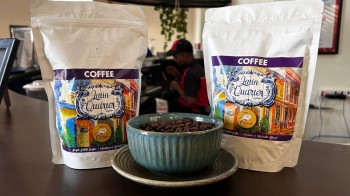
Fresh coffee has a character of its own. Roast it close to where it is served, and the difference is easy to notice. The aroma is stronger, the flavours are clearer, and the cup simply feels more alive.
That belief sits at the centre of Latin Quarter Coffee, a Goan coffee brand started in 2019 by Carlos Noronha. But the story actually begins a few years earlier, with a small café in Panaji.
In 2015, Noronha opened Caravela Café with his father and brother. The idea was straightforward: serve a good cup of coffee and a solid breakfast. The space itself came almost by chance. The family had rooms in the building that were being rented out, and the ground floor below was empty.
“My father had the vision of starting a café there,” Noronha recalls. “The main intention was simple. Serve good coffee and a good breakfast.”
The café began modestly. A few breakfast dishes, coffee, and some desserts. But customers responded quickly, and the menu slowly expanded.
“We started with sandwiches and breakfast,” Noronha says. “Then we added pastas, pizzas, and burgers. We kept taking feedback from customers and building the menu.”
Today, the café has grown into a small chain with outlets in Panaji, Candolim, Margao, and Varca. Despite the larger menu, coffee and breakfast remain at the heart of the brand.
It was while running the café that Noronha noticed a gap in the coffee supply itself.
“Most cafés in Goa were getting roasted coffee from other states,” he explains. “Even we were doing the same initially. But there was always a delay between placing the order and receiving it. By the time the coffee reached Goa, the freshness and flavour had already dropped.”
That realisation led to a new idea: roast coffee locally and supply it fresh.
“So we started Latin Quarter Coffee in 2019,” Noronha says. “The aim was to roast coffee in Goa itself so that cafés and customers could get it much faster.”
The brand now focuses on five types of coffee. Three are single-origin Arabica varieties, one is a blend, and one is Robusta. Each is roasted differently depending on the character of the beans.
Some are roasted light to preserve delicate notes, others medium for balance, and one is roasted darker for those who prefer a stronger cup.
Roasting happens in small batches, something Noronha believes is essential for quality.
“When you roast in smaller batches, you can control the process better,” he says. “Even a few seconds can change the flavour profile of the coffee, so we keep a close eye on it.”
Freshness is another priority. Orders are usually roasted the same day they are received.
“If someone places an order today, we roast it today,” Noronha says. “We don’t keep large quantities of roasted coffee sitting around. Whatever remains is used in our cafés.”
That approach means the coffee supplied to customers is rarely more than ten days old.
The beans themselves come from a farmer in Coorg with whom Noronha has worked for several years. Over time, that relationship has grown into a reliable partnership.
“They supply us good quality beans that are graded before they are sent,” he explains. “There are different grades like AAA, AA, and single A. Those are the ones we work with.”
Behind the scenes, the roasting remains a hands-on process. Noronha oversees everything himself, from sourcing the beans to roasting and packing them.
“Right now I am doing the whole process,” he says. “Roasting takes time to master. If you want to train someone, they need to spend quite a while learning it.”
Latin Quarter Coffee’s blend carries notes of dark chocolate along with mild fruity tones. But Noronha says people should not worry if they cannot immediately identify those flavours.
“Your palate develops with time,” he explains. “Sometimes people expect to taste chocolate or fruit immediately because it’s written on the label. But it takes a little practice to recognise those notes.”
For him, coffee is ultimately about the experience rather than technical descriptions.
“I always say coffee is a hug in a mug,” he says.
Today, Latin Quarter Coffee supplies beans to cafés and customers across Goa. Retail packs of 250 grams are available at the cafés and online through Amazon, while cafés can order larger one-kilogram bags.
Noronha hopes to expand that network as Goa’s café culture continues to grow.
“There are many new cafés opening now,” he says. “If they want something that is locally roasted and fresh, they can approach us, and we can work together.”
What started as a simple response to a freshness problem has now become part of Goa’s evolving coffee culture. And at the centre of it is a roaster who still stands by the machine, carefully watching each batch, making sure every cup begins the way it should.