


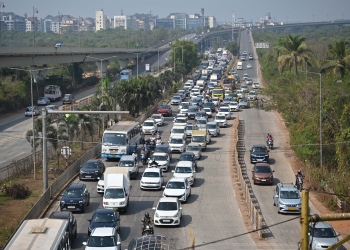
The road can teach one much about human behaviour. In Goa, given our poor public transport, personal and commercial use of two- and four-wheelers has risen exponentially every single year. You will see more people travelling on the road than walking on the footpath. In this transit, usually there is no performance display nor portrayal of being on one’s best conduct. Therefore, there is a chance that you will get to see plain, unfiltered human nature.
Travelling between Panaji and Mapusa for work for over two decades has allowed me to observe people on the go. Displaying raw emotions ranging from aggressiveness to kindness, I would like to highlight typical driving patterns and the possible reasons behind them.
Driving indiscipline is something that is constantly in the news. Our roads are not built for the volume of traffic they handle. Riders and drivers are constantly jostling with each other. The ‘scarcity theory’ would indicate that when road space is limited, there is competition among its users for the same. And that’s why perhaps even the mildest incidents can flare up into ugly road rages.
Then comes the category of people who are always in a hurry to get to their destination. Cab drivers racing towards the airport fit this description. They may not really be late, but it is in their DNA that they have to drive at that rocket breakneck speed. Posing strong competition to these car and bus drivers are those who transport children every morning to and from school. Often, I see parents trying to dodge and squeeze between vehicles, breaking traffic signals when they are running late just to get their kids to school on time. The thought that nothing bad will happen as a result of taking such risky decisions reflects some ‘optimism bias’, and sadly their priority is punctuality at the cost of limb and life.
Being a woman driver comes with its own set of challenges. Heaven forbid, should they overtake a male driver, something just awakens in him. She will be pursued till she is overtaken again. You see, often one’s car is seen as an extension of oneself. Being overtaken by a woman poses a challenge to one’s masculinity and hence the need to restore it at once. This behaviour is called ‘defensive acceleration’, driven by a bruised ego. There is this tendency to assume women are bad drivers with poor road judgement. No doubt there are just as many bad women drivers as there are men. This biased attitude against women drivers will take some time to shake off. In the meantime, most are preoccupied with being united in bias towards vehicles bearing out-of-state registration numbers. How dare these outside visitors drive recklessly on our roads? ‘Territoriality’ in its full form of display.
However, lately I have also noticed a change towards better driving ethics on the Mapusa-Panaji construction-laden highway. Often driving bumper to bumper, the impatient honking has decreased and there is a peaceful pace of moving along together. I see some drivers allowing vehicles waiting on the sidelines to cut in and a grateful wave received in return. The help offered in the event of a breakdown of a vehicle and accidents reflects the ‘altruistic nature’ of people.
Striking was a recent incident earlier this month. During the morning rush, the door of a van swung open, scattering premium bouquets of red roses all over the road for a few metres. The lone driver looked helpless. The traffic came to a standstill, and people got out of their vehicles to help him pick up the flowers. And only when every single rose was picked up did the traffic start in the most orderly manner. Not a single honk during this time. It speaks volumes of the goodness of human nature. And then there was one Charlie recording this on the mobile. ‘Bystander OCDs’ nowadays!
(Associate Professor and Head of Department of Psychology at St Xavier’s College, Mapusa)


