The demonstration during the recent legislative assembly deliberations on March 6 in Goa caught many politicians off guard within the House. The sit-in by the four protesters was an attempt to disrupt normal proceedings to call attention to the perceived threat to their village, Mirabag, that would be affected by the proposed dam project. And their protest did receive attention in subsequent newspapers and social media.
Protests date back a couple of centuries, but in our country, perhaps the most famous form of protest was the Salt March by Gandhi in the months of March to April of 1930. The march was organised to oppose the monopoly of salt manufacture by the British, combined with the heavy taxes on its sale.
Salt, being the most common and perhaps cheapest ingredient in the Indian home, prior to this move by the then coloniser, now came at a heavy price that burdened the poor man.
While on the surface, most protests appear to be economical and political in nature, the behaviour underlying the protest itself stems from fundamental psychological processes.
A protest is usually never a first step but rather one of the last resorts people literally succumb to when all other means of being heard or being understood have failed. When people experience a gap between expectation and reality, and this perception is shared collectively, then there is a high chance that they will move together to form a protest.
Protests don’t just happen casually. There is a set of conditions that accompany it, and many of these conditions are emotionally charged. Fear, anger, frustration and sheer helplessness towards something or someone ignite this behaviour. Public protests are usually a sign of unrest towards a perceived wrongdoing that spurs one to some kind of action in the hope of being heard and the problem at hand being eventually resolved.
While the world is not really a just place and there are visible instances of injustice and inequality all the time, not all these necessarily result in protests. So, there is something else that is required to ignite a rally, and that usually is a sense of deprivation and scarcity coupled with a need for survival and preservation.
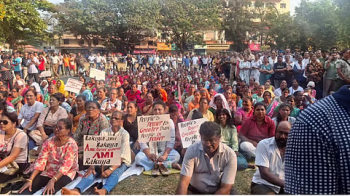
Goa has witnessed several public protests in the last few years and recent weeks. Goans have come to the roads and maidans for protests regarding various concerns. While these protests might be justified, they lose their purpose if they are misused as political weapons by parties to target each other.
Rallies and demonstrations reflect the mood and emotion of the people. It is, after all, a powerful form of public expression. Who can forget the protests over the killing of Jessica to the nationwide rallies in support of Nirbhaya?
These protests made sure that public morality did not die. Admittedly, protests can also result in chaos, damage and the derailment of their very own purpose, besides creating a sense of fear among those who do not agree with the proponents of the protest.
One must remember that a protest is a public right to be protected, and it should be treated as a sharp and important tool for the transformation of society. It can be a catalyst to bring people to the table, shift public opinion and demonstrate the power dynamics of a collective public action.
Who can forget the 2020-21 protest by the farmers, who solely on the basis of a sustained, peaceful and disciplined protest, won the hearts of the people all over the country and managed to change government policy? Finally, a protest reminds us that when ordinary voices rise together along with the grit of the human spirit, it can rewrite and change destiny for a better tomorrow.
(The writer is Associate Professor and Head of Department of Psychology at St Xavier’s College, Mapusa)