EQ is the ability to recognise, understand, and manage our own emotions, while also being aware of the emotions of others
=It was a bright young student. Top of the class. Disciplined. Focused. The kind every parent feels proud of. One examination did not go as expected. Marks dropped — not drastically, but enough to disturb the image of “perfection.”
What followed was not anger, not rebellion — but silence. Withdrawal, self-doubt, sleepless nights! A growing belief that one failure had defined everything. The question is not about this one student. The question is — why does this happen so often today? Why are capable, intelligent young individuals struggling to cope with situations that are, in reality, a natural part of life?
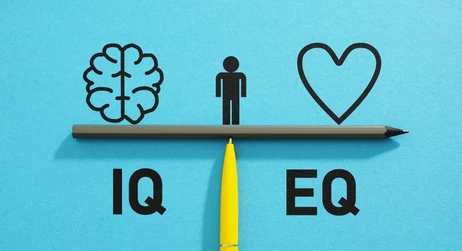
The answer lies in something we often overlook — Emotional Quotient (EQ). If Intelligence Quotient helps us think, Emotional Quotient helps us handle life. EQ is the ability to recognise, understand, and manage our own emotions, while also being aware of the emotions of others. It influences how we respond to stress, how we deal with failure, how we handle relationships, and how we make decisions under pressure.
In today’s world, emotional challenges are not occasional — they are constant. Students face academic pressure and comparison. Young professionals face uncertainty and performance expectations. Families navigate changing dynamics and lifestyles.
In such an environment, emotional strength becomes not just useful — but essential. The absence of emotional strength does not always show immediately. It often remains hidden beneath achievement. But when a challenge arises — failure, rejection, loss, or uncertainty — it begins to surface.
A small setback begins to feel like a major collapse. A moment of failure begins to feel like permanent defeat. This is not a lack of intelligence. This is a gap in emotional resilience.
Emotional Quotient helps bridge this gap. A person with strong EQ does not avoid emotions — they understand them. They recognise stress, but do not get overwhelmed by it. They experience failure, but do not get defined by it. They face uncertainty, but continue to move forward.
EQ does not eliminate challenges — it strengthens our response to them. But how is Emotional Quotient developed? It does not come from textbooks or examinations. It is built through everyday experiences.
When children are allowed to express emotions without fear, they develop awareness. When they are guided through failure instead of being shielded from it, they develop resilience. When they are taught to reflect instead of react, they develop control.
Unfortunately, in our effort to ensure success, we sometimes protect children from discomfort. We solve their problems too quickly. We remove obstacles before they can learn from them. In doing so, we unknowingly weaken their ability to handle life independently. Emotional strength is not built in comfort. It is built in understanding discomfort.
It is built when a child learns that failure is not the end, but a part of growth.
It is built when they realise that emotions are not weaknesses, but signals to be understood. It is built when they learn to pause, reflect, and respond — rather than react impulsively.
In a world that is becoming increasingly demanding, emotional strength is emerging as the defining factor between those who break under pressure and those who rise through it.
Perhaps it is time we redefine what we truly value. Not just intelligence. Not just achievement. But the ability to remain steady when things go wrong.
Because life will not always go as planned. And when it doesn’t, it is not our intelligence that carries us through — it is our emotional strength.
In the next article, we will explore another critical dimension — Adversity Quotient (AQ) — and understand why the ability to face challenges and bounce back may be the single most important skill for long-term success.
(The writer is a counselling psychologist, educator and leadership mentor whose research focuses on developing stronger minds through the study and application of Human Quotients and character-building initiatives)