The Goa Project is a "community-driven un-conference that brings together creators, technologists, entrepreneurs, activists, artists and curious thinkers"
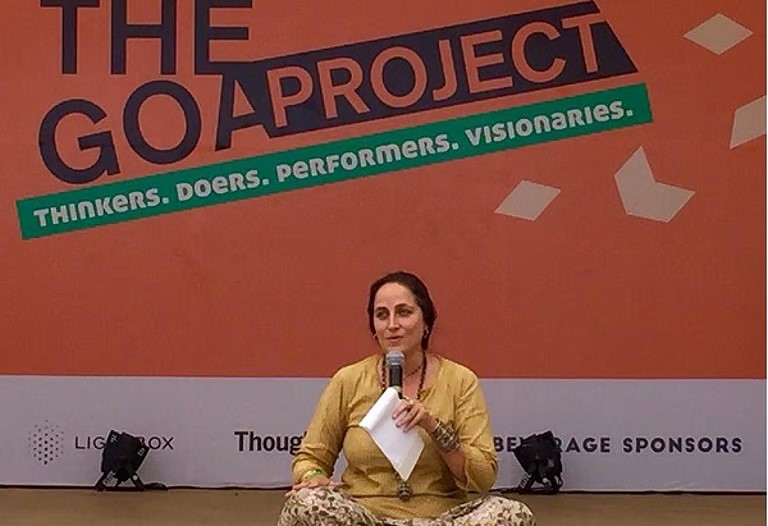
My guess is that 99.99% of the people in Goa (and most of the readers of this column too) would have not heard of The Goa Project. Yet, this "crowd-sourced un-conference" has been active since 2013, and is still going strong a dozen years later. It would not be wrong to say that it has created so many useful ideas, links and networks too.
The Goa Project describes itself as a "community-driven un-conference that brings together creators, technologists, entrepreneurs, activists, artists and curious thinkers". So, if it has some Goa link, and features the state's name prominently in its name, how has it managed to keep so under the radar, as it were?
In the past fortnight, an old friend, Uday Shankar, suggested that we discuss the early days of the Internet in India. By sheer accident of having an early-starter advantage, he felt that I could participate in that informal presentation. And I did.
It was quite a walk down memory lane, going back to the pre-2000 era. In my case, it started in 1995, and, in some ways, carries on till date. Though only feebly. At that time, a set of early expat Goans (Marlon Menezes, Herman Carneiro and Uly Menezes) set up online initiatives. They suddenly showed Goa how the (then) new cyber-technologies could bring in a communication revolution.
Marlon, who plans to observe the 30th anniversary of this event later this year, started GoaWeb. It later morphed into GoaCom. This provided employment to some local young people, and help create affordable websites for those who wanted an online presence. It had a plush office too. Uly (Ulysses) Menezes, who was a fellow alumni of Marlon at Mount Abu, set up Goa-World, a not-for-profit website related to Goa.
Herman launched Goanet, which was Goa's premier social media network together with the other two--predating Instagram, YouTube, Twitter, Facebook, WhatsApp, Snapchat, TikTok, GoogleGroups, LinkedIn, Pinterest, Reddit, Orkut, Egroups, ICQ, AOL Instant Messenger, Six Degrees, Live Journal, Friendster, MySpace, and even Google itself.
Till date, its old archives and postings give a rare insight into the the debates and opinions that raced through the Goan cyberspace of the 1990s and 2000s. Nothing lasts forever, and, today, newer forms of the social media have gone about to replace the earlier pioneers.
At the recent meeting, the dozen-and-half old timers from across India that is Bharat were joined by some pioneers. Among them was trailblazers from Goa. Prof Gurunandan Bhat, who started off as a prof of Physics, then shifted to Maths, and finally to Computer Sciences (if one got it right), was among them. I recall how amazed we were when he showed us the World Wide Web on what was then an amazing browser, Mozaic or maybe Netscape Navigator.
Joseph 'Boogie' Viegas was the hardware man, who introduced us to modems. This was a time when a "fast" 14.4 kbps US Robotics modem cost all of Rs14,000, a large chunk of our life savings while in our twenties. But very much worth it.
But The Goa Project, of course, has a wider and broader vision. See more about it at thegoaproject.wordpress.com
But the surprising thing here is not just the fact that this endeavour has covered so much ground, so consistently, and over such a long period of time. What I find interesting is that the "Goa brand", quite on its own, managed to impress a set of prominent techies and others. So much so, that they went about to create a network in its name, keeping it going and innovative, and thus adding value to Goa itself.
How does it work? It believes that people with diverse backgrounds can indeed add value to a network. So it brings together diverse thinkers, artists, technologists, and creators.
Over the years, it has hosted a wide mix of sessions. These have ranged from krav maga (the Israeli military self-defence system) workshops to teach-ins on guerrilla film-making, and from pinhole photography to design of Indian-language tech solutions.
Its notable speakers have included Vijay Nair (CEO, Only Much Louder, the company that manages artists, produces content and handles brand solutions), John Kuruvilla (ex-Air Deccan), Shiladitya Bora (PVR Directors’ Rare), and Sunita Maheshwari (Teleradio), among others.
In recent years, rather than their face-to-face meetings, the TGP sessions have focussed on monthly online meetups. They also have had debates (like ones on food influences), short talks, and hybrid workshops. This keeps the community active year round, and individuals like Peter Griffin have played a role here.
Instead of formal keynotes, rigid schedules or long PowerPoints, un-conferences favour open discussions, workshops, demos, and collaborative problem-solving. Thus, attendees are free to move between sessions or start new ones as conversations evolve.
This format encourages spontaneity, creativity and equality. Everyone is a contributor rather than a passive audience member. This makes it ideal for communities that want cross-pollination, experimentation and genuine dialogue. Or, to go beyond the traditional conference hierarchy.
Crowd-sourced means a task or idea created, funded, or solved by contributions from a large number of people rather than a single expert or organisation. By getting people from different backgrounds into the same place, there's a lot of potential benefits that come forward.
To me, this idea (and the fact that it sustained so long) was very exciting. It shows how Goa can be more than a beach-bummer's destination. It shows what is possible when some bright brains come together to discuss useful ideas (often going beyond just Goa itself). It also gives us a hint about Goa's real potential as a space to attract bright ideas, thinkers and problem-solvers.
But is Goa at all awake to such a potential?