Medical accountability cannot remain selective if public confidence in healthcare institutions is to survive
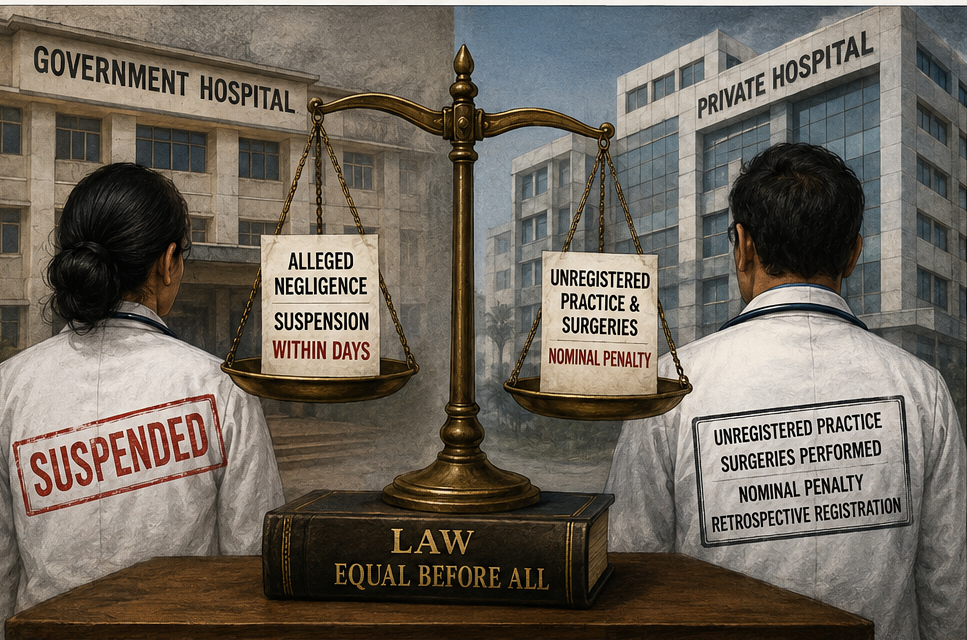
The recent suspension of Dr Yawanti Gawade by the Goa Health Department over allegations of medical negligence at the Valpoi Community Health Centre has triggered renewed public debate regarding accountability within the healthcare administration of Goa. The allegations, as reported publicly, concern treatment rendered to an 11-year-old child whose condition allegedly deteriorated into gangrene and eventual amputation of the limb.
The Health Department moved swiftly. Suspension orders reportedly followed soon after preliminary inquiry findings emerged. Administrative urgency was visibly demonstrated. Public confidence was sought to be reassured through immediate executive intervention.
Yet the larger constitutional question emerging from the controversy is not confined to the facts of one medical incident alone. The deeper concern pertains to whether identical standards of urgency are uniformly applied across all categories of medical misconduct within the State.
Differential responses
The law governing medical accountability in Goa does not distinguish between a government doctor and a private practitioner when statutory violations affecting patient safety arise. Nevertheless, institutional responses often appear dramatically different.
In another medical controversy presently pending before the High Court of Bombay at Goa, proceedings before the Goa Medical Council reportedly recorded that a surgeon had practiced within Goa for more than ten months without valid registration before the State Medical Register. The matter also allegedly involved performance of surgery during the period of unregistered practice, questions concerning informed consent, and subsequent corrective surgery at a tertiary hospital outside Goa.
Despite such findings, the disciplinary response reportedly culminated only in a nominal penalty together with retrospective registration. No visible urgency comparable to executive suspension appeared to follow. The contrast is institutionally uncomfortable.
Nature of violations
Medical negligence ordinarily concerns whether a doctor failed to exercise reasonable care expected from a competent practitioner. However, unregistered medical practice concerns something even more foundational: legality of authority itself.
A doctor accused of clinical negligence may still possess lawful authority to practice medicine. A person practicing without valid registration enters an entirely different statutory territory involving regulatory compliance, professional eligibility, and public law obligations under Section 34(2) of the National Medical Commission Act, 2019 together with Section 54 concerning cognizance of offences. The amended Section 27 of the Goa Medical Council Act, 1991 similarly contemplates regulatory action against unlawful practice.
The Indian Medical Council (Professional Conduct, Etiquette and Ethics) Regulations, 2002 further require every physician to prominently display registration details within the clinic and upon prescriptions, certificates, receipts, and medical documentation. The same ethical framework discourages opaque or improperly obtained consent procedures and recognises the importance of transparent patient communication. Informed consent cannot remain a ritualistic hospital formality executed through administrative pressure upon vulnerable patients or relatives. Ethical medicine requires that consent be meaningful, informed, voluntary, and traceable to a duly registered practitioner lawfully authorised to perform the procedure.
If the State acts swiftly in one case involving allegations of improper treatment protocol, the public may reasonably ask why comparable urgency is absent where the allegation concerns the very legality of medical practice itself.
Vicarious liability
of hospitals
The question of accountability cannot remain confined to individual doctors alone. Modern private hospitals function through institutional systems of credential verification, administrative approvals, surgical scheduling, consent management, and postoperative supervision. Where a hospital permits a surgeon allegedly lacking valid State registration to continue operating within its establishment, questions of institutional culpa and vicarious liability inevitably arise. Consumer proceedings instituted in Goa have specifically alleged that the hospital continued permitting surgical practice despite statutory irregularities, failed to ensure transparent consent protocols, and allowed postoperative complications to progress without adequate escalation. Under settled principles of hospital jurisprudence, private medical institutions cannot entirely dissociate themselves from the acts and omissions of practitioners functioning under their administrative and infrastructural supervision.
The issue therefore transcends medicine and enters the realm of administrative law. Selective governmental urgency can create the impression that accountability depends less upon the nature of the violation and more upon institutional convenience, political visibility, or public pressure.
A rural Community Health Centre doctor employed directly under the State machinery may become immediately vulnerable to executive suspension because departmental control is direct and immediate. Meanwhile, proceedings involving influential private institutions often become prolonged regulatory exercises mediated through professional councils and internal disciplinary frameworks. Such asymmetry weakens public confidence in neutral governance.
The Constitution does not permit selective intensity in enforcement merely because one practitioner belongs to the executive establishment while another operates within private healthcare structures.