India requires a mix of sensitivity and maturity for such an important decision to be taken as it involves ‘right to life’ and ‘right to die with dignity’
Harish Rana, the first person in India to be allowed passive euthanasia, passed away last Tuesday at AIIMS-Delhi where he had been receiving palliative care after his life support system was withdrawn - after being in coma for more than 13 years.
On March 11, the Supreme Court in a precedent-setting ruling allowed passive euthanasia for the 31-year old.
‘Passive’ euthanasia is the legal, and ethical practice of allowing a terminally ill patient to die naturally by withholding or withdrawing life-sustaining treatments, such as ventilators, or feeding tubes.
The Harish Rana V. Union of India case serves as a critical milestone, being the first instance where the Supreme Court applied its euthanasia framework in a practical, real-world scenario.
Apparently, the Supreme Court of India’s jurisprudence on passive euthanasia has matured from theoretical recognition to active, compassionate implementation, navigating complex ethical and constitutional terrain.
Originating with ‘Common Cause’ (2018) and applied in the historic 2026 ‘Harish Rana case’, these rulings emphasize that when medical intervention merely prolongs agony rather than offering hope of recovery, letting nature take its course is an act of compassion rather than abandonment.
“Common Cause v. Union of India,” is a landmark Supreme Court of India case that recognizes the right to die with dignity as a fundamental right under Article 21. It legalized passive euthanasia and permits ‘living wills’ (advance medical directives), allowing patients to refuse life-prolonging treatments in terminal cases.
The Public Interest Litigation (PIL) was filed by the NGO ‘Common Cause’ to protect patients from excessive, involuntary pain when recovery is medically impossible, ensuring that they could opt for a natural end.
‘Common Cause’ approached the Supreme Court of India seeking recognition for ‘living wills’ (advance medical directives) and legalizing passive euthanasia.
They argued that holding terminally-ill patients on life support against their will violates the right to dignity and privacy under Article 21, as well as the right to refuse treatment.
Rana had been in coma since 2013, when he suffered serious head injuries after falling from a fourth-floor balcony. He was an engineering student at the time.
Before his accident, Rana had not made a will specifying ‘directives for his treatment’ if he lost his ability to make decisions.
Also called a ‘living will’, this legal document allows anyone over 18 years to choose the medical care they would like to receive if they develop a terminal illness or condition with no hope of recovery.
In 2018, as mentioned earlier, the Supreme Court legalized passive euthanasia by allowing people to draw up living wills.
But since Harish Rana did not have a living will and could not consent to be taken off living support as he was in coma, his parents approached courts to allow their son’s life-sustaining system to be withdrawn. However, euthanasia is still a controversial issue around the world with big legal, moral, and cultural effects.
Euthanasia however has sparked a lot of scholarly discussion around the world, especially over its moral, legal, and constitutional effects. The right to die with dignity has been a key point in many arguments around euthanasia.
As an instance that captured the attention of the nation, the Aruna Shanbaug case sparked a debate on euthanasia in the country.
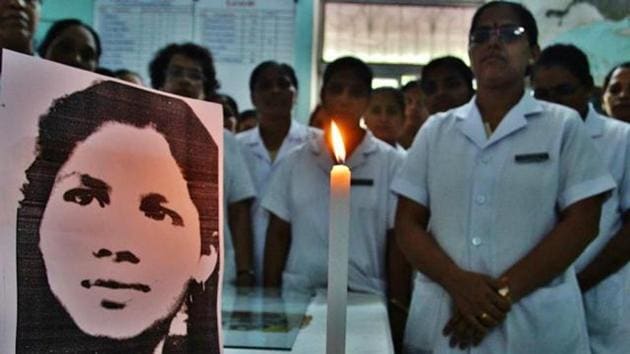
The Aruna Shanbaug case (2011) is a landmark in Indian legal history that fundamentally shifted the national discourse on euthanasia, bringing the ‘right to die with dignity’ into sharp focus.
After she spent 42 years in a persistent vegetative state (PVS) following a brutal 1973 sexual assault, the Supreme Court of India was petitioned in 2009 by journalist Pinki Virani to allow her to die.
Although the court rejected the plea to end Aruna’s life - arguing that her caregivers (the KEM hospital staff) wanted her to live - the 2011 judgment officially recognized passive euthanasia as legal in India under strict conditions and supervision.
The decision laid the groundwork for the 2018 Supreme Court ruling in ‘common cause v. Union of India’, which legalized living wills and allowed passive euthanasia under a simple framework.
It is however the central conflict evolving from whether a person has the right to a dignified exit, to how to implement this right safely without degrading the overall value of human life that still baffles the medical as well as the legal fraternity.
Let us however not confuse passive euthanasia with ‘assisted death’.
These are both distinct acts, often with different legal and procedural definitions, despite both falling under the broad umbrella of ‘merciful killing’, or ‘assisted dying’ to end suffering.
Passive euthanasia involves withholding or withdrawing life-sustaining treatment, allowing a natural death. Assisted death on the other hand, involves a person actively providing means for a patient to end their own life.
The Supreme Court guidelines on passive euthanasia is specific to the point that the decision to discontinue life support needs to be taken either by parents, or the spouse, or other close relatives or in the absence of any of them, such a decision can be taken even by a person or body of persons acting as a ‘next friend’.
The Aruna Shanbaug case established that in cases of incompetence, a ‘next friend’ (or parent/spouse) can decide to withdraw life support, but this decision must be approved by the High Court under the parens patriae (guardian of the nation) principle.
Considering that there is no point in prolonging the physical agony of a terminally ill-person and the mental torture of their loved ones, it does look appropriate to make euthanasia legal in cases where there is no scope of a patient recovering.
But as rightly put, ‘India however requires a mix of sensitivity and maturity for such an important decision to be taken as it involves ‘right to life’ and ‘right to die with dignity’.