In view of Covid, the laity has been asked to keep out extravagant display of celebration so that they don't lose sight of true meaning of Christmas
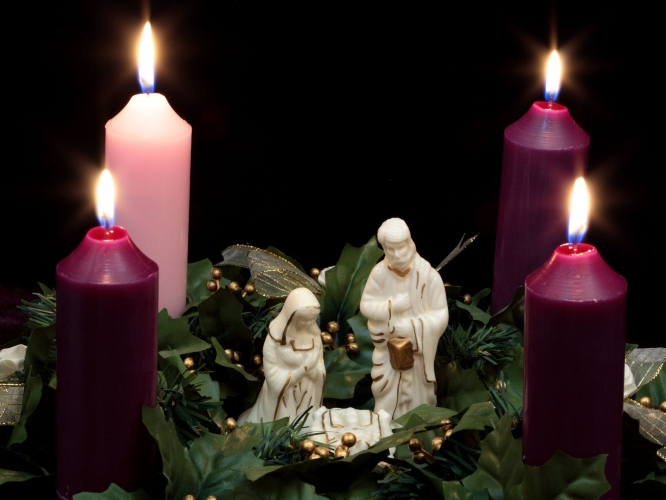
Derived from the Latin word Adventus, Advent means ‘coming’ or a time of expectant waiting and preparation to receive the Saviour. There are three different perspectives of ‘coming’ that describes Advent. Jesus’ first coming was about 2000 years ago when He came into the world as a baby to live as a man and die on the cross. During our worldly journey, he comes into our hearts through the Eucharist. The final coming is eschatological when Jesus will come back in all His glory as a King and Judge (Rev 1:7).
The Advent is the period of four Sundays and lasts until Christmas Eve. It also marks the beginning of the new liturgical year for the Church. During Advent, the clergy wears purple vestments which reflect sorrow as the faithful await the arrival of the Saviour. The Gloria — one of the most festive hymns of the Mass — isn’t sung.
The first Advent Sunday falls on any date between 27th November and 3rd December. It is uncertain when Advent was first celebrated, but it dates back to about 480 when monks were ordered to fast before Christmas. The first mention of Advent was in 300 AD at a meeting of church leaders called the Council of Saragossa, which is now called Spain.
Traditionally, the churches and homes prepare an Advent wreath nestled with four candles - three violet/purple and one pink. The German Christians used wreaths with lit candles during the cold and dark December days as a sign of hope in the future warm and sunlight days of spring. Traditionally, the wreath crown is created out of greens knotted with a red ribbon and decorated with pinecones, holly, and laurel. The crown is the symbol of Christ the King, the holly represents the crown of thorns resting on the head of Christ. The green twigs are a sign of life and hope, while the fir tree is a symbol of strength and laurel a symbol of victory over sin and suffering. The wreath reminds us of Gods’ eternity and endless mercy.
Each candle represents one thousand years, so the four candles complete 4000 years from the time of Adam and Eve until the birth of the Saviour. The progressive lighting of the candles symbolizes the expectation and hope to surround our Lord’s first coming and the anticipation of the second coming. The flame of the candle reminds us that Jesus is the light of the world and that if we follow Him, we will never walk in darkness, but will have the true light of life.
The lighting of the candle of hope or “Prophecy Candle” on the first Advent Sunday, reminds us of the prophets, primarily Isaiah, who foretold the birth of Christ (Is 7:14). The second candle represents faith and is called Bethlehem’s Candle which symbolizes that the Messiah would be born in Bethlehem (Lk 2:12). The third candle symbolizes joy and is called the “Shepherd’s Candle” which is lit on the third Sunday (Lk 2:8–11). The “Angels Candle” is lit on the fourth Sunday, which conveys the message of the angels: “Peace on Earth, Good Will Toward Men” (Lk 2:13–14).
The readings on the First Advent Sunday focus on “End Times” and the coming of the “Day of the Lord” (Mk 13:33-37). Second Sunday of Advent, the Gospel readings focus on the preaching and ministry of John the Baptist as the forerunner of Jesus, the one who came to “Prepare the Way of the Lord” (Mk 1:1-8). On the third Sunday, the Gospel readings continue to focus on John the Baptist, while the first and second readings convey the joy that Christians feel with the increasing closeness of the incarnation and the world’s salvation (Jn 1:6-8, 19-28). On the fourth Sunday, the Gospels tell of the events that immediately preceded the birth of Jesus, including the dreams and visions of Joseph and Mary of Nazareth - “Behold, you will conceive in your womb and bear a son, and you shall name him Jesus” (Lk 1:26-38).
Keeping in mind the Covid-19 pandemic, the Archbishop of Goa and Daman has advised the faithful to be focused more on the spiritual celebration of Advent and Christmas, keeping out the extravagant display of the celebration so that we may not lose sight of the true meaning of Christmas. He has appealed to the flock to use only essential, indeed necessary items to celebrate the Feast of God Emanuel, and to use the savings /resources toward the needs of the underprivileged in the parish, to create greater fellowship among all. Advent is a time to stir up our faith in the Lord. Let us prepare our minds and heart spiritually to receive Jesus with Gloria in Excelsis Deo!