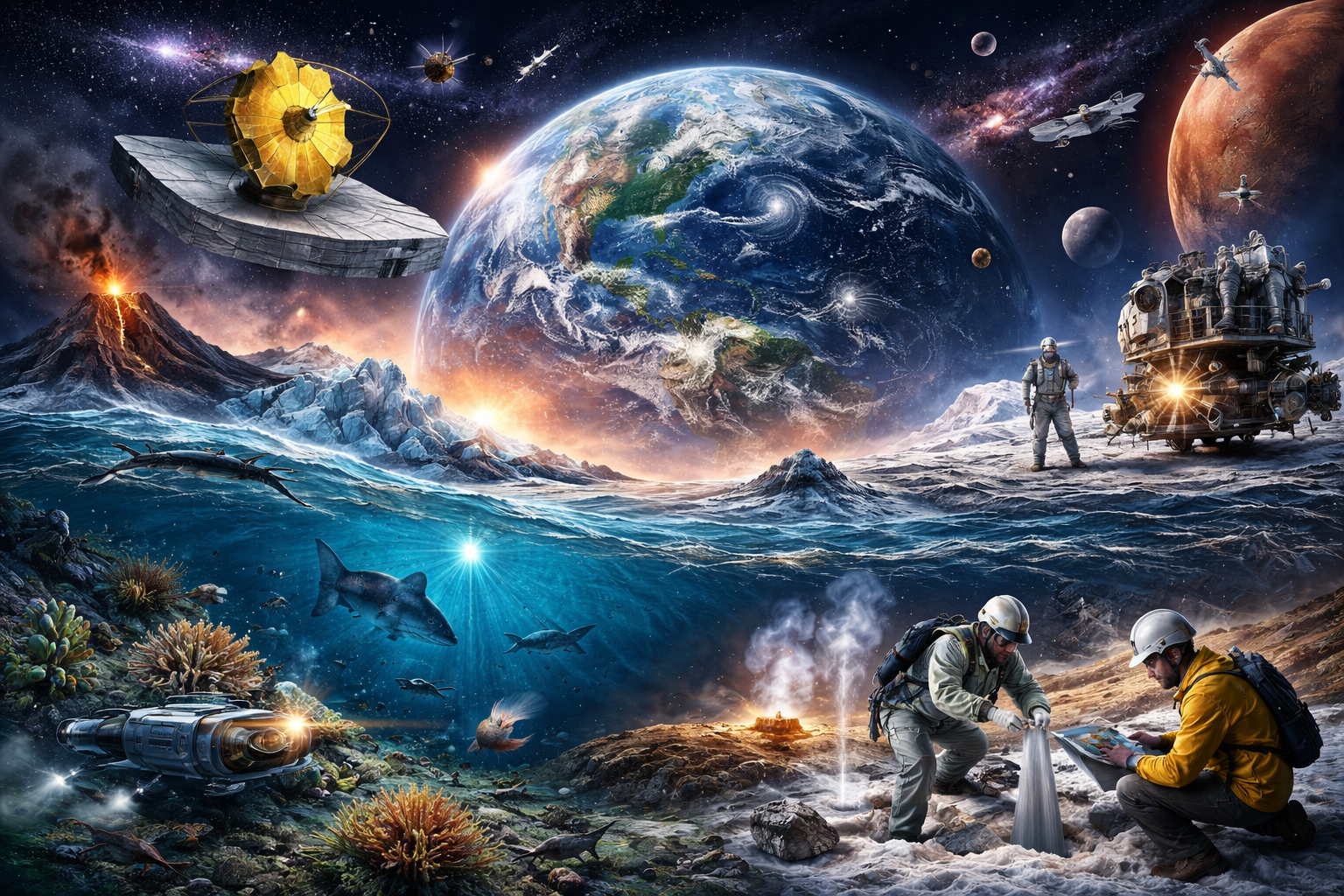
As 2025 draws to a close, advances across climate, oceanography, geophysics, cryosphere, and planetary science—fuelled by improved observations, cutting-edge computing, and cross-sector collaboration—have greatly expanded our understanding of Earth’s systems. These developments have enhanced our ability to address climate change, manage natural hazards, and promote the sustainable use of Earth’s resources.
In astronomy, the James Webb Space Telescope reshaped views of the universe by mapping exoplanet atmospheres and probing the early cosmos, revealing new details about galaxies, black holes, and cosmic structure. Astronomers tracked the interstellar comet 3I/ATLAS and gained insights into dark matter and Population III stars.
The Sun reached the peak of its solar cycle, producing intense activity. Scientists discovered a rare super-Earth in a habitable zone, identified new moons such as Uranus’s S/2025 U 1, and anticipated the bright nova of T Coronae Borealis. New tools such as the Near-Infrared Planet Searcher and the Vera C. Rubin Observatory marked a new era in sky surveys, while NASA’s Lucy mission discovered Selam, the first contact-binary asteroid.
Space science progressed through key missions. Lunar exploration saw success with Blue Origin’s Blue Ghost Mission 1, while Intuitive Machines’ IM-2 partially succeeded, delivering payloads for geology and ice studies. China’s Tianwen-2 targeted asteroid Kamoʻoalewa (2016 HO3) and comet 311P/PANSTARRS, and NASA’s Lucy conducted a fly-by of asteroid Donaldjohanson.
Mars missions included ESCAPADE, studying atmospheric dynamics, while the Perseverance rover continued searching for organic biosignatures. Earth observation advanced with the NASA–ISRO NISAR mission, supporting climate and disaster monitoring.
Both the Arctic and Antarctic showed alarming sea-ice decline. Arctic sea ice reached its lowest recorded maximum on 22 March 2025, well below the long-term average.
Although the September minimum was not a record low, it remained among the lowest observed, reflecting sustained thinning. The Arctic experienced its warmest year in 125 years, warming four times faster than the global average.
Greenland lost about 129 billion tonnes of ice, while glaciers continued widespread retreat, contributing to sea-level rise. Atlantic waters flowing northward disrupted Arctic ecosystems. In the south, West Antarctica showed rapid ice loss, and Antarctic sea ice reached its second-lowest summer minimum in March 2025, signalling a shift from traditionally stable conditions.
Ocean research revealed major discoveries, including many new marine species such as carnivorous sponges, a rare carnivorous bivalve, unusual molluscs, a popcorn-like parasitic isopod (Zeaione everta), a venomous predatory snail (Turridrupa magnifica), and a confirmed third manta ray species. Beneath Antarctic ice, scientists found a vast city of fish nests, while deep Pacific expeditions documented at least 20 new species.
Researchers also mapped unexplored seafloor regions and revealed novel ecological interactions, such as sea anemones living on tusk shells. Beyond biodiversity, studies suggested continents may split from below, fuelling oceanic volcanism.
The Southern Ocean was found to release far more CO₂ in winter than previously estimated, while deep-sea mining plumes were shown to strip nutrients from the twilight zone. The discovery of six-million-year-old Antarctic ice provided the oldest direct record of Earth’s atmosphere.
Atmospheric science highlighted accelerating climate change. Record ocean heat fuelled hurricanes beyond Category 5, extreme weather, and the largest coral bleaching event on record.
Shifting rainfall increased drought risk, while 2025 ranked among the warmest years, reinforcing warnings of a possible “hothouse Earth”.
Cleaner air was shown to accelerate warming by reducing cloud reflectivity, as SPEXone mapped aerosol–cloud–radiation interactions. Greenland and Antarctic ice sheets reached record-low mass, nearing tipping points, while the Antarctic ozone hole remained among the smallest since the 1990s, reflecting the Montreal Protocol’s success. Advances in supercomputing, AI, and global 3-km weather modelling improved prediction and satellite analysis.
Earth and geosciences recorded further breakthroughs. India tested a deep-sea mining system at 5,270 m, while the human submersible MATSYA passed stability trials. Research suggested Earth’s inner core may exist in a superionic state, with mobile carbon atoms flowing through solid iron, making it softer than assumed. Scientists also identified a hidden CO₂ sponge beneath the South Atlantic seafloor, where altered volcanic rocks store carbon for millions of years.
New simulations showed continents can peel apart from below as mantle waves strip continental roots.
Ancient Antarctic ice delivered the oldest direct atmospheric record, while Himalayan uplift was shown to have transformed Kashmir’s climate. AI, quantum sensing, and advanced geophysics transformed mineral exploration and hazard assessment, alongside new landslide forecasting and tsunami early-warning systems.
Collaboration between academia, industry, and government drove advances, highlighted by forums such as Next-Gen Geophysics 2025 in India, focusing on applying new technologies to climate mitigation, hazard assessment, and sustainable resource management. Improved seismic modelling revealed magmatic fluids can trigger earthquake swarms, such as beneath the Eger Rift.
In planetary science, the Atacama Large Millimeter/submillimeter Array provided insights into planet formation, enabling detailed studies of chemical inheritance and early planetary evolution.