If you have ever tried fixing a newer car at home”or even taken it to a trusted local mechanic”you may have noticed something: cars today are far more difficult to repair than the ones we grew up with. This is not just a feeling. It reflects real changes in how vehicles are designed, built, and controlled.
Electronics have taken over
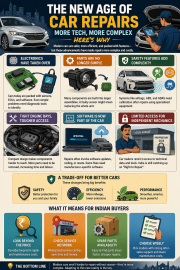
One of the biggest changes is the rise of electronics. Earlier, most cars relied on mechanical systems that could be understood with basic tools and experience. Today, vehicles are packed with sensors, electronic control units, and software.
Even a simple issue, like a warning light or poor engine performance, often requires a diagnostic scan tool. Without access to such equipment, identifying the problem itself becomes difficult. For many local garages in India, this is still a challenge.
Parts are no longer simple
Older cars had more modular parts. If something failed, you could replace just that specific component. In modern cars, many parts are integrated into larger assemblies.
For instance, a faulty sensor may be built into a bigger unit, meaning the entire assembly has to be replaced. This not only increases repair complexity but also raises costs for owners.
Safety features add complexity
Modern vehicles come with multiple safety systems such as airbags, ABS, and electronic stability control. Many cars now also include advanced driver assistance systems (ADAS).
While these features improve safety, they also make repairs more complicated. Even a small repair”like fixing a bumper”may require recalibration of sensors. This often needs specialised tools, which are mostly available at authorised service centres in India.
Tight engine bays, tougher access
Carmakers today focus on compact design and better aerodynamics. As a result, engine bays are tightly packed, and components are harder to reach.
A repair that once took minutes can now require removing multiple parts just to access the faulty area. This increases labour time and adds to the overall repair cost.
Software is now part of the car
Modern cars are not just machines”they are also software-driven systems. Many repairs involve software updates, coding, or electronic resets.
Some issues cannot be fixed without manufacturer-specific software. This creates a dependency on authorised workshops, which may be expensive compared to traditional garages. For Indian car owners used to quick roadside fixes, this is a major change.
Limited access for independent mechanics
Carmakers often use proprietary systems and restrict access to technical data. This makes it harder for independent mechanics to carry out repairs.
While the “Right to Repair” movement is gaining attention globally, India is still catching up. As a result, many owners feel tied to authorised service networks.
A trade-off for better cars
It is important to note that these changes have also brought clear benefits. Modern cars are safer, more fuel-efficient, and less polluting. Technologies like fuel injection, turbocharging, and hybrid systems have improved performance and reduced emissions.
However, this progress has come at the cost of simplicity.
What it means for Indian buyers
For Indian consumers, this creates a mixed situation. You get better features, comfort, and safety, but maintenance becomes more dependent on authorised centres.
Buyers should look beyond the purchase price. Service network, spare parts availability, and repair costs are equally important. Choosing a model with strong after-sales support can save money and effort in the long run.
In the end, modern cars are not necessarily harder to repair without reason”they are simply more complex. The real challenge is adapting to this shift, where fixing a car now requires not just tools and skill, but also technology and access.