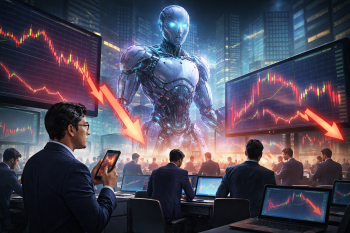
Global markets saw sharp volatility after Anthropic showcased new capabilities in its flagship AI model, Claude. The reaction was swift: software makers, IT service providers and consulting-linked counters came under pressure.
At first glance, this looked surprising. No company reported weak earnings. There was no policy shock. Instead, investors were reacting to what the technology might mean for future revenues across the industry.
For participants in the Indian stock market, especially those holding IT names, the development served as a reminder that AI disruption is moving faster than many had assumed.
What exactly did Anthropic show?
Anthropic demonstrated upgrades that allow AI systems to handle complex, multi-step professional work. Think contract analysis, document review, research support, compliance-style checks, and structured data tasks.
These are not futuristic use cases. They overlap directly with services currently billed by enterprise software vendors and IT firms.
The message traders took away was simple: if AI can perform more of this work reliably, clients may buy fewer traditional licences, need smaller teams, or renegotiate contracts.
Even the possibility of that shift is enough for markets to reprice stocks.
Why did investors react so strongly?
Valuations in global technology ” and in many Indian IT companies ” are built on expectations of stable, long-term cash flows. When a new technology hints those flows could weaken, investors quickly adjust.
Three big fears emerged:
1. Substitution risk “ AI might replace certain tools or manpower rather than just assist them.
2. Pricing pressure “ Clients could demand lower rates if automation improves productivity.
3. Shorter contracts “ Companies may hesitate to commit to long deals while tech is evolving rapidly.
Because markets look ahead, traders did not wait for actual order cancellations. They reacted to the possibility.
Why Indian IT stocks moved
Indian IT firms earn a large share of revenue from overseas clients in sectors like banking, insurance, healthcare, retail and legal services. Many of these areas are exactly where AI automation is improving fastest.
If global corporations believe advanced models can do more in-house or through cheaper digital solutions, outsourcing budgets could come under scrutiny.
That perception alone can weigh on share prices.
It is important to note that this does not mean business will disappear overnight. Large enterprises still need integration, customisation, cybersecurity, cloud management and regulatory oversight. However, the growth mix could change, and margins may face debate.
Assistive AI vs replacement AI
Until recently, the dominant market belief was that AI would help companies work faster while keeping existing vendors in place.
The Anthropic moment challenged that comfort.
Investors began asking: what if clients start skipping layers of software and service providers altogether? What if AI platforms become the primary interface?
Whether this happens or not, the question itself was enough to trigger selling.
Is the fear justified?
Markets often overshoot in the short term. New technology usually creates winners, losers and adapters.
Indian IT companies have navigated earlier waves ” from offshoring to cloud to digital transformation. Many are already investing heavily in AI partnerships, proprietary tools and workforce training.
Firms that move up the value chain, manage complex deployments and offer accountability may still remain critical.
But investors are signalling they want clearer answers on how revenue models will evolve.
What should Indian investors watch now?
Instead of focusing only on headlines about new AI releases, track:
* Management commentary on deal pipelines
* Changes in client spending behaviour
* Demand for AI integration projects
* Hiring patterns and utilisation rates
* Pricing conversations in renewals
If companies show they can monetise AI rather than be disrupted by it, sentiment can stabilise.
The bottom line
The sell-off was less about present damage and more about future uncertainty. When expectations are high, even a small doubt can move billions.
For Indian market participants, the key takeaway is this: AI progress is no longer abstract. It is entering boardroom budgeting discussions. Stocks will react each time the technology crosses a new threshold.