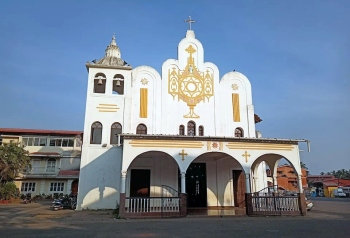
The Church of Our Lady of Health, situated at the centre of the main village of Cuncolim, is dedicated to Our Lady of Health and the Parish Feast is celebrated with great devotion on February 2 every year.
THE ORIGIN
The church was erected between November 25, 1600 and May 1604 by Dom Diogo Coutinho, during the Governorship (Up-raza) of Dom Aires de Saldanha (1600“1603). The church was later enlarged in 1630.
The first Jesuit parish priest of the church was Fr Manuel Pais (1618), while the last Jesuit parish priest was Fr Francisco Filipe (1759). In between, the parish was served by 23 Jesuit parish priests. During this period, diocesan priests also served as parish priests.
Following the suppression of religious orders in Goa, the administration of the church was taken over by the diocese in 1759.
In recent times, the church underwent major redesigning and was solemnly blessed in May 1953. Two wings were added to the structure”the first in 1953 and the second in 1967.
THE ALTARS
The original church had five altars. The main altar at the centre is dedicated to the patron, Our Lady of Health, whose image is encased in a glass case. One of the three side altars is dedicated to St Ignatius of Loyola, the founder of the Society of Jesus.
THE CHURCH
The church is L-shaped in design, owing to the addition of two new wings constructed at right angles to each other. This unique architectural layout gives the church two facades facing different directions. While the exteriors are simple, the interiors”especially the reredos (the decorative backdrop behind the altar)”are intricately designed and artistically crafted.
Originally, the church had one tower with windows housing the bells. The first bell was likely cast on November 25, 1600, and the second on May 20, 1604, coinciding with the period of the church’s construction. These bells were prepared by Bernardo Coutinho, Epifânio Coutinho from Guleakotto, and Biku Kansar from Savorkotto Vaddo. On the front façade of the church is the image of the Holy Spirit in the shape of a dove.
THE FEAST
The annual feast of Our Lady of Health is a unique inter-religious celebration for the villagers of Cuncolim. It serves as a unifying event that includes both Hindus and Catholics, becoming a true rallying point for the entire village.
THE PORTRAIT
The portrait of Our Lady of Health, displayed on the feast flag, originally belonged to the late João D’Souza, in front of whose house the celebrations were once held. After the tragic death of his only son while studying in Mumbai, his wife, late Feliza D’Souza, discarded the holy portrait.
The portrait was later salvaged by the descendants of Arrum Vaddo, Dandora, restored, and eventually housed at its present location”the residence of Athanasio D’ Souza. Initially, during the Maddi celebrations, the portrait was hung on a coconut tree; later it was placed on planks over chairs, and today it is kept on a table at a permanently floored site. Many devotees make vows here, firmly believing that the patroness never fails those who seek her intercession.
The Maddi begins at 5 pm and continues until midnight, and at times into the early hours of the following morning, depending on the number of devotees present. After the veneration and kissing of the holy portrait, it is taken back to the house of Athanasio D’Souza, located just a few metres from the veneration site.
THE VESPERS
The privilege of conducting the Vespers remains, to this day, with the family of João Miranda, who served as the Regidor during the Portuguese period. As he had no children, the tradition has been faithfully continued by his sister’s descendants.
On this day, following the evening Mass, the statue of Our Lady is taken in a grand procession through the village. During the procession, Hindu shopkeepers pay their respects by lighting candles outside their shops, further highlighting the spirit of communal harmony.
The following chapels fall under the jurisdiction of the Church of Our Lady of Health, Cuncolim: Sacred Heart Chapel (Kulvaddo), St Francis Xavier Chapel (Middle Vaddo), Infant Jesus Chapel (Murida), Our Lady of Piety Chapel (Panzorkonni), and Holy Family Chapel, (Sanvorkotto Vaddo).