PANAJI
On April 9, voters in Ponda will head to the polls for a bye-election that has quickly become one of the most closely watched contests in Goa.
Triggered by the passing of veteran leader and former chief minister Ravi Naik, the election is ostensibly about filling a vacant seat. Yet, in reality, it is about much more: dynastic politics, party discipline, defections, grassroots grievances, and the looming shadow of the 2027 general assembly elections.
For Chief Minister Pramod Sawant and the ruling Bharatiya Janata Party (BJP), the bye-election is a test of whether their bet on legacy politics can trump cadre loyalty. For the Opposition Congress, it is a chance to prove it can still hold ground despite defections that have hollowed out its ranks. And for the Aam Aadmi Party (AAP), the only other party in the fray thus far, it is an opportunity to position itself as a credible alternative in Goa’s fragmented political landscape.
The contestants: Legacy, renewal, disruption
The BJP has chosen Ritesh Naik, son of the late Ravi Naik. His candidacy leans heavily on his father’s towering legacy in Ponda, where Ravi held sway for decades across party lines.
Yet, the choice has sparked dissent within BJP ranks, particularly among cadres loyal to Vishwanath Dalvi, the party’s South Goa district president and a long-serving worker overlooked for the ticket. Dalvi is unlikely to rebel, but signs suggest enthusiasm among his supporters may dip.
Congress has turned to Dr Ketan Bhatikar, a physiotherapist who contested Ponda in 2022 on the Maharashtrawadi Gomantak Party (MGP) ticket but lost to Ravi Naik by just 77 votes. Bhatikar switched to Congress last week after in the period following Ravi's death it became evident to him that MGP would not field a candidate, given its supremo Sudin Dhavlikar’s presence in the BJP-led coalition as a cabinet minister.
Bhatikar says his campaign will emphasise local issues, but strategists admit they will seek to capitalise on BJP’s internal discontent during the three-week campaign besides having to work hard to keep the loyal Congress support base intact.
AAP has announced Geetesh Naik as its candidate, a recent entrant into the party. Though unlikely to win, he is expected to play disruptor, cornering votes and complicating the arithmetic in what is otherwise a two-horse race.
The town’s shifting sands
Ponda’s electoral history mirrors Goa’s larger churn.
In the 1960s “ 1980s, the MGP dominated until Congress wrested it in 1980 through the late Joildio Aguiar, who defeated Ravi Naik then of the MGP. Ravi bounced back in 1984, winning on the MGP ticket before shifting to Marcaim in 1989 after delimitation. Shivdas Verenkar then carried the MGP baton in Ponda, winning in 1989 and 1994.
From 1999 onwards, Ravi Naik became Ponda’s towering figure. He won four of five contests on the Congress ticket, losing only in 2012 to MGP’s Lavoo Mamledar. In 2022, he painted Ponda saffron, winning on the BJP ticket by a wafer-thin margin of 77 votes.
This history makes Ponda a constituency where personal loyalty, legacy politics, and party allegiances intersect in unpredictable ways. The April 9 bye-election is unlikely to be any different.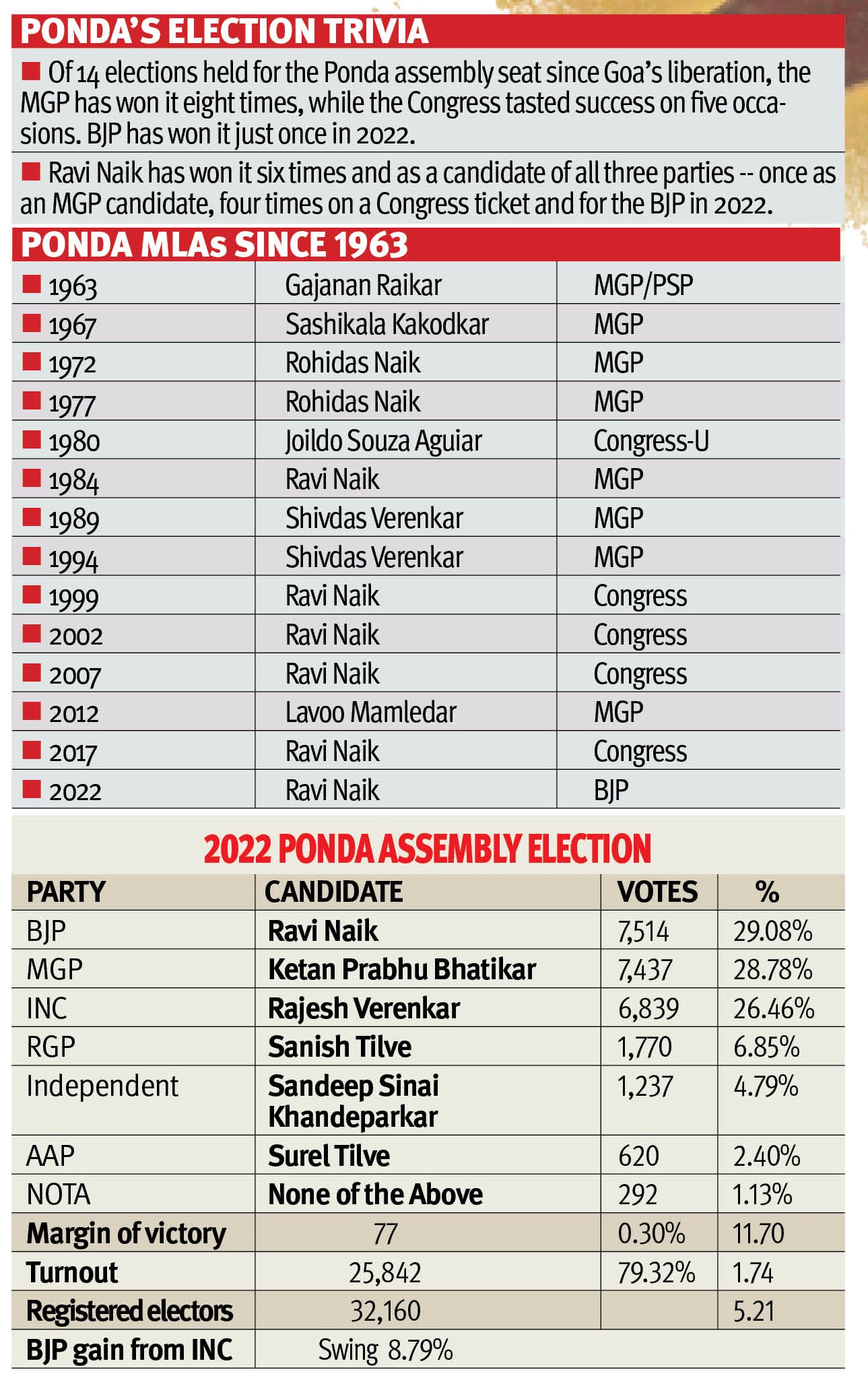
Dynasty vs grassroots
BJP’s choice of Ritesh Naik over loyalist Vishwanath Dalvi has unsettled a section of the saffron party’s otherwise disciplined cadre. Dynastic politics is not new to Goa, but sidelining a grassroots worker has raised questions about the party’s commitment to cadre loyalty.
Governance concerns
The abrupt curtailment of the Goa Assembly’s budget session due to the Model Code of Conduct has given Opposition parties ammunition to argue that governance is being sidelined for electoral reasons. While its impact on Ponda’s turf is debatable, civic issues -- roads, water supply, waste management -- are expected to dominate the micro campaign narrative.
Shadow of 2027 assembly elections
With the general assembly elections less than a year away, this bye-election is widely seen as a symbolic trailer. Political parties may interpret the result as a barometer of public sentiment. Yet, several veteran journalists caution against overstating its significance, arguing the outcome is unlikely to reflect State-wide sentiment.
Local grievances
Infrastructure gaps, unemployment, and municipal management remain pressing concerns in Ponda. For many voters, these issues matter more than party labels. However, whoever wins as MLA is unlikely to achieve much in the 11-odd months tenure he will get until the general election in 2027 and in that sense may not be much of a factor.
Congress’s defection dilemma
If BJP faces resentment over its candidate choice, the Congress faces scepticism of a different kind. Over the last two terms, mass defections by its MLAs to BJP have eroded its credibility, leading many loyalists to wonder whether electing a Congress candidate guarantees opposition to BJP.
The party has labelled defections a “political malaise” in the past but has yet to overcome the phenomenon. Whisper campaigns have already begun, painting Dr Bhatikar as a potential Trojan horse. The challenge before him and the Congress is to overcome this credibility gap and convince voters he will stay.
BJP’s Dalvi factor
The BJP prides itself on discipline, but Ponda has exposed cracks. Dalvi, overlooked for the ticket, remains loyal but visibly hurt. Cadres aligned with him may show reduced enthusiasm -- a risk given the razor-thin margin in 2022.
The party’s gamble on dynastic continuity could consolidate Ravi Naik’s loyal vote bank in Ponda but it also risks alienating grassroots workers. The bye-election will test whether BJP can paper over these cracks.
Political mood ahead of 2027
The bye-election is not happening in isolation. For BJP, a victory would cement its dominance and validate its bet on dynastic continuity. For Congress and other anti-BJP forces, a win would be a morale booster, signalling resistance to BJP’s juggernaut. For the AAP, even a modest vote share would help position it as a credible player in Goa’s contemporary political landscape.
The outcome will be dissected as a preview of the 2027 assembly elections, making Ponda’s voters unusually influential in shaping the political narrative in the months after May 4, the day counting will be taken up and the results known.
Voices from Ponda
“We want development, not just politics,” said a shopkeeper in Ponda’s main square, not wanting to be named as most small businessmen desire at election time.
A former councillor and Congress loyalist from the town argued that the party erred in its choice of candidate:
“Why should we trust an eleventh-hour entrant? Rajesh Verenkar did creditably well in 2022, falling just 600 votes short. He would have been a trusted and safer bet,” he said.
Voices of dissent against BJP’s choice are also more audible. “Dalvi deserved the ticket. Ignoring him has upset many of us,” admitted another shopkeeper, a BJP mandal member.
These voices capture the mood: scepticism, frustration, and cautious hope.
On the campaign trail
With less than three weeks to go, Ponda’s streets are yet to show the usual election frenzy. Supporters of all three parties are sporadically visible, engaging voters in colonies, the streets and the marketplace.
BJP’s campaign machinery is expected to flex its organisational muscle once Ritesh files his nomination, likely on Monday. Congress workers are scrambling to design their campaign and logistics, while AAP volunteers, though fewer, are visible with their trademark insignia.
The atmosphere is somewhat tense. Tea stalls and restaurants buzz with speculation, with locals debating whether “Patrao’s” dynasty will prevail.
A contest of symbols
The April 9 bye-election in Ponda is more than a contest for one seat. It is a referendum on dynastic politics, party discipline, and voter trust. It will test whether BJP’s gamble on Ritesh Naik pays off, whether Congress can overcome its defection stigma, and whether AAP can carve out space in Goa’s crowded political landscape.
For Ponda, the choice is stark. For Goa, the result will echo far beyond the constituency’s borders, setting the tone for the bigger battles to come in 2027.