PANAJI
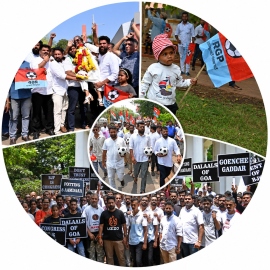
In Goa’s restless political landscape, the Revolutionary Goans Party (RGP) was hailed as a fresh breeze ” a grassroots outfit that dared to challenge entrenched players with a fiery mix of identity politics and all sorts of son-of-the-soil rights activism, often bordering on racism.
Founded in 2017 and registered as a political party in 2021, it made its mark in the 2022 Assembly elections when its candidate, Viresh Borkar, wrested the St Andre seat and earned the fledgling outfit recognition as a State party.
But less than five years into this journey, the RGP is now engulfed in a bitter internal war that has spilled dramatically into the public domain. The trigger was the simmering discontent over disciplinary action taken by the party against Julius Almeida, a panch from Agacaim and a known Borkar supporter.
It then erupted into a full-blown confrontation between party president Manoj Parab and MLA Borkar, exposing deep fissures that threaten the party’s political survival and could reshape the contours of Goa’s anti-BJP space.
The flashpoint
The feud’s origins lie in the expulsion of Almeida, a panch member from Agacaim (St Lawrence) and a staunch Borkar loyalist. The party’s core committee accused Almeida of “anti-party activities” and showed him the door, announcing that he never was, and is not, a member.
The move unsettled grassroots workers in St Andre, where Almeida enjoys local support, and left Borkar visibly upset. Initially, Borkar sought to downplay the discord, insisting “all is well” within the party. However, Parab’s subsequent social media offensive reignited tensions.
In blistering posts, Parab accused Borkar’s allies ” North Goa general secretary Licio Roncon, Dagley Fernandes from Salcete and Michael Queros from Bardez ” of “brainwashing supporters on religious lines” and leaking internal party emails to the media.
Parab's language was sharp, even personal. “Life was given for the party, not for positions,” Parab thundered in one post, before challenging his detractors to explain themselves. His supporters, including general secretary Vishvesh Naik and treasurer Ajay Kholkar, amplified the attack online, demanding accountability from some in Borkar’s camp.
Grassroots vs leadership
The St Andre block, however, rallied behind Borkar. In a strongly worded letter, it condemned Parab, Naik and Kholkar for making “defamatory and baseless allegations” against the MLA and his aides.
It accused the leadership of failing to act against those targeting Borkar publicly through Facebook accounts, some of which were allegedly fake. The St Andre block also publicly advised Borkar to boycott all official meetings of the party's 'central executive committee' until differences were resolved.
This has been the most open display of factionalism within the party yet. What was apparently simmering quietly erupted into a confrontation between grassroots workers and the central leadership.
Borkar himself, after weeks of silence, finally stepped into the fray with a cryptic social media post: “First came the issue of Article 39(A), now its side effects are visible.”
The remark triggered speculation across political circles, linking it directly to the ongoing feud and hinting that the war is a personality clash between him and Parab.
For context, the agitation against the controversial Section 39A of the TCP Act, held responsible for the large-scale conversion of orchard, forest and no-development land for settlement and commercial development, gained statewide traction with Borkar's fast at Azad Maidan. RGP sources say the seeds of disagreement and discord between the Parab and Borkar factions were sown there.
War of words
The feud has since played out in real time on Facebook, with leaders and office-bearers trading posts and accusations. Parab doubled down with fiery rhetoric, while Borkar maintained outward calm, restricting his posts to constituency-level work.
Treasurer Kholkar mocked Borkar’s silence with a jab: “In Santa Andre, there is not just ‘Silent Orchard’, but a silent person too.” Parab backed his post with an ominous warning: “We are coming, be ready.”
Borkar responded with a single word: “Peace.” Parab hit back with emojis, branding his silence as cowardice.
The spectacle has left cadres bewildered and supporters divided. For a party that united a section of Goans around identity issues, the public slugfest has become a test of survival.
The Congress angle
Speculation that Borkar may cross over to Congress has added fuel to the fire. State Congress president Amit Patkar and South Goa MP Viriato Fernandes have refused to comment, neither confirming nor denying the possibility.
For the Congress, absorbing Borkar could strengthen its position in St Andre and bolster its anti-BJP credentials. But it risks alienating the RGP’s hardcore supporters, who distrust mainstream parties.
For the BJP, meanwhile, a divided RGP is a gift. A fragmented opposition will help consolidate its electoral dominance.
Impact on Goa’s polity
The crisis goes beyond the Parab vs Borkar personality clash and strikes at the heart of Goa’s Opposition politics.
The RGP was built on the promise of a clean, grassroots alternative. The feud has badly undermined and dented this notion and shifted the focus from issues to the egos of individual politicians. A split is expected to dilute opposition energy, and support bases that might have consolidated against the BJP are now at risk of scattering among the Congress, AAP, GFP and independents.
For the BJP, a fractured RGP weakens the anti-BJP space, while for the Congress, it will gain only if Borkar formally joins it, though it also faces the risk of a backlash from the regional party's die-hard loyalist base.
As for the RGP itself, survival hinges on an outside chance of reconciliation and consolidation within. Otherwise, irrelevance looms by 2027.
Regional party jinx
Goa has seen this story before. Regional outfits like the Maharashtrawadi Gomantak Party (MGP) and the United Goans Democratic Party (UGDP) once held promise but splintered under internal strife and the lure of power, weakening them permanently. Unless the players in the RGP resolve this feud, the party risks following the same trajectory.
A few sane voices within the party claim that efforts are being made to bring the warring sides to the table to discuss and explore a rapprochement. But even they admit it is a herculean task and that the chances of success are slim, given the temperament of the players involved.
Test of survival
The RGP was born of simmering anger against land grabs, against the perceived dilution of Goan identity and against political complacency. It tapped into a raw sentiment that mainstream parties always struggle to harness.
But anger alone cannot sustain a political outfit. Discipline, unity and vision are essential. The current feud exposes the lack of these in the RGP and an entirely absent institutional discipline and maturity.
As Goa heads towards the 2027 elections, the party faces a stark choice: resolve its differences and emerge stronger, or implode and become another footnote in the State’s turbulent political history.
Even as the spectacle continues on Facebook, where leaders trade barbs and cadres watch in dismay, the RGP, not long ago a symbol of hope for Goan pride, now risks becoming a cautionary tale of how internal wars can derail promising movements.