MAPUSA
The public spat within the Revolutionary Goans Party between party president Manoj Parab and the party’s lone MLA Veeresh Borkar has triggered unease among grassroots workers in Bardez, with many fearing that the escalating infighting could damage the regional outfit’s growing support base ahead of the Assembly elections due in the next eight to nine months.
For the last several days, Parab has posted a series of sharp Facebook posts targeting supporters of Borkar and indirectly attacking the St Andre MLA himself, bringing internal tensions into the public domain at a time when the party was attempting to consolidate its position in North Goa.
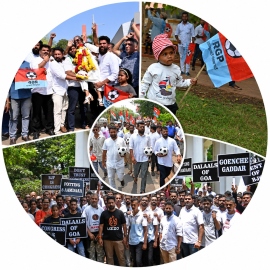
The timing of the fallout has particularly worried party workers in Bardez, where RGP candidates had managed to put up a credible performance in the recent Zilla Panchayat elections despite failing to secure victories.
ZP gains in Bardez
The party had shown signs of gaining traction in pockets of the coastal belt, especially in Calangute and Anjuna, areas where anti-establishment and regional sentiments have traditionally found resonance among younger voters and local communities.
“The acerbic outburst by our party president had definitely hurt the morale of the grassroots workers. We had just had the ZP elections and our candidates had done fairly well in a couple of seats in Bardez, particularly in the coastal belt of Calangute and Anjuna,” a party leader from Bardez said on condition of anonymity.
For many within the party, the concern is not merely about a disagreement between two senior leaders but about the manner in which the dispute has unfolded publicly through social media exchanges.
Workers fear the controversy risks undermining the image RGP had built over the years as a regional alternative to the BJP and Congress.
Workers fear political damage
“This infighting will put us in a poor light among the people of Goa who were looking at us as an alternative. Hope the issue is resolved at the earliest,” the leader added.
The developments come at a crucial juncture for RGP. After struggling to convert its early momentum into electoral success, the party had begun rebuilding its grassroots presence in parts of North Goa through local campaigns and sustained outreach on regional issues.
The relatively encouraging ZP election performance in Bardez was viewed internally as a sign that the party still retained pockets of influence despite its organisational challenges.
However, workers now fear that the public confrontation between Parab and Borkar could weaken that momentum just as preparations for the Assembly elections are beginning to gather pace.
“Many supporters feel internal disagreements should not be played out publicly, and the leadership could have handled these differences differently,” another RGP leader said.
Calls for reconciliation
The concern among cadres is that prolonged infighting may confuse supporters, demoralise local workers and weaken the party’s ability to project a united front in constituencies where it had started rebuilding credibility.
In Bardez, where electoral contests are often shaped by local leadership and booth-level mobilisation, organisational cohesion remains critical for smaller regional parties attempting to challenge larger political formations.
Yet, despite the bitterness visible on social media, several workers continue to hope that the divide can still be bridged before the election season intensifies.
Party members say there remains scope for reconciliation between the leadership and Borkar, with many expecting internal discussions in the coming weeks to prevent the crisis from spiralling further.
For RGP, the stakes extend beyond a personal clash between two leaders. The current turmoil threatens to test whether the party can hold together its fragile support base in North Goa and sustain the regional identity politics on which it was built.
With Assembly elections less than a year away, the handling of the present crisis may well determine whether RGP emerges as a viable alternative force or slips further into political irrelevance.