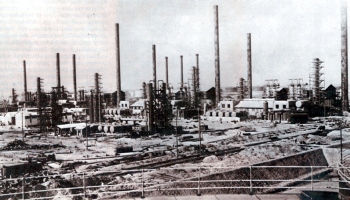
 The Abadan oil fields in 1912. (credit: https://www.britishempire.co.uk/maproom/abadan.htm)
In two decades, Abadan in Persia grew from a modest sheikh’s village to a large company town, which by 1930 had around 30,000 to 40,000 inhabitants, of which about half”17,370 men”worked at the oil refinery. In the early years of the oil company, no standard working day for employees existed at all. Workers were often expected to work seven days a week, from sunrise to sunset.
Some years later, however, on the eve of the First World War, a new work-day regime was implemented: six working days per week, from nine to twelve hours per day, depending on the season. Work typically started at six o’clock in the morning and ended at six o’clock in the evening during the winter, and continued from six o’clock in the morning until three o’clock in the afternoon during the summer.
It was only after several labour protests in the 1920s that Anglo-Persian Oil Company (APOC) eventually adopted standard working hours throughout the year, commencing at 6 in the morning and finishing officially at 5.30 in the afternoon, with an hour and a half for breakfast and one hour for lunch. In the early days, the oil company designated Sunday as an off day. In later years, the rest period started at noon on Thursday, and included Friday.
The Basurkars (as the Goans were fondly called in Bagdad, Basra, Abadan, Bahrain and Saudi Arabia) of yesteryears lived a tough life in the oil fields of the Gulf. It then was basically a desert, without any trees or greenery. There were bare-bones residential buildings with scant comforts.
There were no desalination plants; so they drank raw unprocessed water. The only refrigeration was in the form of crude coolers that ran on kerosene oil; everything stored in these coolers reeked and tasted of petroleum. In short, it was a tough life, far away from his family with letters taking over one month by sea.
The account of an Indian employee of APOC named Dr Ghore in the Bombay Chronicle under the title of ‘Indian Workers in Persia, Miserable Condition’ states: The Anglo-Persian Oil Company Limited alone employed 95 per cent of Indians. There is no restriction on the number of hours worked every day. Neither coal nor ice was supplied to workers until agitation was started. Workers die of sunstroke in summer and pneumonia in winter as little is done to look to their wants and comforts.
Small wonder that labour strikes broke out in 1929. The rise of Shah Reza Pahlavi in December 1925, coupled with growing labour disputes led to the new agreement of 1933 between the Iranian government and APOC, which revoked the D’Arcy concession of 1901 and accelerated the replacement of the Indian workforce with Persians.
Mirza Taghi Khan aka Ami Kabir (meaning Great Leader), who took over as Prime Minister or Vizier of Persia in October 1848, was a skilled diplomat who kept the superpowers of England, Russia and France at bay while ushering in an era of growth and prosperity. He sought to lift Persians from religious prejudices, cumbersome traditions and debilitating poverty by introducing European-inspired education and industry.
A mere 39 months later he was demoted to Commander of the Army by a paranoid and envious Nasser el-Din Shah and was shamefully assassinated in a bathhouse two months later. The incompetent Shah launched an ill-advised attack on Herat in Afghanistan in 1856 giving the British the perfect excuse to invade the Persian Gulf ports of Bushire/Bushehr and Mohammareh (now Khorram Shahr). Soon, British Forces set up a massive military camp in the strategic port of Bushire/Bushehr, where the East India Company had already established a trading presence.
The writer is an engineer who retired in Silicon Valley. His interests include blogging, gardening, nature photography and travelling.