 The writer is professor at Columbia University in the USA who hails from Cortalim
As a teenager growing up along the Zuari River, I never once paused to think about what the village names around me meant. They were simply there, spoken without reflection, as familiar as the tides against the banks and as constant as fields that shifted colours with the seasons.
It was only recently, during our annual travels with well-read friends from Mapusa, that I began to understand that these names were not incidental. They carried within them quiet strands of Goa’s Konkani and Sanskritic past, names that long predated Portuguese arrival. The Portuguese did not erase them; Lusitanisation softened and reshaped their sound. But beneath that layer, their original meanings endure, intact and quietly persistent.
RESPECTING RESOURCES
My own village, Cortalim, was once Kutthali, from the Sanskrit root ‘kuá¹á¹’, meaning 'to pound or grind'. It was, quite literally, a place of processing grain. But the name reveals something deeper: it speaks of water. Cortalim sits along the fertile floodplains of the Zuari, shaped by monsoon rhythms and sustained by a shallow water table. This was a rice-growing belt, organised under communidade lands, dependent on carefully managed freshwater flows.
Under the gaunkari system, water here was not taken for granted; it was engineered, shared, and respected. It moved through channels, nourished fields, sustained fish in village lakes, and made possible the cycles of planting of rice and harvest that defined life.
Before mechanisation, rice planting, harvesting and processing were communal acts, sharing wooden mortars, rhythmic pounding and collective labour. The sound of grain being dehusked was, in its own way, the sound of water translated into sustenance.
Also on the banks of the Zuari River lay the neighbouring village of Sancoale, once Shankhavali, the settlement of the ‘Shanka’ conch. Here too, water shaped identity, but differently. If Cortalim reflected water as a livelihood, Sancoale reflected water as spirituality. The tidal flats left behind shells, including the ‘shankha’, an object deeply embedded in ritual, symbolising purity, auspiciousness, and sacred sound. Water held within the conch when blown out marked transitions, sanctified spaces, and invoked beginnings.
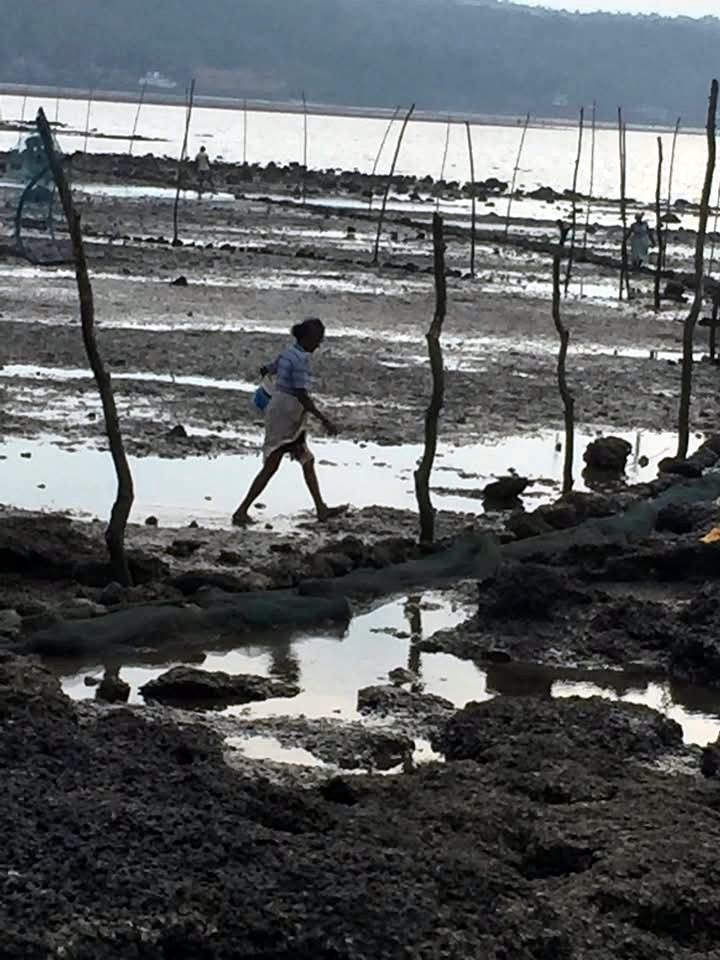 Even the smaller shells carried value. During spring tides, along with the fish that were caught by stake-pole fishing, tiny shells washed ashore in abundance, feeding a modest but enduring economy of lime kilns. The fine, talc-like powder they produced was used to whitewash homes after the monsoon.
When we first arrived from Kenya, there were no commercial paints; this was what we used to whitewash the walls of our homes after every monsoon. What the sea left behind was gathered, transformed, and returned to the village in another form.
Water, in both villages, was not merely a resource. It was a presence, managed, regulated, understood. Village elders knew its pathways. They understood 'recharge' before the word became technical vocabulary. They knew what could be drawn and what had to be left alone. Aquifers were lived systems. To pollute water was not just impractical; it was unthinkable.
FADING WISDOM
That wisdom is now fading. The groundwater that once flowed from the Verna plateau into the aquifers of Cortalim has thinned under the pressure of bore wells that have punctured the plateau on which the industrial estate sits. Crop rotation that depended on the flow from the plateau has begun to falter. What was once regulated through collective knowledge is now extracted through individual industry entitlement.
And then, the shocks. Just days ago, villagers in Sancoale woke to find the well at the 500-year-old church of Our Lady of Health contaminated, with petroleum seeping through an aqueduct from an unknown source on Sancoale plateau. For many, it revived older memories of poisoned wells, withered fields, fish and frogs floating belly up in lifeless water bodies when the ZACL fertiliser plant on Sancoale Plateau was commissioned.
A month ago, in nearby Dabolim, families fell ill when a sewage treatment system failed, polluting groundwater. The response was familiar: deflection. Responsibility is passed on to builders, as if governance begins only after damage becomes visible.
River Sal, once the lifeline of Salcete, is polluted by the development of mega-housing colonies, hotels and industry, many of which stealthily discharge their waste into nearby waterways. Colva beach reeks of sewage.
This is not merely administrative failure. It reflects something deeper, a loss of regard for water itself.
What those in power forget is that the responsibility does not lie with the builder alone but with the process much before, the Town and Country Planning approval process.
Planning today proceeds as if land exists in isolation, as if plateaus, slopes, and valleys are disconnected. But Goa is not flat. It is a layered, interconnected system of aquifers and flows. What is built on a plateau does not remain there. It moves, silently, invisibly, through subsurface pathways, emerging elsewhere, often long after decisions have been made and accountability has dissolved.
This is why the questions people of Chimbel, Santa Cruz, Mirabag and elsewhere, where land is being primed for mega projects, ask of institutions like the Town and Country Planning Department matter. Has the aquifer been mapped? Are drainage pathways understood? Is hydrological expertise embedded in decision-making? These are not technicalities. They are the difference between foresight and failure.
The people of Sancoale have not taken to spectacle despite lack of acknowledgement from those in power. They have remained measured, even restrained, as their aquifers face yet another assault. But their restraint should not be mistaken for acceptance.
LESSONS VILLAGES OFFER
If there is one lesson these villages offer, it is simple: everything connects through water.
The names we inherited, Kutthali and Shankhavali, are not just linguistic relics. They are records of a worldview. One where water nourished the land in one village and sanctified life in another. One where it was protected not by policy, but by understanding.
What we risk losing today is not just water. It is the wisdom that once taught us how to live with it. And if that is lost, the names we still speak will remain, but emptied of meaning.