During this period, Goans struggled to make a living, as conditions for employment, education and social life were a tough reality. Those who came to Karachi from prosperous backgrounds in Goa, and with basic education, found work easily and assimilated into the city’s nascent civic, business, and social matrix.
Those with lesser skills and social connections found it difficult to make ends meet but did not give up and continued to work diligently at places which offered them employment and the means to live a decent life. Hardships were a part and parcel of life in a city they had chosen to migrate to and start a new life. There was no looking back, Goans were determined to find a place for themselves.
Karachi was slowly growing to become an important place for trade and business, numerous small and medium enterprises were set up by prospering communities, the Sindhi Moslems, Hindus, Gujrati, Zoroastrians, Jews, and others. It was not a big town; the population was less than 100,000 people, they lived, worked, and respected each other. Goans too were in the same melee, integrating well, opening small businesses, and at the same time, content with gainful employment.
Some stood out and made significant progress, achieved distinctions, and assumed leadership roles. LC Gomes was among the pioneers; Joseph A Vaz became the first Goan to join the Indian Civil Service; Lawrence Duarte, Cincinnatus D’Abreo and others set up India’s largest life assurance company at that time – the ILACO (Indian Life Assurance Company) in 1896.
Better known as Portuguese-Goans, with a penchant for social rallying, they decided to form a permanent ‘club’ for their social needs. By 1886, they had convened to form the Goa-Portuguese Association (GPA), choosing “Unity and Brotherhood” as their motto. More than 100 well-off Goans gave an ‘Entrance Donation’ of Rs 25 – quite a significant amount at that time – towards the association. A couple of Hindu and Parsi businessmen also donated towards the cause.
Success and opportunities stared into the face of Goans so they converged and resolved to build a dedicated place (a magnificent clubhouse) for themselves to meet their social pursuits. Though life was a challenge, they were seemingly content with their sense of belonging, contribution to the city’s growth and were now able to spread their wings. Meanwhile, more Goans from Goa got lured into moving to Karachi – it offered them economic sustenance and hope!
Next: 1860-1900 - The Missionary Movement
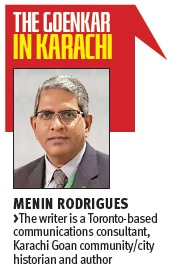
(The writer is a Toronto-based communications consultant, Karachi Goan community/city historian and author)