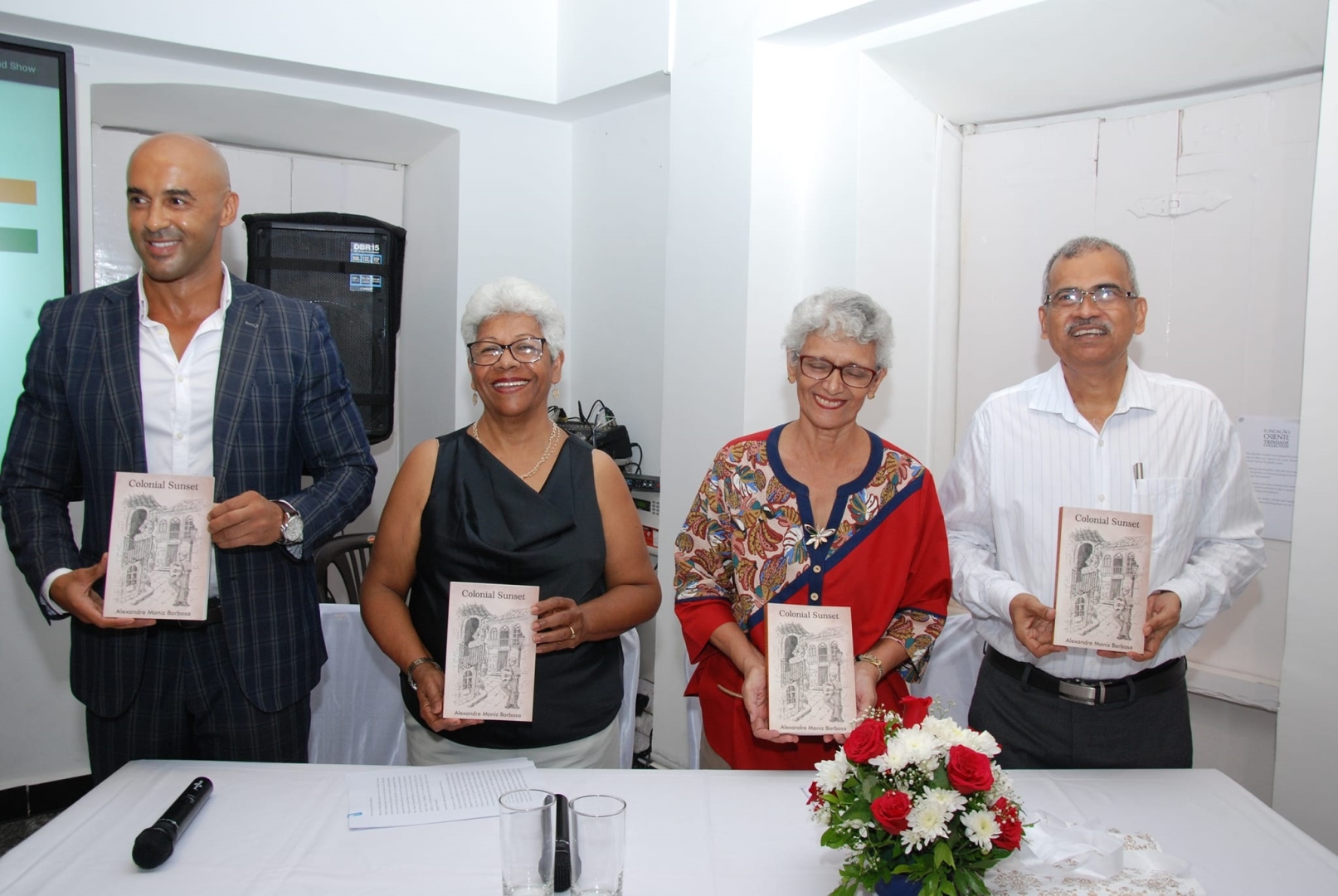
Alexandre Moniz Barbosa's novel 'Colonial Sunset' was released at Fundação Oriente in Panaji.
PANAJI
'Colonial Sunset' is a novel where political intrigue and love stories mingle, said Professor Isabel Santa Rita Vas, at the launch of the book, authored by Alexandre Moniz Barbosa on Friday at the Fundação Oriente, Panaji.
Stating that she liked the title, Vas said, “I was struggling with the adjective I was going to use to describe Colonial Sunset, interesting was a boring adjective. This book for me is exciting, a very exciting book. It has a number of layers – the political as you can guess from the title, the romantic, a novel without romance is not all that popular and for people like me, great familiarity with the setting.”
She added, “There are characters that are, though fictional, people that we can empathize with, people that we think, this could be my neighbour, this could be my friend, this could be me. Very, very familiar, and love stories not one but two in the novel and two ages but love is the same in any.”
A teacher of English, a writer and playwright, Vas said, “What resonated with me as a reader, is familiarity, from page to page. I was home, everything was familiar. I lived many years of my life in Panaji, but many things were not just recognizable, but it was home. I walk a great deal and in the novel I walked some more.”
She added, “What resonated with me were also the events. I am sure that people of my generation will not forget, where they were, what they were doing at the time of Liberation. We remember, where we went, who was with us, who said what, what happened on the 18 and 19 of December 1961. We shall not forget,” said Vas.
Giving a historic perspective of the time, Dr Maria da Lourdes Bravo da Costa Rodrigues, described Panaji in the times of the novel, mentioning some of the locales in the book, bringing in her memories and interspersing them with anecdotes.
Speaking on the Café Central which plays a big role in the story, Rodrigues said, “The Café Central was on the ground floor of the Jesuit House which is opposite the municipal garden. The Café Central had four tables, but one of the tables facing the garden was eyed by the youngsters, especially boys. There were only three chairs at that table but they would wait for it to get empty, the reason was that they could see the girls passing by and also pass comments or talk to them or see what was happening in the garden.”
Stating that since the novel is about a love affair, she said that parents at that time would not favour love marriages. Rodrigues gave an example saying, “To better understand society, the mothers, aunties, spinsters grandmothers would chaperone the girls to parties and dances, to keep a watch with who the mingled or danced. They were instructed, for example, not to dance the midnight special to ring in the New Year, as it could make people think that they were lovers.”
“It was a society that went to the extent of disowning their children if they went against their wishes, so it wasn’t a surprise that the love affair of Maria das Dores, the protagonist in the story, was opposed by the parents,” Rodrigues said.
Alexandre explained the title Colonial Sunset saying, “There is more than one sunset in this book. Of course sunset is of the colonial period, but there are other sunsets, and this is of the perspectives of that time, the way of thinking of that time, and this is apparent in the second story that occurs alongside, where the same generation of 1961, is now thinking differently. You will understand as you read the novel.”
Dr Paulo Gomes, Director of Fundação Oriente, welcomed the gathering and had a curious fact to relate, as the two settings in the novel – Vila Nova de Barquinha in Portugal and Fontainhas in Goa are both familiar to him, he having grown up close to the town in Portugal.
Vas concluded by saying that the book would appeal to everyone who lived through that period, to the younger generation of Goa as a historical novel, to Goans living out of Goa because many of them live on saudades, and to the general reader as Goa is always a happening place.
A large number of people turned up to the launch and some were even standing.