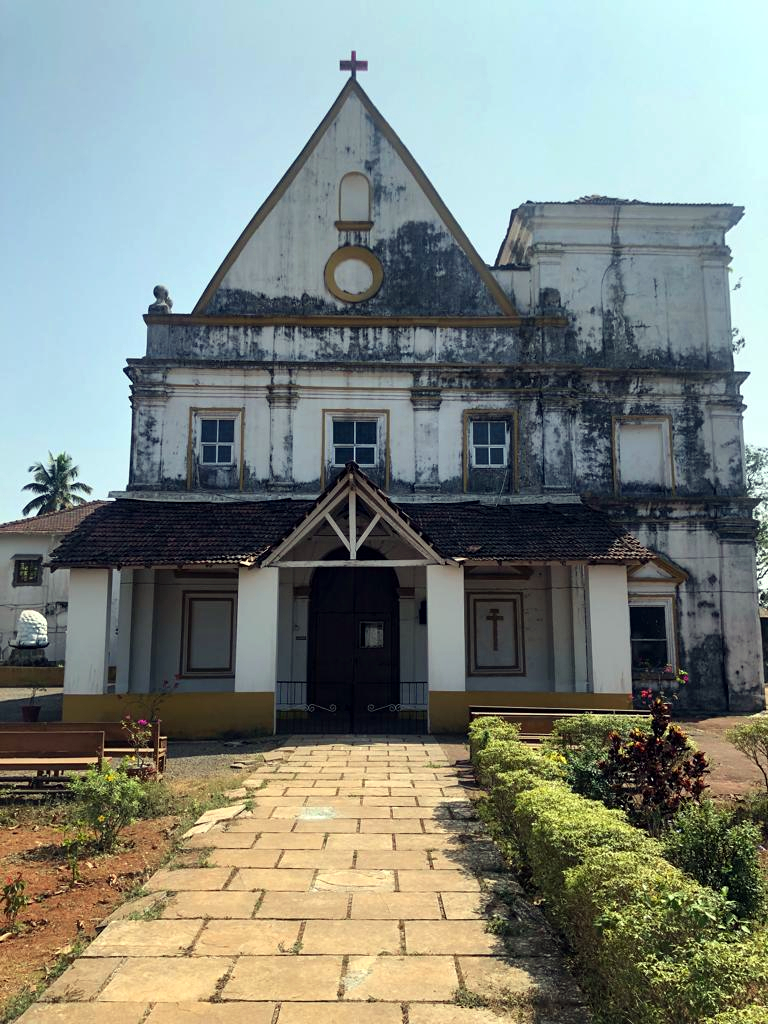
The church in Corlim is dedicated to St John the Eloquent, an Augustinian monk; it is also called Sao Joao Facundo Igreja em Corlim, Goa in Portuguese. It has a Catholic population of 3,000. The feast is celebrated on the last Sunday of January, which this year was on January 29.
HISTORY
The church was constructed in 1610 by Frei Aleixo de Menezes, an Augustinian bishop. Others put the construction between 1595 and1610 and during this time (1595-1609), Frei Aleixo de Menezes was the Archbishop of Goa.
On the steps of the altar one sees the following words: Esta obra fez Aleixo No anno de 1584. (this work was done by Frei Aleixo in 1584), which are now covered with the matting. Opposite the church is the cemetery.
Almost on the opposite side of the pulpit is a small chapel dedicated to All the Saints (Santas Almas) and in has a big altar, and in it is the statue of St Tiago. There is also a painting on the altar depicting the scene of the last judgement. St Michael is seen with the tagddi (weighing machine) all around are souls. Now the choir occupies this area for liturgical services.
THE ALTARS
The main altar, which is simple and having an arc is dedicated to the patron. The statue of St John the Eloquent, is portrayed as holding the bible in one hand and in the other the chalice with the host. Above it is the statue of Our Lady. Below it is a beautiful painting of the Last Supper.
Besides this there are two other altars, one dedicated to Our Lady of Penha da Franca and the other to Bom Jesus. On either side of these statues are the images of St Paul, St Jose Vaz, St Sebastian and St. Rock.
There is also an image of St Lazarus in the church, which was originally in St Lazarus hospital established in Corlim in 1530, not far from the Church. The poor and those with leprosy were taken care of here. A diocesan priest was put in charge of the hospital.
The hospital was closed in 1840 and the image of the saint was brought to the church. The feast of the Saint Lazarus was celebrated with much pomp in the past, but has been discontinued for some reason or the other. The tradition here was that on the feast day, people would bring or buy two brooms and sweep the statue of the saint imploring to wipe away their diseases. Then they would keep one broom at the feet of the saint and take home the other one.
Other devotees would bring lumps of jaggery, touch them to the wounds of image of the saint and then take them home, requesting the saint to heal their wounds and drive away all sicknesses from their lives.
LATER DEVELOPMENTS
There are no changes to the structure of the Church in the course of time, except that the floor tiles have been changed; the altar where daily Eucharist is celebrated is a new one. A grotto of Our Lady of Fatima has been installed in the church courtyard; renovation has been done to the sacristy and the parochial house.
THE FEAST
The faithful celebrate the feast on with much religiosity and zeal, which is preceded the Maddi, and the nine days of thematic Novena taken care of by the various wards of the parish. After the Feast Mass is a small procession on the ground, followed by the blessing and the veneration by the faithful. One also sees a small fair in the vicinity. There would be a Tiatr in the evening but it has been discontinued now.
(The writer is Superior at Casa Professa, Basilica of Bom Jesus in Old Goa)