Tree Authority has directed PWD to plant 3 trees for every tree axed
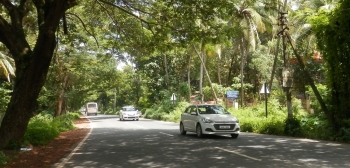
The green cover lining the NH66 between Navelim and Cuncolim will disappear with the PWD proposing felling of 1,918 trees along the stretch for highway widening.
MARGAO
A total of 2,395 trees standing on Public Works Department (PWD) property have been proposed for felling for the widening of National Highway 66, triggering concerns over the department’s ability to fulfil mandatory compensatory plantation and translocation obligations.
Of these, 1,918 trees are proposed to be felled for the widening of the Navelim–Cuncolim stretch, while another 477 trees will be removed along the Cortalim–Verna stretch.
While the Tree Authority has directed the project proponent to plant three trees for every tree felled, and to translocate at least 10 per cent of the affected trees wherever feasible, questions are being raised about whether the PWD can realistically meet these conditions. The concern stems from official records which reveal that 44,995 trees have been pending plantation for the last five years by various government agencies, with the PWD alone accounting for 33,723 pending plantations.
Recommendations
and conditions
The PWD had approached the Deputy Conservator of Forests (DCF–South) seeking permission to fell 1,918 trees on PWD-acquired land for the widening of NH66 from the end of the Margao Western Bypass at Navelim to Uskini Bandh, Cuncolim.
Records show that the DCF (South) has recommended the proposal, while also suggesting the translocation of approximately 10 per cent of the trees, subject to feasibility and species suitability.
At a meeting of the Tree Authority, it was decided to constitute a joint committee comprising the Goa State Biodiversity Board (GSBB), the Forest Department, and the PWD. The committee will inspect the project site and recommend the number of trees suitable for translocation from among the 1,918 proposed for felling.
Additionally, the PWD has been directed to ensure plantation of three times the number of trees felled, over and above the mandatory median and roadside plantations required under NHAI guidelines. The species to be planted will be finalised in consultation with the Forest Department and the GSBB, based on the suitability of the planting area.
The project proponent has also been instructed to plant only indigenous mixed tree species, maintain a geo-tagged record of all plantations, and submit the data for monitoring by the Forest Department.
Similar conditions have been imposed on the PWD for the Cortalim–Verna highway widening, where the DCF (South) has recommended the felling of 477 trees, with a directive to translocate at least 10 per cent of the trees, depending on feasibility and species involved.
Mounting plantation
pendency
Meanwhile, the massive backlog in compensatory plantation has drawn the attention of the Tree Authority. Even as the Forest department has recommended the proposal of felling 1918 and 477 trees along the Navelim-Cuncolim and Cortalim-Nuvem stretch of the NH66 respectively, questions are raised whether the PWD will be able to achieve the target of planting the trees, three times the number, leave along the translocation of about 10 per cent the trees listed for felling.
For, statistics reveal that a total of 44995 trees have been pending since the last five years for plantation by various government agencies, including the PWD.
In fact, of the total pendency of 44995 trees, total of 33723 trees awaiting plantation falls in the domain of the PWD.
Following deliberations by the Tree Authority, it was decided that the DCF would furnish a division-wise list of plantation pendency against specific projects to the Principal Chief Engineer (PCE), PWD, for follow-up action.
The DCFs concerned have also been directed to circulate updated pendency details to all user agencies and project proponents, enabling them to submit reconciled statements and timelines for clearing the backlog.
Furthermore, all agencies against whom plantation pendency has been recorded have been instructed to submit planting locations and other essential details within a fortnight, in order to ensure compliance with High Court directives.