


The word ‘Grace’ stems from the Latin word gratia, which means kindness. Lent is a time when grace flows in abundance; be it from the Creator or be it from the creations of the Creator. For Catholics spread the world over, more so for those who received the gift of faith through the evangelising of the Jesuits, the period from March 4 to March 12 is a period of divine grace as during this period an assurance of St Francis Xavier to receive favours from God through his intercession brings people of all faiths and beliefs to pray to the Almighty in the Novena of Grace!
The Novena of Grace is a nine-day prayer devotion to St Francis Xavier that originated in the city of Naples in Italy. St Francis Xavier, one of the founders of the Jesuit Society, preached the Gospel of Jesus to the Japanese faithful. But then, with the passage of time and the spread of Buddhism in Japan, it was a testing time for the evangelists of the day. In Naples in 1633, Fr Marcello Mastrilli SJ took the vow to ask to be assigned to the Japan Mission, then the most difficult; for at that time the Buddhist persecution was most cruel against the Catholic religion and the new form of martyrdom introduced was most excruciating. It was known as the ‘Pit’, for the martyrs were kept hung, head downwards over a volcanic pit from which sulphurous gases and waters welled up. At times, the martyrdom was protracted for several days before the victim expired.
The torture was so horrible that in 1633 the Provincial of the Japan Mission, Fr Ferrara, after five days of agony over the ‘Pit’, apostatised. But hundreds of others, priests and laymen, Europeans and Japanese, in holy emulation reached the martyr’s crown through the terrible ‘Pit’. When the news of the unfortunate Ferrara’s apostasy reached Europe, many Jesuits vowed themselves to the Japan Mission to replace their martyred brethren and to atone for the apostate. Fr Marcello Mastrilli SJ was one of them.
While waiting in Naples for the passage to Japan, Fr Mastrilli organised on a grand scale the feast of the Immaculate Conception in the College of Naples, putting up for the occasion an elaborate structure that drew the admiration of the whole town. The feast was a stupendous celebration that helped to bring home to the faithful the great privilege of Our Lady, which then was not yet defined as a dogma of the faith. When the festive celebrations concluded, Fr Mastrilli was supervising the removal of the temporary pandal when a heavy hammer slipped from the hands of a worker and fell with deadly precision on Fr Mastrilli’s head. The injury caused thereby was severe, and Fr Mastrilli was in a coma and on the verge of death!
Doctors attended to Fr Mastrilli with diligence and when no efforts could get him out of the comatose condition, the Jesuits were asked to invoke divine intervention for the passage of his soul and Fr Mastrilli was anointed with the Extreme Unction, the last sacrament before death! Just when the crisis was on, St Francis Xavier appeared to Fr Mastrilli and informed him that he would not pass away then but would die a martyr in Japan! St Francis Xavier asked Fr Marcello Mastrilli SJ to renew the vow to go to Japan, saying to him:
“All those who implore my help daily for nine consecutive days, from the fourth to the twelfth of March inclusive, and worthily receive the Sacraments of Penance and Holy Communion on one of the nine days will experience my protection and may hope with entire assurance to obtain from God any grace they ask that is for the good of their souls and the glory of God.”
The vision vanished and Fr Marcello Mastrilli SJ arose entirely cured. Faithful to his vow, he led a band of thirty-three Jesuits to Japan. He had hardly landed there when he was seized and condemned to the ‘Pit’, where he suffered from October 5 to 17 and died the death of a glorious martyr.
But before leaving for Japan, Fr Mastrilli widely published the news of his cure and the promises of Saint Francis Xavier. The saint himself kept his words and many faithful experienced his protection after praying the “Novena of Grace”. The devotion spread far and wide and it has been instrumental in obtaining many favours, spiritual and temporal.
Key Aspects of Novena
Intercession: The focus is on seeking the intercession of St Francis Xavier, known as a great Jesuit missionary to India and Japan.
Special Intentions: A hallmark of the tradition is the writing down of personal intentions, which are often placed in a basket in the church during the service.
The Prayer: The novena typically involves specific prayers, hymns, and attendance at Mass, often featuring sermons on the life, miracles and work of St Francis Xavier.
Global Tradition: Today, the Novena of Grace is a major annual devotional event in many parishes worldwide, particularly in Jesuit churches.
In the year 1963, a devout, charismatic and visionary priest, Rev Fr George de Sa, was appointed as the Rector of the Basilica of Bom Jesus. Fr George began his ministry in right earnest, taking up the Spiritual Exercises of St Ignatius of Loyola and founding the Youth Retreat Movement involving the SSCE students. It was the visionary Fr George D’Sa who began the Novena of Grace in the Basilica of Bom Jesus in the late sixties and this practice is carried on till today with Fr Patricio Fernandes SJ conducting prayers with the recitation of the Rosary and Stations of the Cross between the celebration of the Holy Eucharist in the morning and evening.
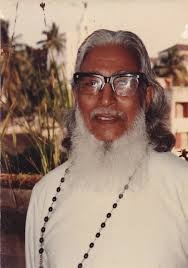
Rev Fr George D'Sa Sj.
The Novena of Grace has no feast celebrated. However, the final day of the novena, the 12th of March, marks the day when the pioneers of the Society of Jesus, St Ignatius of Loyola and St Francis Xavier, were canonised as saints of the Roman Catholic Church. On this day, true to the spirituality of St Ignatius, a penitential service from the Basilica of Bom Jesus is taken to the Church of Our Lady of the Rosary on the mount of Old Goa. This church too has significance to St Francis Xavier as it is in this very church that St Francis spent his Sundays and holidays teaching catechism to the young and the old from morning till evening, and preached sermons to the well-attended crowd that would gather in the church to listen to their favourite and most loved priest. The spirit of poverty (a vow that the Jesuits take) is then manifested when all gathered in the Church of Our Lady of the Rosary take part in the humble meal of Cunji (pez) “ the food that the prince of Navarre, our beloved Goycho Saib, cherished when in India!


