MAPUSA
Late night last month in Arpora, a 45-year-old man was on his way home when his motorcycle suddenly swerved. Stray cattle were locked in a fight in the middle of the road. In the chaos, he lost control and rammed into an oncoming car. He never made it back.
Just weeks before that, a young woman from Benaulim, barely 26, died en route to hospital after the two-wheeler she was riding pillion on crashed into a cow. The rider survived but with severe injuries.
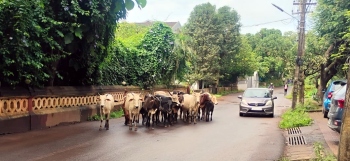
These are not freak accidents. They are chilling reminders of a menace that refuses to go away “ stray cattle on Goa’s roads.
Danger lurking in the dark
Motorists in Goa have learnt to live with potholes and broken roads. But ask anyone who travels after dusk and another worry tops the list.
“At night, it’s not the potholes that scare me, it’s the cattle. They sit in the middle of highways and village roads and don’t budge even when you honk,” said Rohan Naik, a daily commuter from Mapusa.
The danger is not limited to humans. Cattle themselves often pay the price.
In one grim incident in Canacona last month, 11 stray bovines were found dead along NH-66 at Loliem after being mowed down by a speeding vehicle.
Why do they end up on roads?
In bustling towns, the sight of cattle loitering near markets is common.
The lure is simple “ heaps of vegetable waste left behind by vendors.
During the monsoons, the problem worsens as cattle take to squatting on highways and village lanes for shelter, creating blockades and hazards for motorists.
“With no owners taking responsibility, the animals are left to fend for themselves. They wander the streets during the day and settle on the roads by night. The risk is obvious,” explains Maria Fernandes from Benaulim.
Official response
The State government, through the Department of Animal Husbandry and Veterinary Services, has been providing grants to panchayats to curb the problem.
Several panchayats have tied up with gaushalas to shelter abandoned cattle. Yet, officials admit the issue persists.
“We are working with local bodies and NGOs, but this is not just a governance issue “ it is also about community behaviour,” said a senior veterinary officer.
“When farmers abandon unproductive cattle, they become the State’s responsibility. Unless people change their practices, the problem will continue,” he added.
Menace that refuses to fade
Despite attempts to tackle it, the menace has only become part of Goa’s everyday life.
Letters to editors, angry social media posts and repeated appeals by citizens highlight the frustration.
“Stray cattle have become as permanent as potholes,” says Maria bluntly.
Until there is a stronger, more coordinated effort, Goa’s roads will remain unsafe “ for motorists, pedestrians and the cattle themselves.
Because every time a rider turns a blind corner or a driver speeds down a dark stretch, the question remains: is it the pothole they should fear “ or the cow waiting in the middle of the road?