 Captured by : Narayan Pissurlenkar
MAPUSA
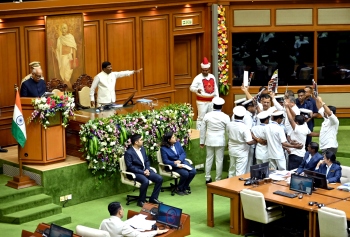
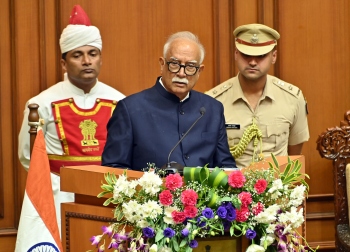
The first address of Governor Pusapati Ashok Gajapathi Raju to the Goa Legislative Assembly, delivered on the opening day of the winter session, was heavy on government achievements, ambitious policy announcements and statistical assurances.
It was only at the fag end of the nearly two-hour speech that the Governor turned to the tragedies that have deeply scarred the State “ the Birch by Romeo Lane fire inferno, the Shirgao Zatra stampede and deaths in road accidents “following which the House observed a minute’s silence for the departed.
For most of the address, however, the emphasis remained firmly on governance milestones and future plans of the BJP-led “double engine” government.
The headline announcement was the creation of Goa’s third district “ Kushavati “ projected as a step towards inclusive development, focused administration and preservation of Goa’s cultural and social legacy.
According to the Governor, the new district would reduce the administrative burden on North and South Goa districts and bring governance closer to the people, aligning with the government’s long-term vision of Viksit Goa @ 2037. While the announcement was framed as an efficiency-driven reform, the address offered little detail on timelines, financial implications or administrative preparedness.
Housing and land regularisation formed a substantial part of the speech, with the Governor highlighting a series of measures aimed at providing legal certainty to homeowners.
The Mhaje Ghar Scheme was presented as a fulfilment of Goans’ long-cherished dream of owning a home.
Long-pending issues surrounding pre-1972 houses were addressed through a circular treating structures reflected in Forms I and XIV as standing on settled land, removing the requirement of conversion sanads “ a move the government claims has ended decades of uncertainty.
Further, amendments to Section 38-A of the Goa Land Revenue Code and changes to laws governing constructions on comunidade land were cited as one-time relief measures for houses built prior to February 28, 2014.
The amended Goa Regularisation of Unauthorized Construction Act, 2016, now allows a two-year window for previously rejected applicants and permits increased built-up areas.
While these steps were projected as citizen-friendly, critics have consistently flagged concerns over their environmental and planning implications.
On the economic front, the Governor said Goa recorded a 14.94 percent growth rate in 2023“24 (provisional), alongside improved ease of doing business.
He said 17 projects worth Rs 397 crore had been approved by the Goa Investment Promotion and Facilitation Board, promising employment for 2,449 persons. Yet, the address did not touch upon job quality, sectoral spread or the sustainability of such investments.
Law and order claims featured prominently, with the Governor asserting that the situation was “under control” and citing a crime detection rate of 87.72 percent. However, this assertion stood in sharp contrast to unresolved high-profile crimes, including at least two major dacoities in Mapusa and Dona Paula that remain undetected.
Concerns over late-night noise violations by nightclubs along the coastal belt, often alleged to be ignored by enforcement agencies, also cast doubt on the narrative of effective policing.
The Governor did announce the strengthening of the Cybercrime Centre through AI-based investigative tools and proposed a new Android and iOS app for citizens to register grievances with geo-tagging and multimedia support “ a move widely seen as a positive step towards digital accountability.
In mining, the government highlighted the auction of 12 iron ore blocks, five of which are operational, generating Rs 252.83 crore in upfront payments. Goa’s top ranking in the State Mining Readiness Index was also cited.
Infrastructure development claims included completion of 59 projects worth Rs 1,410.87 crore and ongoing works exceeding Rs 1,000 crore, spanning water supply, roads, underground cabling and power upgrades.
Social sector highlights included Goa being declared a “Fully Literate State” with a literacy rate of 99.72 percent, progress in TB detection and the announcement of a Goa Cancer Hospital in collaboration with Tata Memorial Centre.
Tourism figures showed modest domestic growth and a sharp rise in international arrivals, aided by new direct flights to Uzbekistan.
Concluding the address, the Governor announced a first-of-its-kind Happiness Index for Goa, aimed at measuring citizen well-being across multiple parameters.
The Assembly’s minute of silence for those who lost their lives in tragedies closed the session’s opening address, leaving behind a speech that showcased ambition and data, but also raised questions about priorities, ground realities and the timing of empathy.
Sawant to table four key bills today
The second day of the Goa Legislative Assembly’s Winter Session on Tuesday is expected to see significant legislative business, with Chief Minister Dr Pramod Sawant slated to introduce four government bills.
Among them is the Goa Jan Vishwas (Laws Amendment) Bill, 2026, which seeks to decriminalise minor offences to enhance the ease of doing business. The Chief Minister will also table the GIM University Bill, 2026, proposing private university status for the Goa Institute of Management. Other bills on the agenda include the Goa Value Added Tax (Amendment) Bill, 2026, aimed at streamlining tax procedures, and the Goa School Education (Amendment) Bill, 2026, intended to update the state’s education framework.
Additionally, the House will consider a special motion moved by the Chief Minister to mark 150 years of India’s national song, Vande Mataram, composed by Bankim Chandra Chattopadhyay in 1875.